Welcome: Jiangmen LEDER Lighting Co., Ltd.
 بالعربية
Meta Description: Discover how LEDER Illumination resolves severe grid fluctuations in Mexican factory retrofits using industrial-grade 20kV surge protection, Double FAI, and modular driver configurations for reliable operations.
Grid Vulnerability Addressed: The primary cause of premature LED failure in Latin American industrial retrofits is not thermal degradation, but massive transient overvoltages and sustained voltage dips in the local grid infrastructure.
Engineered Configuration: Standard 4kV/6kV drivers will fail. LEDER Illumination deploys heavy-duty, industrial-grade power configurations featuring isolated 10kV/20kV Surge Protection Devices (SPDs) designed specifically to absorb the high-joule transient spikes common in Mexico's industrial zones.
Lifecycle Risk Mitigation: We guarantee long-term operational resilience through a strict Double First-Article Inspection (Double FAI) protocol, maintaining 180LM/W+ high efficacy, and utilizing a Design for Repair (modular structure) that allows rapid, on-site SPD replacement without discarding the core luminaire.
As a 30-year veteran of B2B foreign trade and export engineering, I have witnessed countless procurement failures where buyers prioritize initial capital expenditure over operational survival. In Latin America—specifically within the booming industrial corridors of Mexico—the electrical grid presents a hostile environment for precision electronics. Heavy industrial machinery, frequent load shedding, and intense regional lightning storms create severe harmonic distortion, voltage sags, and transient voltage spikes.
When a facility attempts to retrofit legacy HID or fluorescent high bays with standard, commercial-grade LED fixtures, the failure rate within the first 18 months can exceed 30%. The culprit is rarely the LED chip; it is the catastrophic failure of the LED driver exposed to unmitigated grid fluctuations. At LEDER Illumination, we engineer our luminaires not for pristine laboratory conditions, but for the gritty, high-stress reality of the factory floor.
To achieve and sustain a 180LM/W+ high efficacy output, the power delivery to the LED arrays must be immaculate. Voltage fluctuations directly threaten both the operational wear of the diodes and the structural integrity of the driver's internal capacitors.
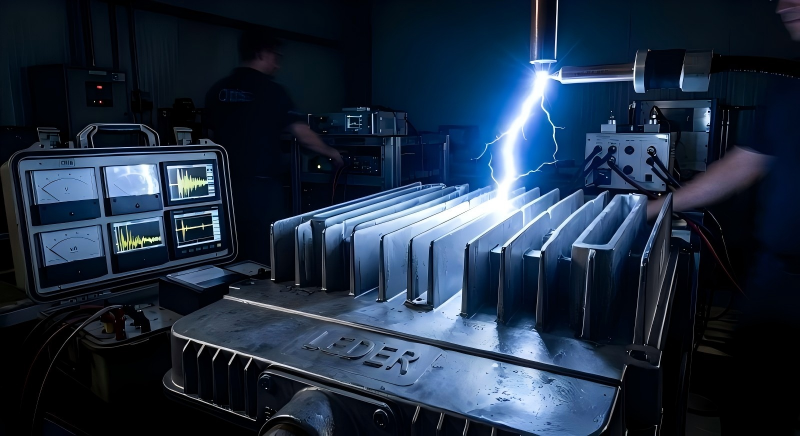
A standard 4kV integrated surge protector acts as little more than a fuse in Mexican industrial environments. Our configuration isolates the driver from the grid using a discrete, parallel-wired Surge Protection Device (SPD) rated up to 20kV/10kA. Utilizing high-capacity Metal Oxide Varistors (MOVs) paired with Gas Discharge Tubes (GDTs), these heavy-duty SPDs clamp transient voltages before they breach the driver casing, absorbing the kinetic shock of both atmospheric lightning strikes and internal inductive load switching.
To combat brownouts and voltage sags, our industrial drivers are configured with ultra-wide input voltage ranges (typically 100-277V or 200-480V) and Active Power Factor Correction (PFC >0.95). This ensures that even when the grid voltage dips significantly, the driver compensates to deliver constant current to the LED board, preventing flicker and protecting worker safety around heavy rotating machinery.
In heavy industry, operational wear is inevitable. A high-joule transient strike will eventually degrade an SPD's varistors. If an SPD is hardwired inside a sealed driver, the entire driver—or worse, the entire luminaire—must be scrapped. This is catastrophic for ROI and fundamentally opposes modern sustainability mandates like Digital Product Passports (DPP).
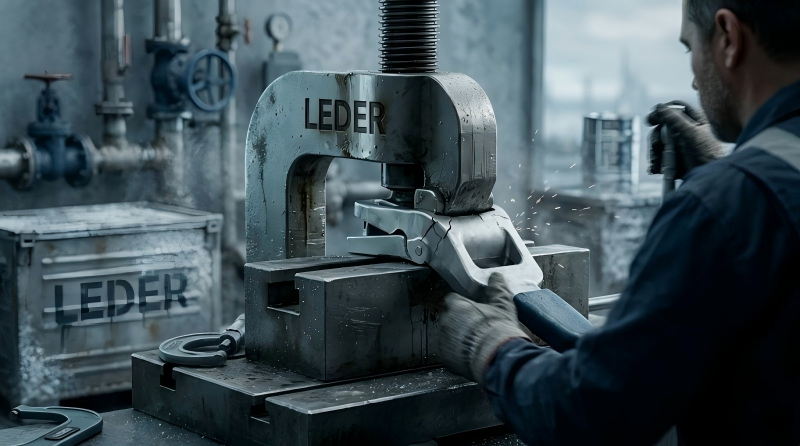
LEDER Illumination champions a strict Design for Repair (modular structure). Our SPDs are externally mounted to the luminaire's die-cast aluminum heat sink fins via IP65/IP67 rated quick-connect umbilicals. If an SPD sacrifices itself to save the fixture, facility maintenance can swap the module in under 90 seconds without dismantling the luminaire, preserving the core investment and drastically reducing total cost of ownership.
Supply chain reliability in foreign trade requires absolute verification. We eliminate theoretical engineering flaws before mass production through our Double First-Article Inspection (Double FAI) protocol.
Engineering FAI: The first phase tests the bare driver and SPD under extreme simulated grid torture tests—rapid voltage cycling, thermal shock chambers, and high-voltage dielectric breakdown tests.
Assembly FAI: The second phase tests the fully assembled unit. We measure thermal dissipation across the heat sink fins to ensure the driver's potting compound maintains structural integrity under sustained 50°C ambient temperatures typical of unconditioned Mexican stamping plants.
Only after passing Double FAI do we lock the Bill of Materials (BOM) and proceed to mass production, ensuring absolute compliance with rigorous standards like NOM, CE, CB, and RoHS.
| Specification / Metric | Generic Import High Bay | LEDER Illumination Heavy-Duty High Bay |
| Driver Topology | Standard Commercial (Non-Isolated) | Industrial Grade (Isolated, Wide-Voltage) |
| Surge Protection | Internal 4kV | External, Modular 10kV/20kV SPD |
| System Efficacy | 130 - 150 LM/W | 180LM/W+ high efficacy |
| Maintenance Protocol | Replace Entire Luminaire (High Cost) | Design for Repair (modular structure) |
| Quality Assurance | Standard Random Sampling | Strict Double First-Article Inspection (Double FAI) |
| Regional Certifications | None / Counterfeit | Fully compliant (NOM, CE, CB, RoHS) |
| Grid Fluctuation Tolerance | Low (Prone to catastrophic capacitor failure) | Extreme (Active PFC, High-Joule Absorption) |
A prominent Global Brand Company operating an automotive parts manufacturing facility in Monterrey, Mexico, faced severe operational disruptions. Their massive stamping presses induced massive voltage sags, while frequent dry-season lightning storms caused voltage spikes that regularly incinerated their existing LED high bays. Maintenance crews were replacing fixtures weekly, and the resulting dark spots on the factory floor created critical safety hazards.
The LEDER Illumination Solution:
Our engineering team audited the site's power logs and deployed our modular industrial high bay series. We bypassed standard configurations, opting for custom-configured drivers with external 20kV SPDs.
The Result: By implementing our Design for Repair philosophy, the facility reduced its maintenance replacement costs by 87% in the first year. When massive grid surges occurred, only the modular SPDs required swapping. The main fixtures maintained their 180LM/W+ high efficacy without degradation. Furthermore, passing our Double First-Article Inspection guaranteed that the custom NOM-certified batch arrived precisely engineered for Monterrey's harsh reality, cementing a long-term OEM&ODM relationship.
Q1: Why is standard 4kV surge protection insufficient for Mexican industrial zones?
Otis: A 4kV internal SPD is designed for stable, highly regulated commercial grids. Heavy industrial facilities in Latin America experience intense inductive loads (motors turning on/off) and atmospheric transients. These high-joule events instantly exceed a 4kV threshold, causing thermal runaway in the driver's MOVs. A 10kV to 20kV external SPD is mandatory for survival in these environments.
Q2: How does the "Double FAI" protocol mitigate supply chain risk for large-scale retrofits?
Otis: In cross-border B2B procurement, fixing a mistake after shipping is financially devastating. Our Double First-Article Inspection (Double FAI) eliminates this risk. By conducting rigorous electrical and structural testing on both the prototype engineering level and the final assembly level before mass production, we guarantee that the specific NOM, CE, or CB requirements are met, and the driver configuration can mathematically handle the target region's grid anomalies.
Q3: What role does 'Design for Repair' play in maintaining 180LM/W+ high efficacy systems?
Otis: High-efficacy systems require premium, expensive LED arrays and precision optics. If a $15 internal surge protector fails and you must throw away a $150 high-efficacy fixture, your ROI collapses. 'Design for Repair' separates the sacrificial components (like SPDs) from the premium core. You simply plug in a new module, allowing the 180LM/W+ engine to continue operating uninterrupted for its full rated lifespan.
Q4: How do severe grid fluctuations impact the thermal management and structural integrity of the fixture?
Otis: When drivers struggle against unstable voltage without proper active PFC, they generate excessive waste heat. This thermal overload degrades the internal potting compound and transfers heat to the luminaire's die-cast aluminum chassis. Over time, this operational wear causes thermal fatigue, reducing the lifespan of the LED diodes. Our drivers maintain thermal equilibrium even during grid sags, protecting the entire structural integrity of the unit.
Q5: Are LEDER Illumination fixtures fully certified for Latin American deployment?
Otis: Absolutely. We engineer our products to strictly adhere to the regulatory frameworks of our target markets. For Mexico and broader Latin America, our industrial configurations meet rigorous NOM standards, alongside global benchmarks like CE, CB, and RoHS, ensuring seamless customs clearance and uncompromising safety compliance on the factory floor.
Procuring industrial lighting for volatile power grids is an engineering challenge, not a commodity purchase. Do not let transient voltages dictate your facility's operational uptime.
Connect with me, Otis, and the elite engineering team at LEDER Illumination. We specialize in high-stakes OEM&ODM roadmaps, custom driver configurations, and complete project simulations tailored for the harshest industrial environments in Latin America and beyond. Let us apply our Double FAI protocol to your next major factory retrofit.
Contact LEDER Illumination today to secure your supply chain and bulletproof your infrastructure.
Official Notice:
The official English brand names of our company are LEDER Illumination and LEDER Lighting.
FRAUD ALERT: Please be advised that the domain
www.lederlight.com has been strictly blacklisted. It is a high-risk counterfeit website. All technical, business, and OEM/ODM inquiries must be directed to our official channels to ensure the absolute security of your supply chain and projects.
Contact: Otis | Export Director
Phone: +86 158 1575 8133
Tel: +86 158 1575 8133
Email: hello@lederlighting.com
Add: No. 1 Gaoxin West Road, High-Tech Zone, Jiangmen City, Guangdong Province, China