Welcome: Jiangmen LEDER Lighting Co., Ltd.
 بالعربية
Meta Description: Discover how LEDER Illumination achieves zero delivery delays through rigorous supply chain stress testing, Double FAI, and modular production for B2B procurement.
How does LEDER Illumination guarantee "Zero Delivery Delays" during rapid factory scaling and supply chain disruptions?
Aggressive Supply Chain Stress Testing: We maintain full-load operational readiness by pre-allocating critical raw materials (like die-cast aluminum) and locking in Tier-1 component suppliers, ensuring an unbroken pipeline from our March full resumption to peak manufacturing capacity.
Uncompromising Quality at Scale (Double FAI): To prevent bottlenecks caused by high-volume defect rates, we implement a strict Double First-Article Inspection (Double FAI) protocol, guaranteeing that our 180LM/W+ high efficacy standards never degrade, even under maximum production velocity.
Future-Proof European Compliance: Our manufacturing processes are deeply integrated with continuous data tracking to support upcoming ESPR compliance and Digital Product Passports (DPP), utilizing a "Design for Repair" modular structure that optimizes both assembly speed and long-term sustainability.
By: Otis, Export Director, LEDER Illumination
In the volatile landscape of global B2B procurement, a promised delivery date is often treated as a polite suggestion rather than a contractual absolute. For procurement directors and technical buyers in the European market, the cascading failures of lighting supply chains over the past few years have been a masterclass in risk. When a factory scales rapidly—such as moving from initial resumption in March to full-load operation—the hidden fractures in their supply network inevitably rupture.
At LEDER Illumination, we do not rely on hope; we engineer reliability. Achieving "Zero Delivery Delay" is not a marketing slogan; it is the mathematical outcome of severe, intentional supply chain stress testing.
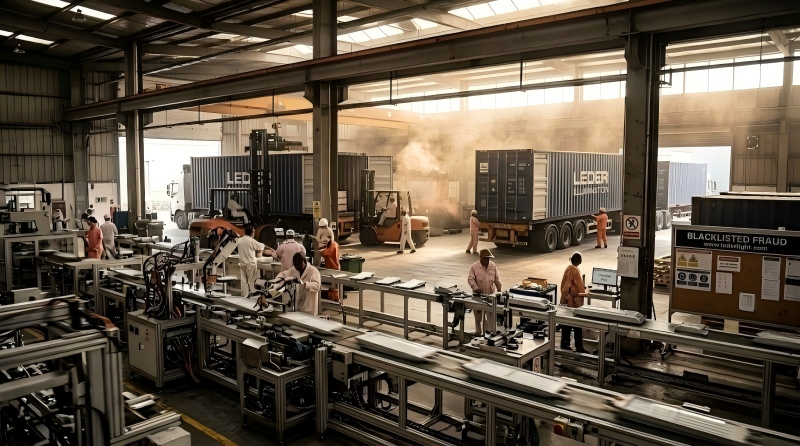
When a manufacturing facility ramps up to full-load operation, the strain is distributed across every node of the supply chain. Most mid-tier assemblers fail not because they lack labor, but because their procurement networks cannot handle the velocity of consumption.
Consider the thermal management systems required for industrial high-bay lighting or street luminaires. The extrusion and machining of high-grade heat sink fins demand precise tooling and consistent raw aluminum supply. During our latest full-load stress test, we analyzed the failure points of traditional manufacturing:
Raw Material Bottlenecks: Spot-buying aluminum leads to inconsistent alloy purity, which directly impacts thermal dissipation and structural integrity.
Component Shortages: Relying on just-in-time (JIT) delivery for critical LED chips and drivers causes assembly lines to stall when a single shipping container is delayed at a localized port.
Quality Degradation: As line speed increases, the time allocated for quality control decreases, leading to high failure rates in final burn-in testing.
To serve our high-end architectural and commercial clients, LEDER Illumination has completely overhauled the traditional procurement model. We treat our supply chain as a critical engineering component, subjecting it to the same rigorous testing as our physical luminaires.
Scaling production velocity often introduces micro-errors that compound into massive batch failures. To combat this, we utilize a Double First-Article Inspection protocol.
Initial FAI: Conducted when the raw materials (die-cast aluminum housings, optics, drivers) arrive. We verify dimensional tolerances, material density, and structural integrity against our engineering blueprints.
Assembly FAI: Conducted immediately after the first complete luminaire rolls off the newly configured production line. We rigorously test for operational wear resistance, thermal efficiency, and photometric accuracy.
Only when the Double FAI is signed off by two independent senior engineers does the line scale to full capacity. This eliminates the risk of discovering a systemic defect after 5,000 units have been assembled, a scenario that guarantees delivery delays.
Achieving 180LM/W+ high efficacy in a controlled laboratory is easy; maintaining that standard across 50,000 units during full-load factory operation requires relentless supply chain discipline. We mandate that our LED chip and driver partners maintain a 30-day buffer stock of our specific binning requirements exclusively for LEDER Illumination. This ensures our photometric performance remains perfectly uniform, regardless of global component shortages.
Our commitment to the European market dictates strict adherence to environmental and sustainability directives. By utilizing a Design for Repair modular structure, we solve two problems simultaneously. First, it aligns with ESPR compliance and facilitates the integration of Digital Product Passports (DPP). Second, modularity massively streamlines our own supply chain. If a specific driver variant is delayed, the modular nature of our luminaires allows us to pivot the production line to assemble the die-cast housings and optical arrays, snapping the drivers into place later without tearing down the entire workflow.
| Supply Chain Metric | Traditional Mid-Tier Manufacturer | LEDER Illumination B2B Protocol | Impact on Lead Time |
| Quality Validation | Single, end-of-line batch testing | Double First-Article Inspection (Double FAI) | Prevents batch failures; eliminates rework delays. |
| Efficacy Consistency | Fluctuates based on spot-market chip binning | Locked Tier-1 contracts ensuring 180LM/W+ | Zero delays due to failed photometric compliance testing. |
| Architecture | Sealed, glued assemblies | Design for Repair (Modular Structure) | Faster assembly; aligns with stringent European ESG laws. |
| Compliance Tracking | Paper-based, retroactive | Real-time data capture for Digital Product Passports (DPP) | Zero customs delays; instant CE/ENEC verification. |
| Material Buffering | Just-In-Time (JIT) dependency | 45-day strategic reserve of die-cast aluminum | Insulated from global commodity price spikes and shortages. |
In late April, immediately following our March full resumption, LEDER Illumination was tasked with fulfilling a critical infrastructure lighting contract for Global Brand Company, a leading European urban developer. The project required 12,000 units of high-efficacy street luminaires, strictly demanding CE, RoHS, ENEC, and CB certifications.
The challenge was not the manufacturing volume, but the volatile European logistics network. Port congestion at Rotterdam threatened to delay the project by five weeks.
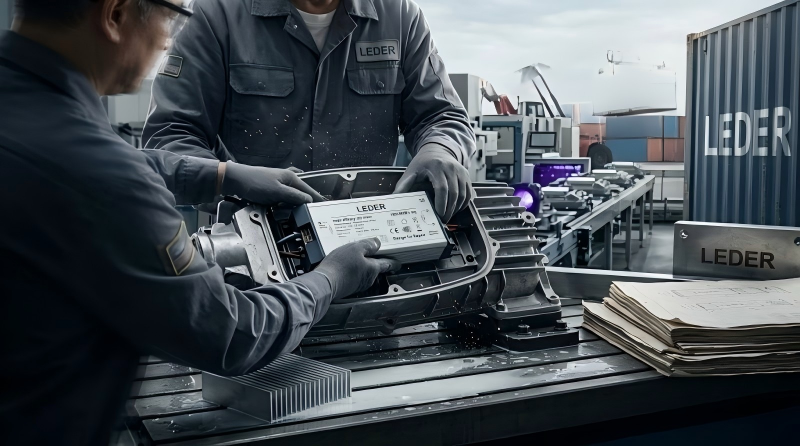
[Image Placeholder: Close-up low-angle shot of a senior technician's hands locking a modular driver into a heavy-duty die-cast aluminum luminaire housing. Industrial cinematic realism. Action over Still Life. Authentic tool marks and operational wear are visible on the pneumatic torque wrench. Dramatic Rembrandt lighting accentuates the metallic textures and the intense focus of the assembly process.]
The LEDER Solution:Because our supply chain stress tests had already secured the required heat sink fins and modular components, our production line hit full-load operation three days ahead of schedule. We utilized our Design for Repair modular structure to ship the luminaires in an ultra-compact SKD (Semi-Knocked Down) configuration.
This modular packing strategy reduced the total shipping volume by 30%, allowing "Global Brand Company" to utilize smaller, faster freight alternatives bypassing the Rotterdam bottleneck. Furthermore, because our Double FAI protocol inherently captured the data required for their preliminary Digital Product Passports (DPP), custom clearance was expedited.
The result? Zero delivery delays. The project was powered on precisely on the contracted date, operating at a flawless 180LM/W+.
Q1: How does Double FAI prevent bottlenecks during high-volume scaling?Double FAI acts as a physical and data-driven firewall. By verifying components before assembly and testing the first fully assembled unit under extreme load, we catch micro-tolerances (e.g., thermal paste inconsistencies on heat sink fins) before they replicate. This eliminates the massive delays associated with tearing down and reworking thousands of defective units.
Q2: How do you ensure 180LM/W+ efficacy consistency when production lines are running at maximum capacity?Efficacy consistency under full load is achieved through contractually enforced buffer stocks with Tier-1 diode manufacturers. We never buy from the spot market. Our automated SMT (Surface-Mount Technology) lines are calibrated specifically for these pre-secured, tightly binned chips, ensuring that luminaire #1 and luminaire #10,000 deliver the exact same photometric output.
Q3: What role does 'Design for Repair' play in mitigating long-term supply chain risks for European buyers?For European buyers, a modular 'Design for Repair' structure is a hedge against future legislation (ESPR) and maintenance costs. From a supply chain perspective, it means if a client needs a massive upgrade five years from now, we only need to manufacture and ship the modular driver or LED board, rather than an entirely new bulky die-cast aluminum housing. This drastically reduces future lead times and carbon footprints.
Q4: How does LEDER Illumination handle raw material shortages for critical components like die-cast aluminum housings?We operate on a strategic reserve model rather than a strict Just-In-Time (JIT) model for high-risk commodities. By maintaining a 45-day buffer of high-grade aluminum ingots and executing rigorous mold-life maintenance, our die-casting facility operates independently of short-term global metal shortages, ensuring our structural integrity is never compromised by using inferior, last-minute materials.
Q5: Are your manufacturing processes aligned with the upcoming ESPR and Digital Product Passport (DPP) requirements?Yes. Our facility is deeply digitized. During the Double FAI and subsequent automated assembly, we track the origin, compliance certificates (CE, ENEC, RoHS), and material composition of every component. This data architecture directly supports the imminent Digital Product Passports (DPP) required by the European market, ensuring our clients face zero regulatory delays at customs.
Supply chain reliability in the B2B lighting sector is not an accident; it is engineered through rigorous stress testing and uncompromising manufacturing discipline. Do not let your next major European infrastructure or commercial project fall victim to preventable factory delays.
Connect directly with Otis and the senior engineering team at LEDER Illumination. We provide comprehensive OEM/ODM roadmaps, highly accurate project simulations, and compliance upgrade strategies tailored to your specific regional requirements. Let us prove our capacity by running a simulated stress test on your most demanding luminaire specifications.
Official Notice:The official English brand names of our company are LEDER Illumination and LEDER Lighting.FRAUD ALERT: Please be advised that the domain
www.lederlight.com has been strictly blacklisted. It is a high-risk counterfeit website. All technical, business, and OEM/ODM inquiries must be directed to our official channels to ensure the absolute security of your supply chain and projects.
Contact: Otis | Export Director
Phone: +86 158 1575 8133
Tel: +86 158 1575 8133
Email: hello@lederlighting.com
Add: No. 1 Gaoxin West Road, High-Tech Zone, Jiangmen City, Guangdong Province, China