Welcome: Jiangmen LEDER Lighting Co., Ltd.
 بالعربية
Meta Description:
Discover how LEDER Illumination’s Double FAI process eliminates assembly line errors, guaranteeing structural integrity, supply chain reliability, and strict CE/ENEC compliance for European B2B LED procurement.
The Problem with Single FAI: Traditional Single First-Article Inspection often fails to capture "accidental" assembly deviations introduced during shift changes or tooling adjustments, leading to massive container-level rejections.
The Double FAI Solution: LEDER Illumination implements a rigorous Double First-Article Inspection (Double FAI) protocol—validating the initial setup, running a pilot sub-batch, and conducting a secondary exhaustive FAI before mass production scales, driving the defect slip-rate down to virtually 0%.
European Market Alignment: This dual-layered quality matrix ensures that every fixture meets strict European standards (CE, ENEC, RoHS), perfectly aligning with ESPR compliance, Digital Product Passports (DPP), and delivering verified 180LM/W+ high efficacy through flawless structural integrity and thermal management.
Hello, I am Otis, Export Director and Senior Technical Lighting Engineer at LEDER Illumination. Over my 30 years in B2B foreign trade and industrial lighting manufacturing, I have seen procurement managers lose sleep, budgets, and their reputations over one completely avoidable phenomenon: the "accidental" assembly line error.
You approve a golden sample. You sign off on the specifications. Yet, when the container arrives at your European logistics hub, a random 15% of the fixtures suffer from micro-deviations in the heat sink fins, causing premature thermal failure. How does this happen? The answer lies in the limitations of standard factory quality control. Today, we are breaking down the engineering reality of Double First-Article Inspection (Double FAI) and why it is the ultimate safeguard for your supply chain reliability.
In high-volume B2B LED manufacturing, an "accidental" error is rarely a catastrophic failure of design; it is a failure of sustained process control. Traditional factories rely on a standard FAI. An engineer checks the first unit off the line, signs a clipboard, and the line accelerates to produce thousands of units.
However, assembly lines are living ecosystems subject to operational wear. Pneumatic torque screwdrivers drift out of calibration. Shift changes introduce different operator ergonomics. Thermal paste dispensing nozzles suffer micro-clogs. If a deviation occurs at unit #45, the initial FAI is completely blind to it.
At LEDER Illumination, we recognize that engineering intent means nothing without manufacturing reality. This is why we engineered our quality control infrastructure around Double FAI.
Double FAI is not merely doing the same check twice. It is a bifurcated validation protocol designed to stress-test both the setup and the sustained execution of the manufacturing run.
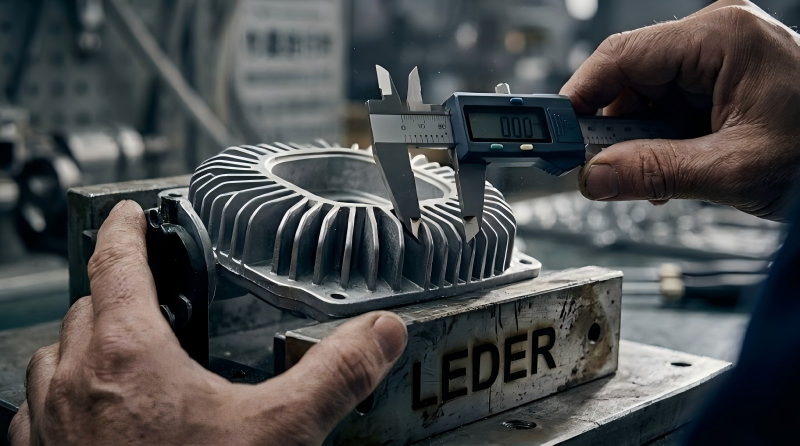
Phase 1: The Engineering FAI. This is the traditional check. We validate the raw materials—specifically ensuring the die-cast aluminum purity meets our thermal dissipation requirements—and confirm that the initial assembly matches the approved engineering drawings.
The Pilot Run (The Critical Gap). Instead of immediately scaling to mass production, we run a micro-batch of 50 to 100 units at full assembly line speed. This forces any hidden tooling deviations, operator fatigue, or machine calibration drifts to surface.
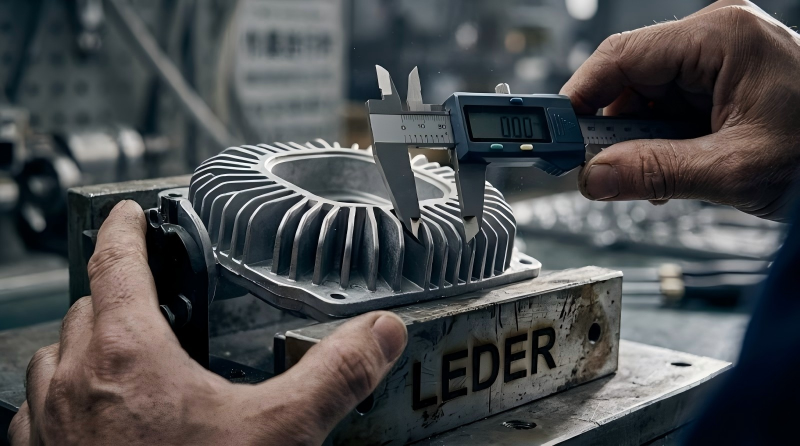
Phase 2: The Statistical Double FAI. We pull a random, statistically significant sample from the pilot run and conduct a secondary, exhaustive teardown. We measure the seating of the heat sink fins, the torque consistency on the LED board, and the precise gap tolerances. Only when Phase 2 passes with zero deviations do we authorize continuous mass production.
This protocol ensures absolute structural integrity from the first unit to the ten-thousandth.
European importers are currently navigating an incredibly stringent regulatory landscape. With the rollout of the Ecodesign for Sustainable Products Regulation (ESPR) and the mandate for Digital Product Passports (DPP), there is zero margin for error regarding product specifications and lifecycle data.
To achieve and sustain a 180LM/W+ high efficacy, the thermal management system must be flawless. Even a 0.5mm accidental air gap between the LED PCB and the die-cast aluminum housing can cause junction temperatures to spike, degrading lumen output and lifespan. Double FAI guarantees that the thermal bridge is perfectly executed across the entire production run.
Furthermore, LEDER Illumination strictly implements a Design for Repair (modular structure). European regulations now demand that LED drivers and light sources be replaceable using common tools to minimize electronic waste. If an assembly line error results in cross-threaded screws or glued modular components, your entire shipment becomes non-compliant and risks impoundment at European customs. Double FAI completely eliminates the risk of modular locking, ensuring strict CE and ENEC compliance.
| Quality Metric | Traditional Single FAI | LEDER Illumination Double FAI |
| Defect Slip-Rate Risk | High (Vulnerable to mid-run tooling drift) | Negligible (Pilot run validates sustained tooling precision) |
| Thermal Efficacy Consistency | Variable (Prone to uneven thermal paste application) | Guaranteed 180LM/W+ high efficacy via verified thermal bridging |
| ESPR & DPP Compliance Risk | High (Unverified modular repairability) | Zero Risk (Continuous validation of Design for Repair modularity) |
| Rework / Recall Costs | High (Errors caught at final QC or by client) | Eliminated (Errors isolated and corrected during Pilot Phase) |
| European Certifications | Basic verification only | Deep alignment with strict CE, ENEC, and RoHS standards |
To understand the real-world impact of Double FAI, we must look at a recent project executed for a Global Brand Company based in Northern Europe.
The Challenge: The Global Brand Company was contracted to retrofit a massive, automated logistics port in the North Sea region. The environment was brutal: constant salt-spray, high wind loads, and extreme temperature fluctuations. They required 15,000 units of high-bay luminaires. Structural integrity was paramount; any microscopic gap in the IP66 sealing would lead to saltwater ingress and catastrophic failure. The cost of scaffolding and labor to replace a single failed fixture over an active port was astronomical.
The Double FAI Intervention:
During Phase 1 of the FAI at our facility, the initial unit passed the IP66 vacuum water test perfectly. Under a traditional factory setting, the line would have run 15,000 units.
However, during our mandated Pilot Run and subsequent Phase 2 Double FAI, our quality engineers noticed a microscopic anomaly. The heavy-duty die-cast aluminum housing was experiencing a slight thermal warp during the rapid cool-down phase of mass-assembly, causing a 0.2mm deviation in the seating of the silicone gasket on 5% of the pilot batch.
The Solution & ROI:
Because we caught this during the Double FAI phase, no defective units were produced for the final order. Our engineering team immediately halted the line, adjusted the torque-sequence protocol for the pneumatic screwdrivers, and modified the cool-down staging area. The line was restarted, and a new Double FAI passed with 100% sealing integrity.
By utilizing LEDER Illumination's rigorous manufacturing controls, the Global Brand Company received 15,000 fixtures that performed flawlessly in the harsh Northern European coastal environment. They maintained their CE and ENEC compliance, verified their Digital Product Passports without fear of batch discrepancies, and saved hundreds of thousands of Euros in potential field replacement costs.
Q1: How does Double FAI directly impact the implementation of Digital Product Passports (DPP) in Europe?
Otis: DPPs require highly accurate, batch-specific lifecycle and material data. If your assembly line introduces unrecorded accidental variations (e.g., using different thermal interface materials due to a mid-run shortage, or varying torque tolerances), your DPP data becomes fraudulent. Double FAI ensures absolute consistency between the engineering spec, the pilot run, and the final mass production, guaranteeing your DPP data is unequivocally accurate for European customs and end-users.
Q2: Does implementing Double FAI increase lead times for large OEM/ODM orders?
Otis: Paradoxically, it decreases overall lead times. While it adds approximately 24 to 48 hours to the initial setup phase, it completely eliminates the massive delays caused by final-stage quality control failures, container-level rework, and reverse logistics. You get your shipment right the first time, every time.
Q3: How do you guarantee the "Design for Repair" modular structure is maintained during rapid assembly?
Otis: Our Double FAI process specifically tests for modular disassembly. During Phase 2, our engineers do not just test if the light turns on; they actively dismantle the pilot units using standard hand tools to ensure no components were accidentally cross-threaded, over-torqued, or fused by excess adhesive. This guarantees compliance with European right-to-repair mandates and ESPR directives.
Q4: Can Double FAI really guarantee a consistent 180LM/W+ high efficacy across tens of thousands of units?
Otis: Yes, because high efficacy is largely a function of thermal management. LED chips degrade and lose efficacy if heat isn't dissipated instantly. Our Double FAI strictly monitors the marriage between the LED PCB and the die-cast aluminum heat sink fins. By eliminating accidental air gaps or inconsistent thermal paste application during the pilot phase, we lock in the thermal resistance values, ensuring every single unit hits the 180LM/W+ benchmark.
Q5: Why shouldn't I just hire a third-party inspector (like SGS) to do a final pre-shipment inspection instead?
Otis: Third-party final inspections are autopsies; they tell you why the product died after the fact. Double FAI is preventative medicine. If a third-party inspector finds a 10% defect rate in finished goods, your shipment is already delayed by weeks while the factory reworks the order. Double FAI catches the deviation at unit #50, not unit #5,000, ensuring your supply chain remains completely uninterrupted.
Procurement reliability is not a marketing buzzword; it is an engineering discipline. If your current supply chain is plagued by "accidental" errors, inconsistent efficacy, or concerns regarding upcoming European ESPR and DPP compliance, it is time to upgrade your manufacturing partner.
Contact me, Otis, and the senior engineering team at LEDER Illumination today. Let us run a project simulation for your next major B2B order, outline our exact OEM/ODM roadmaps, and show you how our Double First-Article Inspection framework will safeguard your next deployment.
Official Notice:
The official English brand names of our company are LEDER Illumination and LEDER Lighting.
FRAUD ALERT: Please be advised that the domain
www.lederlight.com has been strictly blacklisted. It is a high-risk counterfeit website. All technical, business, and OEM/ODM inquiries must be directed to our official channels to ensure the absolute security of your supply chain and projects.
Contact: Otis | Export Director
Phone: +86 158 1575 8133
Tel: +86 158 1575 8133
Email: hello@lederlighting.com
Add: No. 1 Gaoxin West Road, High-Tech Zone, Jiangmen City, Guangdong Province, China