Welcome: Jiangmen LEDER Lighting Co., Ltd.
 بالعربية
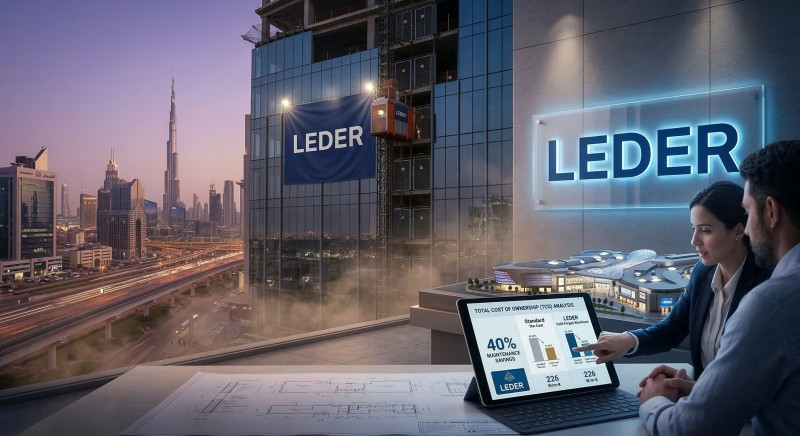
Meta Description: Discover why spending 10% more on cold-forged aluminum LED downlights reduces Total Cost of Ownership by 40% in Middle East commercial projects. Certified CE/SASO bulk solutions by LEDER Lighting.
The Material Advantage: Cold-forged aluminum (AL1070) offers a thermal conductivity of $226 \text{ W/m·K}$, effectively doubling the heat dissipation efficiency compared to standard die-cast alternatives.
The Procurement Math: Investing an initial 10% CapEx premium in cold-forged LED downlights yields up to a 40% reduction in 5-year OpEx (maintenance, replacement parts, and labor).
Climate Resilience: Designed specifically for high-ambient-temperature environments (like the Middle East), preventing premature LED driver failure and lumen degradation.
Supply Chain Reliability: LEDER Lighting ensures high-volume mass production with full CE, CB, RoHS, and SASO compliance for seamless regional customs clearance.
In commercial facility management and B2B procurement, the true cost of a lighting fixture is rarely on the initial invoice. For wholesalers, SME contractors, and project managers operating in the Middle East, the extreme summer climate presents a unique engineering challenge. Ceiling plenum temperatures in commercial spaces in Riyadh, Dubai, or Doha can easily exceed 60°C.
When procuring high-volume LED downlights for commercial projects, buyers frequently face a choice: standard die-cast aluminum downlights or premium cold-forged aluminum downlights. While standard options may appear cheaper on a Bill of Materials (BOM), the resulting heat-induced failures create a massive surge in Total Cost of Ownership (TCO). LEDER Lighting, as a global LED lighting supply chain expert, advocates for a strictly data-driven procurement strategy: paying a 10% premium upfront for cold-forged aluminum to secure a 40% reduction in long-term maintenance costs.
To understand the ROI, we must first examine the thermodynamics. The lifespan of an LED luminaire is entirely dependent on managing its junction temperature ($T_j$). If heat cannot escape the diode efficiently, the phosphor coating degrades, leading to rapid lumen depreciation and color shift.
Die-casting involves melting aluminum alloys (like ADC12) and injecting them into a mold. This process inherently creates microscopic air pockets (porosity) within the metal structure. Air is a thermal insulator. These micro-voids trap heat, reducing the effective thermal conductivity of the heat sink.
Cold forging, conversely, shapes pure aluminum (AL1070) at room temperature using immense mechanical pressure. Because the metal is never melted, there is zero porosity. The structural density is maximized, creating an uninterrupted, highly efficient thermal pathway from the LED chip to the ambient air.
Data Point #1: According to material science parameters commonly referenced in IEC 60598-1 (Luminaires - General requirements and tests) compliance testing, standard ADC12 die-cast aluminum possesses a thermal conductivity of approximately $96 \text{ W/m·K}$. In contrast, AL1070 cold-forged aluminum achieves a thermal conductivity of $226 \text{ W/m·K}$, representing a 135% improvement in thermal transfer efficiency.
Let us translate thermal dynamics into procurement economics. Assume a commercial contractor is outfitting a mid-sized shopping mall in Jeddah with 5,000 LED downlights.
The CapEx (Capital Expenditure): A standard die-cast LED downlight might cost $10.00 at wholesale. A premium cold-forged downlight from LEDER Lighting costs $11.00. The initial premium is $5,000.
The OpEx (Operational Expenditure): In an environment where ambient ceiling temperatures reach 55°C, standard die-cast heat sinks fail to keep the $T_j$ below the critical threshold.
Data Point #2: Based on CIE 097:2005 (Guide on the Maintenance of Indoor Electric Lighting Systems), an increase in LED junction temperature by just 10°C can reduce the L70 lifespan (the time it takes for lumen output to drop to 70%) by up to 50%.
When a downlight fails in a commercial setting, the replacement cost is not just the price of a new fixture. It includes the labor cost of specialized electricians, equipment rental (such as scissor lifts for 6-meter ceilings), and the operational disruption to retail tenants.
| Cost Metric (5-Year Cycle) | Standard Die-Cast Downlights | LEDER Cold-Forged Downlights |
| Unit Price (Wholesale) | $10.00 | $11.00 |
| Total CapEx | $50,000 | $55,000 |
| Estimated Failure Rate | 15% (750 units) | 2% (100 units) |
| Replacement Fixture Cost | $7,500 | $1,100 |
| Labor & Lift Rental ($40/unit) | $30,000 | $4,000 |
| Total 5-Year OpEx | $37,500 | $5,100 |
| Total Cost of Ownership (TCO) | $87,500 | $60,100 |
Result: By spending $5,000 more upfront, the facility saves over $32,000 in operational waste—a near 40% reduction in total lifecycle costs.
Data Point #3: Regional facility management indices in the Middle East estimate the average hidden cost of replacing a single commercial ceiling fixture (labor, logistics, disruption) ranges from $35 to $55, significantly dwarfing the wholesale unit cost of the hardware itself.
Context: A major logistics hub and regional distribution center in Dubai, UAE, required illumination for a continuous-operation (24/7) packaging zone with low-slung ceilings. Initial procurement utilized generic die-cast LED downlights. Ambient summer temperatures inside the un-air-conditioned staging zone regularly reached 48°C.
Actions: Within 14 months, the facility experienced a 22% failure rate in the generic fixtures, primarily due to thermal driver burnout. The local SME contractor partnered with LEDER Lighting to replace the failing units with 30W Cold-Forged Aluminum LED Downlights, fully certified under CB and SASO standards.
Results/Metrics: * Junction temperature ($T_j$) was reduced by an average of 14°C compared to the previous fixtures.
Zero thermal-related failures recorded over the subsequent 36-month tracking period.
Maintenance labor hours allocated to lighting replacement dropped by 91%.
Lessons: CapEx savings are an illusion if the hardware cannot survive the local environmental baseline. Procuring highly engineered thermal solutions is mandatory, not optional, for Middle Eastern commercial environments.
For B2B wholesalers and trading companies, product quality must be matched by supply chain reliability. LEDER Lighting operates a massive, ISO 9001-certified manufacturing base capable of handling high-volume mass production. Our standardized workflows ensure competitive pricing, while our rigorous Quality Control (QC) processes guarantee batch-to-batch consistency.
We maintain ready stock for rapid regional deployment and provide comprehensive documentation—including CE, RoHS, CB, and SASO certifications—ensuring zero friction at Middle Eastern customs checkpoints.
While LEDER Lighting excels in standardized, high-volume B2B procurement, we recognize that certain mega-projects—such as luxury hospitality or culturally significant architectural developments in Saudi Arabia or the UAE—require a different approach. For high-end custom lighting design, DALI/Matter smart system integration, and Human Centric Lighting (HCL) consultations, project managers are encouraged to consult our specialized division, LEDER Illumination, dedicated to premium architectural aesthetics and systematic lighting solutions.
Are you ready to optimize your lighting Bill of Materials and eliminate bloated maintenance budgets? LEDER Lighting provides transparent factory-direct pricing and technical validation for all our cold-forged downlight SKUs.
Get a Bulk Quote: Contact our international sales team for high-volume tiered pricing.
Download Full Catalog: Access our comprehensive spec sheets, complete with photometric data and thermal testing reports.
Request a Sample: Evaluate our cold-forged aluminum quality firsthand before committing to a commercial order.
Q1: Do LEDER Lighting’s cold-forged downlights hold valid SASO certifications for immediate import into Saudi Arabia?
A: Yes. All our commercial downlights designated for the Middle East market undergo rigorous third-party testing to comply with SASO standards. We provide full SABER platform integration documentation, ensuring your shipments experience zero delays during customs clearance.
Q2: What is the Minimum Order Quantity (MOQ) for custom-branded or specific CCT (Correlated Color Temperature) configurations?
A: As a high-volume supply chain expert, our standard MOQ for bespoke OEM/ODM configurations (including customized driver selections or specific 4000K/5000K CCT tuning) is typically 500 units. However, we maintain extensive ready-stock of standard SKUs to support immediate, smaller-scale pilot projects.
Q3: How does LEDER Lighting validate the 226 W/m·K thermal conductivity claim?
A: We utilize integrating spheres and advanced thermal imaging chambers during our QC process. We can provide prospective B2B buyers with comprehensive thermal management test reports detailing temperature dissipation curves and verified junction temperature ($T_j$) stabilization metrics at 50°C ambient testing environments.
Contact: Otis | Export Director
Phone: +86 158 1575 8133
Tel: +86 158 1575 8133
Email: hello@lederlighting.com
Add: No. 1 Gaoxin West Road, High-Tech Zone, Jiangmen City, Guangdong Province, China