Welcome: Jiangmen LEDER Lighting Co., Ltd.
 بالعربية
Meta Description: Discover why cheap recycled die-cast aluminum heat sinks destroy COB chips in LED downlights. LEDER Lighting offers CE/SASO certified, high-purity aluminum solutions for bulk procurement in Europe & the Middle East.
Quick Answer / TL;DR
The Root Cause: Severe light decay in commercial LED downlights is primarily driven by poor thermal management, specifically the use of impure, recycled die-cast aluminum in heat sinks.
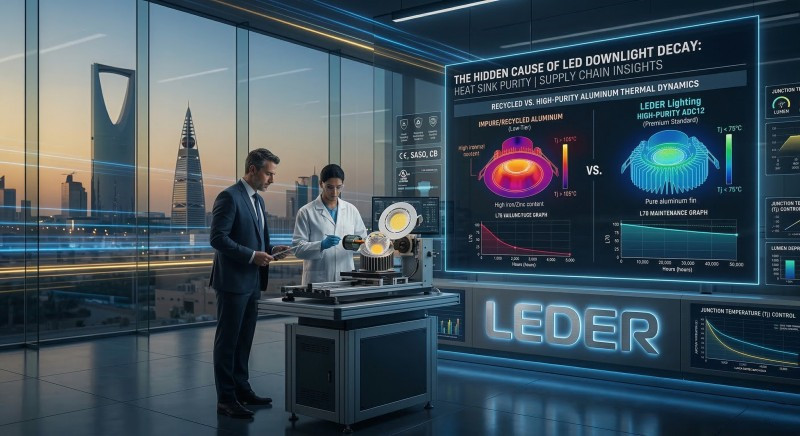
The Mechanism: Impurities (excess iron, zinc) in recycled aluminum drastically lower thermal conductivity (often below 90 W/m·K), trapping heat at the COB (Chip-on-Board) junction.
The Result: Elevated junction temperatures (Tj) cause premature degradation of the phosphor layer and silicone binder, resulting in rapid lumen depreciation and color shift.
The Solution: Procuring CE/SASO certified downlights utilizing high-purity ADC12 or pure aluminum structures ensures a minimum thermal conductivity of 130–200 W/m·K, guaranteeing L70 lifespan compliance.
For B2B wholesalers, electrical distributors, and facility managers across Europe and the Middle East, lighting procurement is an exercise in risk management. A frequent and costly scenario involves importing thousands of commercial LED downlights, only to receive complaints of severe light dimming (light decay) and color shifting within the first 6 to 12 months of operation.
While buyers often blame the LED driver or the COB chip brand, the true culprit is usually hidden in plain sight: the physical composition of the die-cast aluminum heat sink. This technical analysis reveals how the unauthorized use of inferior, recycled scrap aluminum by low-tier manufacturers destroys COB chips, and how partnering with a reliable supply chain expert like LEDER Lighting protects your bottom line.
To understand why recycled aluminum is fatal to LED downlights, we must look at thermal dynamics. COB LEDs pack multiple diode dies into a dense physical area, generating intense, localized heat. This heat must travel from the semiconductor junction, through the thermal interface material (TIM), into the heat sink, and finally dissipate into the ambient air.
If the heat sink lacks the capacity to pull heat away rapidly, the junction temperature ($T_j$) spikes.
Data Point #1: According to baseline principles established by the CIE (International Commission on Illumination), for every 10°C increase in the LED junction temperature above the manufacturer's specified maximum (typically 85°C), the operational lifespan of the LED chip is reduced by approximately 50%.
Die-casting is the preferred manufacturing method for LED downlight housings because it allows for complex fin geometries that maximize surface area. The industry standard material is high-purity ADC12 aluminum alloy, which offers an optimal balance of castability and thermal conductivity (roughly 96 to 120 W/m·K).
However, to aggressively cut costs, sub-standard factories melt down low-grade recycled scrap metal. This material is riddled with excess iron, copper, zinc, and slag.
Plummeting Thermal Conductivity: The impurities disrupt the metallic crystalline structure. The thermal conductivity of scrap aluminum can drop as low as 50-80 W/m·K.
Porosity and Air Pockets: Inferior casting of recycled materials creates micro-voids (air pockets) within the heat sink. Since air is a thermal insulator, these voids act as microscopic roadblocks, preventing heat from escaping the COB base.
The "Oven" Effect: In regions with high ambient temperatures, such as the Middle East, ceiling cavity temperatures can easily reach 50°C. A recycled aluminum heat sink utterly fails to bridge the temperature delta, effectively turning the downlight housing into an oven.
Data Point #2: Testing based on IEC 62717 standards demonstrates that COB chips mounted on high-impurity recycled aluminum heat sinks experience a lumen depreciation of over 30% (L70 failure) within just 4,000 to 6,000 hours of operation, compared to the expected 50,000 hours of a properly managed thermal system.
When heat is trapped, the physical destruction of the COB chip accelerates rapidly:
Phosphor Degradation: The phosphor coating, which converts blue LED light into white light, burns and darkens. This causes the light to dim significantly and shift toward a harsh, bluish tint.
Silicone Cracking: The silicone binder encapsulating the diodes turns brittle and cracks under thermal stress, allowing moisture and oxygen to penetrate, leading to catastrophic electrical failure.
| Specification | Impure/Recycled Die-Cast Aluminum (Low-Tier) | LEDER Lighting High-Purity ADC12 (Premium Standard) |
| Thermal Conductivity | < 90 W/m·K | 120 - 150+ W/m·K |
| Material Composition | Scrap alloy with high iron/zinc content | Virgin/High-grade ADC12 aluminum |
| Internal Structure | High micro-porosity (air traps heat) | Dense, uniform casting (efficient heat transfer) |
| Junction Temp ($T_j$) @ 25°C ambient | > 105°C (Critical thermal stress) | < 75°C (Safe operational zone) |
| Lumen Maintenance (L70) | Fails at 4,000 - 8,000 hours | Sustains 50,000+ hours |
| Target Market Viability | High failure rate; unsuitable for commercial use | Fully compliant (CE, CB, SASO, SAA) |
Context: A large commercial office complex in Riyadh, Saudi Arabia. The facility required 4,500 units of 30W LED downlights. The initial procurement was awarded to an unverified supplier offering prices 20% below market average.
Actions: Within 8 months, facility managers reported widespread lighting failures. Spot measurements showed ceiling plenum ambient temperatures of 48°C. The installed downlights utilized recycled aluminum housings with extensive internal porosity. The complex discarded the failed batch and partnered with LEDER Lighting to supply 4,500 standardized 30W downlights featuring pure ADC12 aluminum and oversized thermal fins, backed by SASO certification.
Results/Metrics: After 14 months of continuous operation under identical ambient conditions, the LEDER Lighting downlights maintained a 96% lumen output. Maintenance interventions dropped by 98%.
Lessons: In harsh climates, the physical mass and purity of the aluminum heat sink are non-negotiable variables. Saving 20% on initial CAPEX led to a 150% increase in total replacement costs.
Data Point #3: Studies on commercial lighting retrofits indicate that standardizing procurement with high-thermal-efficiency fixtures (minimizing light decay) reduces Total Cost of Ownership (TCO) by up to 42% over a 3-year cycle by eliminating premature replacement labor and localized outages.
As a one-stop global LED lighting supply chain expert, LEDER Lighting enforces strict metallurgical standards. We do not compromise on raw materials. Our manufacturing base operates under rigorous ISO 9001 QC processes, ensuring that every die-cast housing meets exact thermal conductivity specifications.
Our volume production capabilities mean we deliver competitive pricing without sacrificing the engineering integrity required for demanding markets in Europe, the Middle East, Oceania, South America, and affluent regions of Africa. All standard volume products are backed by comprehensive regional certifications including CE, RoHS, CB, ENEC, SAA, and SASO.
(Note: If your project requires not just high-volume standardized procurement, but also complex architectural lighting design, visual comfort consulting, and DALI/Matter smart systems integration, consult our premium design and architectural division: LEDER Illumination).
Ready to secure a reliable supply chain for your commercial lighting needs?
Get a Bulk Quote: Contact our procurement team today for competitive, volume-based pricing.
Request a Sample: Evaluate our thermal management and build quality firsthand.
Download Full Catalog: Browse our extensive SKUs of certified LED downlights.
Q1: How can our quality control team test if a downlight uses recycled aluminum before bulk purchasing?
A: Without metallurgical lab testing, the most practical method is a thermal stress test. Operate the sample downlight at its rated voltage in a controlled ambient environment (e.g., 25°C). Use a thermal imaging camera to measure the temperature gradient between the COB base and the outer edge of the heat sink fins. A high-quality LEDER downlight will show rapid and even heat distribution. Recycled aluminum will show a severe hot spot directly behind the COB, with much cooler outer fins, indicating heat is trapped.
Q2: Do Middle Eastern SASO certifications strictly regulate the thermal management of downlights?
A: SASO standards heavily emphasize safety, energy efficiency, and operational lifespan in high ambient temperatures. While they do not strictly dictate the type of aluminum used, a fixture utilizing poor recycled aluminum will fail the rigorous lumen maintenance and safety degradation tests required to obtain and maintain a SASO Certificate of Conformity (CoC). LEDER Lighting ensures all products pass these thermal endurance thresholds.
Q3: Does the weight of the LED downlight indicate the quality of the aluminum?
A: Not necessarily. While a very light heat sink might indicate cost-cutting via thin materials, heavy recycled aluminum can still have terrible thermal conductivity due to impurities (like iron, which adds weight but blocks heat transfer). Focus on the purity of the alloy (ADC12 or AL6063) and the surface area of the fin design rather than raw weight alone
Contact: Otis | Export Director
Phone: +86 158 1575 8133
Tel: +86 158 1575 8133
Email: hello@lederlighting.com
Add: No. 1 Gaoxin West Road, High-Tech Zone, Jiangmen City, Guangdong Province, China