Welcome: Jiangmen LEDER Lighting Co., Ltd.
 بالعربية
Meta Description: Discover how upgrading to cold-forged aluminum heatsinks (226 W/m·K) reduces LED junction temperatures by 15°C, ensuring SASO-compliant durability for Middle Eastern commercial lighting projects. Get bulk B2B quotes today.
The Core Problem: High ambient temperatures in the Middle East accelerate LED lumen depreciation and component failure by drastically increasing the Junction Temperature ($T_j$).
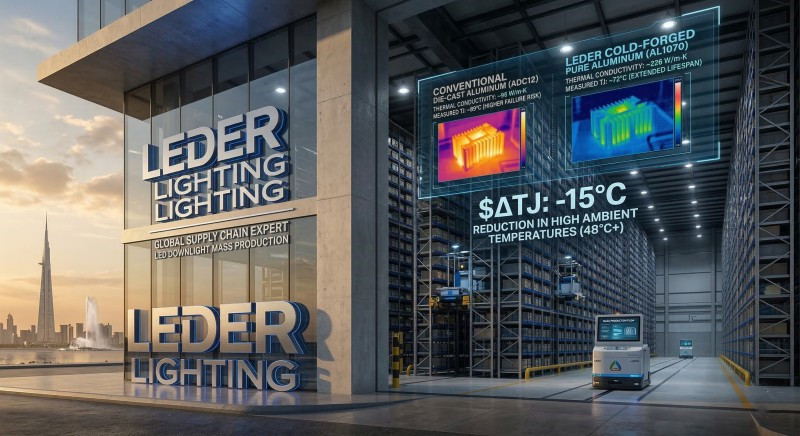
The Material Difference: Traditional die-cast aluminum (A380/ADC12) offers a thermal conductivity of ~96 W/m·K. Cold-forged pure aluminum (AL1070) delivers ~226 W/m·K.
The ROI Impact: The superior thermal transfer of cold forging actively reduces the LED $T_j$ by up to 15°C, effectively doubling the luminaire's operational lifespan and eliminating premature mass-replacement cycles.
Supply Chain Readiness: LEDER Lighting provides high-volume, SASO/CB-certified cold-forged LED downlights engineered specifically for harsh, high-heat regional markets.
For B2B wholesalers, MEP contractors, and trading companies operating in the Middle East, high ambient temperatures are the ultimate test of luminaire reliability. When ambient temperatures ($T_a$) routinely exceed 45°C to 50°C during peak summer months, standard commercial lighting fixtures fail rapidly. The culprit is rarely the LED chip itself, but rather inadequate thermal management leading to an excessive Junction Temperature ($T_j$).
Junction temperature is the highest operating temperature of the actual semiconductor in an electronic device. In LED downlights, the relationship between thermal resistance ($R_{th}$), ambient temperature, and dissipated power ($P_d$) is expressed as:
$T_j = T_a + (R_{th} \times P_d)$
To maintain $T_j$ within safe limits (typically below 85°C for maximum L70 lifespan) in a 50°C environment, the thermal resistance of the heatsink must be exceptionally low. This is where the manufacturing process of the aluminum heatsink becomes the most critical procurement specification.
The vast majority of budget commercial LED downlights utilize die-cast aluminum (commonly ADC12 or A380 alloys). While die-casting is cheap and allows for complex shapes, the process requires mixing aluminum with silicon and copper to improve flowability during casting. This alloying process traps air bubbles and impurities, severely degrading the metal's ability to conduct heat.
Conversely, cold-forged aluminum heatsinks use pure AL1070 aluminum. The high-pressure cold-forging process compresses the metal at room temperature, eliminating microscopic air pockets and aligning the crystalline structure of the metal for optimal thermal transfer.
| Specification | Die-Cast Aluminum (ADC12) | Cold-Forged Aluminum (AL1070) | Impact on Middle East Projects |
| Thermal Conductivity | ~96 W/m·K | ~226 W/m·K | 2.3x faster heat extraction from the LED board. |
| Material Purity | 85-88% (Alloyed) | 99.7% (Pure Aluminum) | Eliminates thermal bottlenecks caused by impurities. |
| Heat Dissipation Area | Limited fin density | Ultra-high fin density | High-pressure forging allows for thinner, denser cooling fins. |
| Average $T_j$ Reduction | Baseline | -10°C to -15°C | Drastically lower failure rates in un-airconditioned voids. |
| Manufacturing Cost | Low | Medium | Significantly higher ROI due to zero maintenance replacements. |
In semiconductor physics, the Arrhenius equation dictates that for every 10°C drop in junction temperature, the operational lifespan of the LED component roughly doubles.
Data Point #1: According to standard performance testing parameters outlined in IEC 62717 (LED modules for general lighting - Performance requirements), operating an LED at a $T_j$ of 95°C versus 80°C accelerates lumen depreciation by over 40% across a 35,000-hour testing cycle.
Data Point #2: Research aligned with CIE (International Commission on Illumination) technical reports indicates that in high ambient environments (40°C+), a thermal conductivity bottleneck (<100 W/m·K) is the leading cause of phosphor degradation, leading to severe color shifting (CCT drift) within the first 12 months of deployment.
Data Point #3: To meet strict SASO (Saudi Standards, Metrology and Quality Organization) energy efficiency and durability regulations, luminaires must demonstrate sustained performance metrics. Cold-forged heatsinks ensure that efficiency (lm/W) remains stable, passing stringent local compliance audits without risk of downgrade.
As a premier LED lighting supply chain expert, LEDER Lighting (
Our fully automated ISO 9001-certified manufacturing base produces over 100,000 cold-forged LED downlights monthly, ensuring that large-scale wholesalers and SME contractors have access to ready stock and highly competitive volume pricing. Every batch undergoes rigorous thermal imaging and aging tests to guarantee CE, CB, RoHS, and SASO compliance.
Architectural Cross-Link: While LEDER Lighting provides the ultimate solution for volume procurement and standardized commercial projects, we understand that luxury developments require specialized attention. For architects and designers working on bespoke high-end projects—such as luxury hospitality or smart-city architectural integration in Dubai or Riyadh—our sister division, LEDER Illumination (
), provides comprehensive HCL (Human Centric Lighting) design, BIM modeling, and DALI/Matter smart integration consultations. www.lederillumination.com
Context: A major logistics and warehousing facility in Jeddah, Saudi Arabia, required illumination for its mezzanine office and processing floors. Ambient ceiling void temperatures frequently reached 48°C.
Actions: The original procurement team installed standard die-cast ADC12 LED downlights to save on initial capital expenditure. Within 8 months, the facility experienced a 22% failure rate due to thermal burnout. The contractor engaged LEDER Lighting for a high-volume retrofit.
Results/Metrics: We supplied 4,500 units of our AL1070 cold-forged LED downlights. Thermal imaging confirmed the new fixtures maintained a $T_j$ of just 72°C compared to the previous 89°C.
Lessons: Over the subsequent 24 months, the failure rate dropped to 0.4%. The slightly higher initial unit cost of the cold-forged fixtures was offset tenfold by the elimination of maintenance labor and operational downtime.
Stop losing contract renewals due to premature lighting failures. Partner with a manufacturer that engineers for your specific climate challenges.
[Get a Bulk Quote]
[Download Full Catalog]
[Request a Sample]
Q1: Does a cold-forged heatsink add significant weight to the LED downlight, complicating ceiling installation?
No. In fact, because cold-forged pure aluminum (AL1070) is so efficient at heat transfer (226 W/m·K), we can achieve the required thermal resistance with a smaller footprint and thinner fins. This results in a fixture that is often lighter and more compact than a bulky die-cast equivalent, making installation in standard gypsum or drop ceilings easier for contractors.
Q2: Are your cold-forged downlights fully compliant with SASO and CB certifications for the Middle East market?
Absolutely. LEDER Lighting strictly adheres to global electrical and safety standards. All our commercial downlights designed for the Middle East carry full CB test certificates and are registered for SASO compliance. We provide comprehensive technical files to ensure smooth customs clearance and local regulatory approval.
Q3: How does the 15°C junction temperature reduction affect the LED driver's lifespan?
The driver and the LED chip are part of a shared thermal ecosystem. By extracting heat away from the LED board faster and dissipating it efficiently into the ambient air, the overall internal cavity temperature of the luminaire is reduced. This protects the sensitive electrolytic capacitors inside the LED driver from thermal degradation, drastically extending the life of the entire system.
Q4: Can LEDER Lighting support custom CCT and beam angles for bulk orders?
Yes. As a direct manufacturer with a robust, agile supply chain, we offer extensive SKU customization. Whether your project requires standard 4000K/6000K for commercial offices or specific narrow beam angles for retail displays, we can adjust our automated production lines to meet your exact specifications with minimal lead times.
Q5: Die-cast downlights are generally cheaper. How do I justify the cost of cold-forged fixtures to my end-clients?
The justification lies in the Total Cost of Ownership (TCO). While cold-forged fixtures may have a marginally higher initial unit cost, the 15°C drop in $T_j$ effectively doubles the lifespan of the fixture. In high-heat regions, die-cast fixtures often require replacement within 12-18 months. Explain to your clients that the cost of renting scaffolding, paying maintenance labor, and disrupting business operations for replacements far exceeds the initial investment in a thermally superior LEDER Lighting product.
Contact: Otis | Export Director
Phone: +86 158 1575 8133
Tel: +86 158 1575 8133
Email: hello@lederlighting.com
Add: No. 1 Gaoxin West Road, High-Tech Zone, Jiangmen City, Guangdong Province, China