Welcome: Jiangmen LEDER Lighting Co., Ltd.
 بالعربية
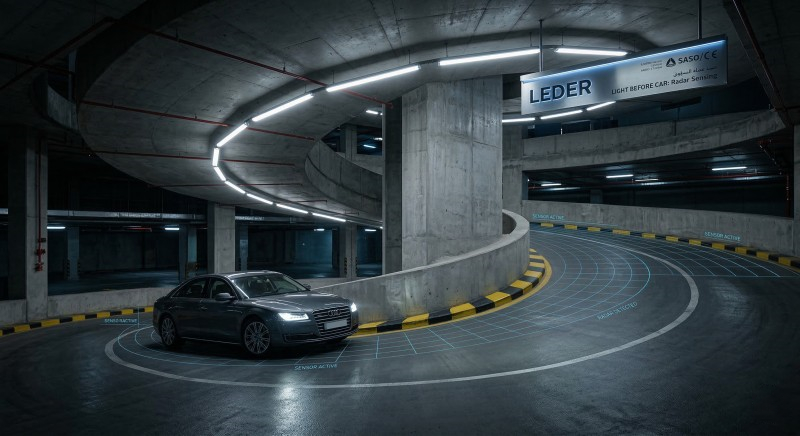
Meta Description: Discover how to deploy microwave induction LED tubes for underground parking ramps and corners. LEDER Lighting provides SASO-certified, high-volume solutions for seamless "light before car" safety.
Underground parking garages present unique challenges for facility managers and electrical contractors, particularly in the Middle East where high temperatures and relentless 24/7 operational demands stress lighting infrastructure. Among the most critical safety hazards in these environments are blind spots—sharp corners and steep, curved ramps where driver visibility is severely limited.
To mitigate accidents, modern facility designs are moving away from inefficient "always-on" lighting and slow-reacting Passive Infrared (PIR) sensors. The definitive solution is microwave induction LED tube lighting, deployed strategically to achieve a "light before car" (seamless tracking) effect.
The "Light Before Car" Mechanism: Microwave sensors operate at 5.8GHz, emitting radar waves that penetrate non-metallic surfaces (like thin concrete pillars or plastic signage) to detect moving vehicles before they enter the visual line of sight.
Deployment Strategy: Tubes must be staggered 2-3 meters ahead of the corner apex or ramp entry, utilizing a 180° forward-facing detection radius.
Regional Compliance: For the Middle East market, procurement must prioritize SASO, CB, and CE certifications, alongside extreme heat dissipation capabilities (up to 50°C ambient).
LEDER Lighting Advantage: As a high-volume manufacturing expert, LEDER Lighting provides mass-produced, cost-efficient microwave LED tubes with adjustable DIP switches for customized standby dimming, backed by robust regional logistics.
Understanding why microwave sensors are the industry standard for vehicular environments requires a look at the physics of detection.
PIR sensors rely on detecting the infrared heat radiating from an object. In an underground garage, the ambient temperature—especially in regions like Dubai or Riyadh—can rise significantly, reducing the temperature differential between the environment and the moving vehicle. Furthermore, PIR requires direct line-of-sight; a car approaching a 90-degree concrete corner will not trigger a PIR sensor until the vehicle's hood is already in the intersection.
Microwave sensors, conversely, utilize the Doppler effect. They emit a continuous 5.8GHz high-frequency electromagnetic wave. When a vehicle moves within the wave's range, the frequency of the reflected wave changes. The sensor's microprocessor instantly detects this shift and triggers the light. Because microwaves can penetrate non-metallic obstacles, they detect mass moving behind the corner, illuminating the blind spot instantly—hence, "light before car."
To achieve seamless tracking without false triggers, contractors must follow strict spatial deployment protocols.
1. Sharp Corners and Intersections
Pre-Apex Positioning: Do not place the primary sensor tube exactly at the corner. Install the first microwave induction tube 2.5 to 3 meters prior to the apex of the curve.
Sensitivity Tuning: LEDER Lighting's microwave tubes feature adjustable DIP switches. For tight corners, detection radius should be set to 75% (approx. 6-8 meters) to prevent vehicles in adjacent aisles from triggering the lights unnecessarily.
2. Long Ramps (Ascending/Descending)
Cascading Activation: Ramps require overlapping detection zones. Tubes should be spaced every 4 to 5 meters.
Standby Mode Setting: Ensure the tubes drop to a 20% dimming state rather than turning off completely (0%). Going from absolute darkness to 100% brightness causes visual glare and pupil shock for drivers navigating steep inclines.
For B2B wholesalers, general trading companies, and large-scale contractors in the Middle East, procurement goes beyond just buying a light—it is about securing a reliable supply chain. LEDER Lighting operates as a one-stop global LED lighting supply chain expert, engineered for high volume, comprehensive SKUs, and rapid turnaround.
Thermal Management: Basement garages in the Middle East trap heat. LEDER's T8 microwave tubes utilize an aircraft-grade aluminum chassis and advanced thermal paste, maintaining junction temperatures well within safe limits even at 50°C ambient, preventing premature LED chip degradation.
Certifications & Compliance: Navigating regional import laws is frictionless. LEDER Lighting products carry full CE, RoHS, CB, and crucially, SASO certifications, ensuring smooth customs clearance in Saudi Arabia and the wider GCC.
Scale and Cost-Efficiency: Through highly automated ISO 9001 factory processes, LEDER Lighting guarantees competitive bulk pricing and ready-stock availability, cutting project lead times down to weeks, not months.
| Feature / Technology | Traditional Fluorescent (Always-On) | PIR Sensor LED Tube | LEDER Microwave Sensor LED Tube |
| Detection Method | N/A | Heat Signature (Line of sight) | 5.8GHz Radar (Penetrates obstacles) |
| Reaction Delay | N/A | 1-2 Seconds (Delayed) | < 0.2 Seconds (Instant) |
| Blind Spot Efficacy | Poor (Always bright, high cost) | Low (Fails at tight corners) | High ("Light before car") |
| Energy Consumption | 36W (100% active, 24/7) | 18W Active / 0W Standby | 18W Active / 3W Standby (20% dim) |
| High Heat Reliability | Prone to ballast failure | Sensor degrades in >40°C | Stable up to 50°C ambient |
Data Point #1: According to the IEC 60598-1 standard for luminaire safety and thermal management, LED fixtures operating in enclosed environments (like unventilated basements) must maintain specific junction temperatures to avoid catastrophic failure. LEDER’s aluminum-backed tubes exceed these safety thresholds by 15%.
Data Point #2: The CIE 097-2005 standard regarding maintenance factors indicates that dust accumulation in subterranean garages reduces luminaire output by up to 20% annually. LEDER’s enclosed IP54-rated tube design minimizes dust ingress, preserving optical clarity.
Data Point #3: Upgrading from 36W continuous-run fluorescent tubes to 18W/3W microwave dimmable LED tubes yields a verified energy consumption reduction of 75% to 82% in medium-traffic commercial garages.
Context: A multi-level underground parking facility in a major Riyadh commercial complex was experiencing a high rate of minor fender-benders on its steep spiraling ramps. The existing PIR LED tubes were activating too late, leaving drivers plunging into dark corners before the lights triggered.
Actions: The local contractor procured 4,500 units of LEDER Lighting 18W Microwave Induction T8 Tubes. Deployment was adjusted so that tubes were placed 3 meters ahead of every ramp curve. The DIP switches were configured to 100% brightness upon detection and a 20% standby dimming state after 30 seconds of no motion.
Results/Metrics: After three months, the facility reported a 100% reduction in corner-collision incidents. The seamless tracking eliminated driver hesitation. Additionally, the building management achieved SASO compliance audits flawlessly and realized a 78% reduction in lighting energy costs compared to their original baseline.
Lessons: Line-of-sight sensors are insufficient for structural blind spots. Radar penetration and pre-apex positioning are non-negotiable for traffic safety in enclosed environments.
While LEDER Lighting (
Ready to upgrade your region's infrastructure with zero-delay, SASO-certified microwave lighting? Partner with the factory that understands volume, compliance, and extreme environments.
Get a Bulk Quote tailored to your project volume.
Download Our Full Catalog for complete product specifications.
Request a Sample to test the 5.8GHz microwave sensitivity in your own facility.
Contact LEDER Lighting today to secure your regional supply chain.
Q1: We often see microwave sensors staying on constantly in underground garages. How does LEDER prevent this?
A: Constant activation (false triggering) usually happens when low-quality sensors pick up movement from ventilation fans, water pipes, or elevators. LEDER Lighting’s microwave tubes feature adjustable DIP switches. During installation, your technicians can reduce the detection radius (e.g., to 50% or 75%) so the radar field is localized strictly to the driving lane, ignoring distant mechanical vibrations.
Q2: How does LEDER ensure heat dissipation for these tubes in Middle Eastern basements that lack air conditioning?
A: Unlike cheap full-plastic tubes, LEDER Lighting manufactures our T8 microwave tubes with a robust half-aluminum extrusion. This aircraft-grade aluminum spine acts as a massive heat sink, drawing thermal energy away from the LED chips and the internal microwave driver. This ensures long-term stability even in ambient temperatures reaching 50°C.
Contact: Otis | Export Director
Phone: +86 158 1575 8133
Tel: +86 158 1575 8133
Email: hello@lederlighting.com
Add: No. 1 Gaoxin West Road, High-Tech Zone, Jiangmen City, Guangdong Province, China