Welcome: Jiangmen LEDER Lighting Co., Ltd.
 بالعربية
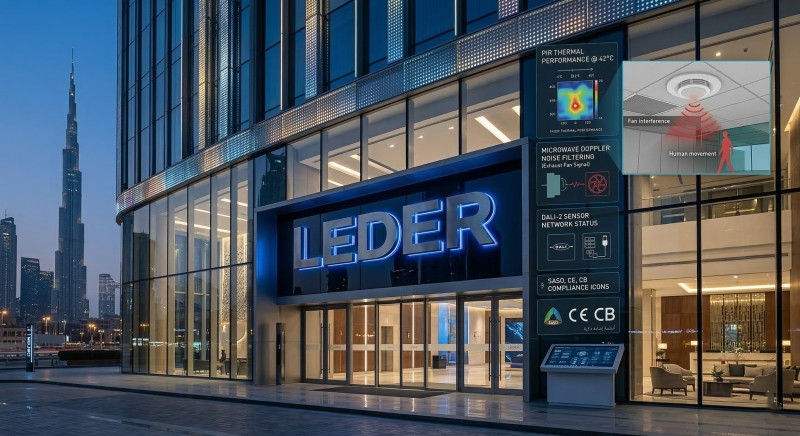
Meta Description: Discover how LEDER Illumination resolves complex PIR thermal failures and microwave sensor HVAC interference for high-end Middle Eastern architectural projects. SASO compliant smart lighting design.
PIR Thermal Blindness: Passive Infrared (PIR) sensors frequently fail in Middle Eastern climates when ambient temperatures exceed 35°C, as the temperature delta between human bodies and the background diminishes.
Microwave Interference: While immune to heat, microwave sensors penetrate thin walls and are notoriously susceptible to false triggers from moving non-human objects, particularly HVAC exhaust fan blades.
The LEDER Solution: LEDER Illumination resolves these issues through precision DALI-integrated dual-technology sensors, localized sensitivity tuning, and strategic architectural BIM planning to isolate detection zones.
Target Compliance: All integrated solutions meet SASO, CE, and CB standards for the Middle Eastern market.
The integration of smart lighting systems into luxury commercial spaces and mega-projects across the Middle East demands flawless execution. Architects and lighting designers frequently encounter a frustrating post-installation issue: lighting systems that turn on when spaces are empty or fail to activate when occupied.
At LEDER Illumination, we specialize in the systematic integration of high-end lighting solutions. We understand that visual comfort and energy efficiency rely entirely on accurate automation. Today, we are dissecting the two most common pitfalls in lighting automation—PIR thermal failure and microwave sensor interference—and providing engineering-grade solutions.
Passive Infrared (PIR) sensors operate by detecting the infrared heat radiation emitted by human bodies against the background thermal footprint of a room.
Data Point #1: According to IEC 60669-2-1 standards for electronic switches, sensor performance is evaluated based on thermal deltas. A standard PIR sensor requires a minimum temperature difference of 4°C to 5°C between the moving object and the ambient environment to trigger reliably.
In regions like Dubai, Riyadh, or Doha, ambient temperatures in semi-enclosed spaces (like luxury parking garages, transitional lobbies, or service corridors) can easily reach 35°C to 40°C. When the ambient temperature matches the human body temperature (37°C), the PIR sensor experiences "thermal blindness." The sensor simply cannot distinguish a person from the background heat, leading to total activation failure.
To combat high temperatures, lighting designers often pivot to Microwave (Radar) sensors. These sensors operate on the Doppler effect, emitting high-frequency electromagnetic waves (typically 5.8 GHz) and measuring the shift in the reflected waves caused by movement.
Because they do not rely on temperature, microwave sensors are highly effective in extreme heat. However, they introduce a new set of architectural challenges:
Wall Penetration: Microwave signals can pass through glass, gypsum board, and thin masonry. A sensor in an executive office might trigger when someone walks down the adjacent hallway.
HVAC & Machinery Interference: The most notorious pitfall is the exhaust fan. The rotating blades of a ventilation fan, or the swinging of an elevator cable, create continuous Doppler shifts. The microwave sensor interprets this continuous mechanical motion as human presence, locking the lights in the "ON" state permanently.
Solving these frequent false triggers requires a shift from standard product application to comprehensive architectural integration.
For microwave sensors, spatial geometry is critical. During the BIM modeling phase, LEDER Illumination consultants map the exact radiation patterns of microwave sensors against HVAC layouts. By establishing minimum setback distances from exhaust vents and utilizing physical metallic masking (which blocks 5.8 GHz waves), we effectively blind the sensor to fan blades.
Instead of basic dip-switch settings, high-end projects require intelligent systems. We integrate sensors that communicate via DALI protocols. This allows our commissioning engineers to digitally adjust the detection threshold, hold-time, and daylight harvesting metrics via software, filtering out the specific frequency footprint of a rotating fan blade while maintaining human detection.
For the most demanding environments, we recommend Dual-Technology sensors that combine both PIR and Microwave capabilities.Data Point #2: The CIE (International Commission on Illumination) technical reports suggest that combining sensing technologies can reduce false trigger rates by up to 85% in complex architectural spaces. In a DT setup, both technologies must register movement simultaneously to activate the light (eliminating the microwave fan trigger), but the system can be programmed to hold the lights on if either technology detects continued presence (solving the PIR thermal blindness).
| Feature | Standard PIR Sensor | Standard Microwave Sensor | LEDER Illumination Dual-Tech (DALI) |
| High Heat Performance (>35°C) | Poor (Thermal Blindness) | Excellent | Excellent (Compensated) |
| Susceptibility to HVAC Fans | Immune | High (False Triggers) | Immune (Requires Dual Verification) |
| Wall Penetration Limits | Excellent (Cannot penetrate) | Poor (Triggers through drywall) | Tunable via Software |
| Ideal Architectural Use | Climate-controlled offices | Deep underground parking | Luxury lobbies, smart green buildings |
| Regional Certifications | SASO, CE | SASO, CB | SASO, CE, ENEC |
Data Point #3: Implementation of precisely tuned, interference-free smart lighting networks contributes directly to regional sustainability goals. For instance, conforming to the Estidama Pearl Rating System in Abu Dhabi requires optimized lighting power densities. Eliminating false "ON" states in a commercial building can reduce wasted lighting energy by an additional 22% annually.
Context: A newly constructed luxury commercial tower in Riyadh experienced severe lighting control issues in its semi-open architectural corridors and utility zones. Summer ambient temperatures exceeded 40°C, rendering the installed PIR sensors useless.
Actions: The local contractor replaced the PIR units with standard microwave sensors. Immediately, the heavy-duty exhaust fans in the utility shafts caused continuous false triggers, keeping the 50W LED corridor panels illuminated 24/7.
Results/Metrics: LEDER Illumination was consulted to rectify the system. We executed a full spatial simulation and replaced the standard units with our architectural-grade, SASO-certified Dual-Technology DALI sensors. We programmed a custom algorithmic filter to ignore continuous rhythmic motion (the fans) while instantly responding to variable human motion. Energy waste was reduced to zero, and the system operated flawlessly through the peak of summer.
Lessons: Hardware swapping is not a solution. Sensor deployment requires environmental analysis and advanced digital commissioning.
While LEDER Illumination focuses on custom aesthetic design, BIM integration, and high-end smart lighting consultancy, we recognize the need for robust supply chains in mega-projects. For contractors requiring standardized volume procurement of high-quality, SASO/CE certified LED fixtures and components to support these smart systems, our manufacturing base at LEDER Lighting offers uncompromised mass-production efficiency and reliable regional logistics.
Do not let sensor miscalculations compromise the aesthetic and functional value of your projects. Our team of lighting designers is ready to integrate seamless, human-centric automation into your blueprints.
[Consult with Our Designers Today] | [Request a Project Simulation] | [Book a Technical Consultation]
Q1: How does LEDER Illumination address the issue of microwave sensors triggering through drywall in private office spaces?A: We utilize DALI-compatible microwave sensors with highly granular spatial zoning capabilities. During the commissioning phase, our engineers program exact sensitivity thresholds (e.g., reducing the detection radius from 8 meters to 3 meters). Additionally, we use directional shielding components hidden within the luminaire housing to focus the microwave beam strictly downward, preventing lateral wall penetration.
Q2: We are designing a luxury resort in Dubai with significant HVAC infrastructure. Can your smart systems differentiate between a swinging chandelier and a person?A: Yes. Our high-end Dual-Technology sensors utilize advanced microprocessor algorithms that analyze the frequency pattern of the Doppler shift. A swinging chandelier or an exhaust fan creates a cyclical, repetitive wave signature. Our sensors are programmed to map and ignore these specific repetitive signatures, responding only to the irregular wave patterns generated by human ambulation.
Q3: Does upgrading from standard PIR to your DALI-integrated Dual-Tech sensors require a complete rewiring of our existing commercial space?A: Not necessarily. If your space lacks a dedicated DALI bus cable, LEDER Illumination can deploy wireless Matter-over-Thread or localized Bluetooth mesh sensor nodes that communicate directly with the smart LED drivers. This provides top-tier algorithmic sensitivity tuning without the heavy civil works associated with running new control wires.
Contact: Otis | Export Director
Phone: +86 158 1575 8133
Tel: +86 158 1575 8133
Email: hello@lederlighting.com
Add: No. 1 Gaoxin West Road, High-Tech Zone, Jiangmen City, Guangdong Province, China