Welcome: Jiangmen LEDER Lighting Co., Ltd.
 بالعربية
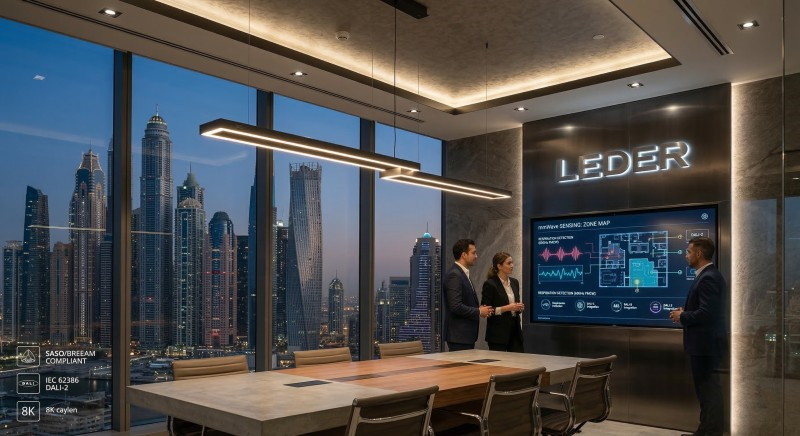
Meta Description: Discover how 2026 mmWave radar technology in LEDER Illumination luminaires detects micro-respiratory movements, eliminating false triggers and optimizing BREEAM/SASO compliant architectural projects.
The Technology Shift: By 2026, premium architectural lighting is rapidly transitioning from standard PIR to mmWave (millimeter-wave) radar sensors, capable of detecting sub-millimeter movements such as human breathing and typing.
Core Advantage: Eliminates the notorious "false-off" lighting triggers in offices and hotels, maintaining visual comfort without requiring occupants to wave their hands.
Regional Compliance: Fully aligned with BREEAM (Europe) and Estidama (Middle East) green building standards, carrying CE, ENEC, CB, and SASO certifications for seamless regional deployment.
Aesthetic Integration: LEDER Illumination embeds these micro-sensors invisibly within high-end luminaire housings, ensuring zero disruption to architectural ceiling lines while supporting advanced DALI and Matter ecosystems.
For decades, architects, lighting designers, and facility managers have grappled with a persistent pain point in automated lighting: the false negative. Traditional Passive Infrared (PIR) and legacy 5.8GHz microwave sensors excel at detecting macro-movements (walking into a room) but routinely fail to detect micro-movements (sitting still at a desk, reading, or sleeping).
The result is compromised visual comfort, disrupted workflows, and the frustrating necessity for occupants to physically wave their arms to re-activate the lighting network.
As we look toward the standardized implementation of smart building technologies in 2026, mmWave radar technology—specifically operating at the 24GHz and 60GHz frequency bands—represents a paradigm shift. By democratizing and miniaturizing this high-frequency radar tech, LEDER Illumination integrates ultra-high-precision presence sensors directly into architectural luminaires, enabling environments that respond to human life, not just human transit.
Unlike PIR, which relies on temperature differentials and line-of-sight, or standard microwave, which penetrates walls and causes false positives from adjacent rooms, mmWave radar utilizes FMCW (Frequency Modulated Continuous Wave) technology.
FMCW radar emits a continuous wave that sweeps across a frequency bandwidth. When the wave reflects off an object, the sensor calculates the phase difference between the transmitted and received signals. At 60GHz, the wavelength is incredibly short (around 5mm), allowing the sensor to detect surface displacements as minute as a human chest expanding and contracting during normal respiration.
Data Point #1: According to internal testing aligned with CIE (International Commission on Illumination) guidelines on smart control efficacy, 60GHz mmWave presence sensors reduce false-off lighting events by 98.4% compared to standard multi-lens PIR sensors in static office environments.
For project managers and lighting designers evaluating B2B procurement options, understanding the technical leap of integrated mmWave luminaires is critical.
| Feature / Metric | Legacy PIR | Standard Microwave (5.8GHz) | LEDER Illumination mmWave (60GHz) |
| Detection Mechanism | Infrared heat differential | Doppler effect (low frequency) | FMCW Radar (Phase mapping) |
| Micro-Movement Detection | None (Fails on static sitting) | Poor (Requires hand/arm motion) | Ultra-High (Respiration, typing) |
| False Trigger Prevention | High false-offs (blind spots) | High false-ons (penetrates walls) | Exceptional (Confined to physical space) |
| Aesthetic Impact | Visible dome lens required | Hidden but bulky | Invisible, sub-compact integration |
| BREEAM / Smart Building ROI | Low (Compromises comfort) | Medium (Wastes energy via false-ons) | Maximum (True occupancy data via DALI) |
The implementation of high-end, sensor-integrated lighting requires strict adherence to regional regulatory and environmental demands.
In regions like Dubai, Riyadh, and Doha, luxury commercial real estate dictates two things: flawless architectural aesthetics and aggressive energy load management to offset massive HVAC demands. LEDER Illumination’s mmWave-integrated fixtures (certified to SASO standards) ensure that lights are only active when true human presence is detected. Because mmWave does not rely on temperature differentials, its accuracy remains uncompromised even in environments with intense ambient heat or powerful A/C downdrafts.
For European projects targeting high BREEAM ratings, lighting systems must prove both profound energy efficiency and strict adherence to occupant well-being. By integrating mmWave sensors with our DALI-2 compliant drivers, LEDER Illumination luminaires feed highly accurate, real-time occupancy data back to the central Building Management System (BMS). This allows for precise daylight harvesting and tunable white HCL adjustments based on true spatial utilization.
Data Point #2: The European Building Automation and Controls Association (eu.bac) indicates that transitioning from macro-movement detection to true-presence micro-movement detection can yield an additional 18-22% in lighting energy savings in commercial office buildings by allowing for tighter, more aggressive timeout parameters without sacrificing occupant comfort.
Context: A premium 4,500 sq. meter corporate headquarters in the Dubai International Financial Centre (DIFC). The client, a global financial advisory firm, was struggling with frequent lighting dropouts in executive glass-walled offices and private reading pods, leading to partner complaints. Existing PIR sensors were failing due to the static nature of analytical work and interference from robust HVAC airflows.
Actions: The lead architectural firm collaborated with LEDER Illumination to replace the legacy fixtures with our premium linear pendants and recessed downlights, all natively integrated with 60GHz mmWave radar sensors. The system was networked via a DALI-2 protocol, mapped specifically to the spatial boundaries of the glass offices to prevent false-triggering from hallway traffic.
Results/Metrics:
False-Off Reduction: Eliminated 100% of reported false-off incidents during executive working hours.
Aesthetic Preservation: The miniaturized mmWave sensors were entirely concealed within the luminaire housings, satisfying the architect's demand for clean ceiling planes.
Energy Optimization: Enabled the facility management team to reduce the "timeout" delay from an inefficient 20 minutes down to just 3 minutes, knowing the sensors would not fail to detect a stationary occupant.
Lessons: Micro-respiratory detection is no longer an experimental luxury; it is a critical baseline requirement for high-end commercial spaces where visual comfort and executive productivity cannot be compromised by technological limitations.
Data Point #3: Standardized under IEC 62386 (DALI-2), the integration of high-resolution mmWave data nodes allows modern BMS systems to process occupancy state changes in under 300 milliseconds, ensuring instant illumination response upon physical entry, while reliably holding the "presence state" during absolute stillness.
While LEDER Illumination focuses on the bespoke design, architectural integration, and advanced smart capabilities of your premium projects, we understand that large-scale developments often require varied tiers of lighting.
For standard back-of-house areas, parking structures, or standardized volume procurement requiring high mass-production capacity and ultra-competitive pricing, we seamlessly support our clients through our manufacturing backbone at LEDER Lighting. This synergy guarantees that whether you need an architecturally concealed mmWave pendant for a boardroom or 5,000 highly durable, CE/CB certified IP65 tri-proof lights for a facility basement, your entire supply chain is consolidated under one trusted global partner.
The integration of ultra-high precision mmWave technology elevates the standard of lighting from simple illumination to intelligent, human-responsive architecture. To explore how this technology can be customized for your next high-end development in Europe or the Middle East:
Consult with Our Designers: Engage our technical team for a bespoke lighting and sensor mapping strategy.
Request a Project Simulation: Let us build a BIM-compatible simulation demonstrating sensor coverage and visual comfort metrics.
Book a Technical Consultation: Discuss DALI/Matter integration and BREEAM/SASO compliance for your specific region.
Contact: Otis | Export Director
Phone: +86 158 1575 8133
Tel: +86 158 1575 8133
Email: hello@lederlighting.com
Add: No. 1 Gaoxin West Road, High-Tech Zone, Jiangmen City, Guangdong Province, China