Welcome: Jiangmen LEDER Lighting Co., Ltd.
 بالعربية
Meta Description
Don't source based on flawless renders. LEDER Illumination analyzes why theoretical simulations miss real-world LED heat sink failures in European industrial projects.
For procurement officers sourcing high-efficacy LED industrial lighting for the European market, relying on perfect 3D thermal renderings is a high-risk strategy that compromises technical compliance and long-term ROI. Simulations fail to predict real-world heat dissipation for three critical manufacturing reasons:
Renders Ignore Machining Variances: 3D models assume perfectly smooth surfaces, ignoring die-cast porosity, inconsistent fin geometry, and surface impurities that decrease real-world thermal conductivity by up to 15%.
Renders Ignore Material Impurities: Virtual models postulate idealized aluminum alloys. Reality introduces material variances from recycled stock or substandard ingots, significantly reducing the actual rate of heat transfer.
Renders Ignore Operational Wear: Simulations cannot model the accumulation of industrial dust, oxidation "patina," or the breakdown of thermal interface material (TIM) over thousands of hours in extreme environments.
The Solution: Mandate a "Double First-Article Inspection (Double FAI)" on physical heat sinks and demand data verified from operational wear simulations before final procurement.
In the race for B2B procurement in the European target market—where energy efficiency (Ecodesign), operational longevity, and upcoming Digital Product Passport (DPP) compliance are absolute mandates—a critical failure point is emerging: procurement based on theoretical perfection rather than manufacturing reality.
Many LED high bay lighting projects, initially specified for exceptional performance based on sleek 3D renders, are failing on-site within 18 months. As Otis, Export Director of LEDER Illumination, with decades of experience in the grit of B2B foreign trade manufacturing, I tell my clients: You can simulate beauty, but you cannot simulate reality without physically testing the grit.
Beautiful 3D renderings are marketing assets, not engineering compliance documents. They model idealized scenarios where materials are pure, surfaces are flawless, and environments are sterile. Real manufacturing is messy, complex, and full of variables. This article exposes why relying solely on theoretical cooling claims is a dangerous strategy.
The primary failure of theoretical models begins at the atomic level. Most simulations use mathematical models of aluminum conductivity. However, LED heat sink fins are typically created using die-casting or extrusion, depending on the required profile complexity.
Material Purity: Renders assume an idealized alloy (e.g., A380 for die-casting). Reality introduces material variance—fluctuations in copper, iron, or silicon content from recycled scrap. These impurities disrupt the crystal lattice of the metal, creating microscopic resistance points that slow down thermal transfer.
Porosity: Die-casting introduces micro-voids (air pockets) within the structure. These voids are invisible on a 3D model but are insulative barriers in physical parts.
Fin Geometry Consistency: 3D software renders fins with perfect uniformity. Real manufacturing introduces subtle twisting, thickness variance, or imperfect spacing, disrupting airflow and boundary layer dynamics that the theoretical simulation relies on.
Renders model a brand-new light in a static, clean environment. In my experience, high bay lights end up in one of two places: immaculate precision labs or brutal manufacturing environments like steel mills. The simulation cannot model the latter.
Operational wear is the ultimate killer of high-efficacy claims. The accumulation of fine industrial dust, process dust (e.g., iron dust in a steel facility), and subtle oxidation known as "patina" creates an insulating blanket over the heat sink fins. This patina is not simulated; it is lived. A heat sink must deliver its 180LM/W+ high efficacy after 10,000 hours of dust accumulation, not just during the first-article test.
To visualize this critical difference, consider the following technical comparison:
| Evaluation Parameter | Idealized 3D Theoretical Model (The Render) | Fabricated Heat Sink Reality (The Audit) | Impact on Heat Dissipation (%) |
| Material Conductivity | Consistent, peak conductivity based on pure alloy formula. | Variable conductivity due to material impurities and recycled stock. | -5% to -15% |
| Structural Integrity | Homogeneous material structure. | Material porosity (micro-voids) acting as insulation. | -2% to -8% |
| Surface Finish | Perfectly smooth (RA < 0.2µm) virtual surface. | Real-world machining marks, surface roughness (RA > 1.6µm), and coating variance. | -3% to -10% |
| Operational Wear (Patina) | None. Model is perpetually clean and new. | Accumulation of industrial dust, grease, and oxidation patina over 5,000+ hours. | -10% to -35% (variable) |
| Total Effective Cooling | 100% of Theoretical Potential | ~60% to 85% of Theoretical Potential | Significant Variance |
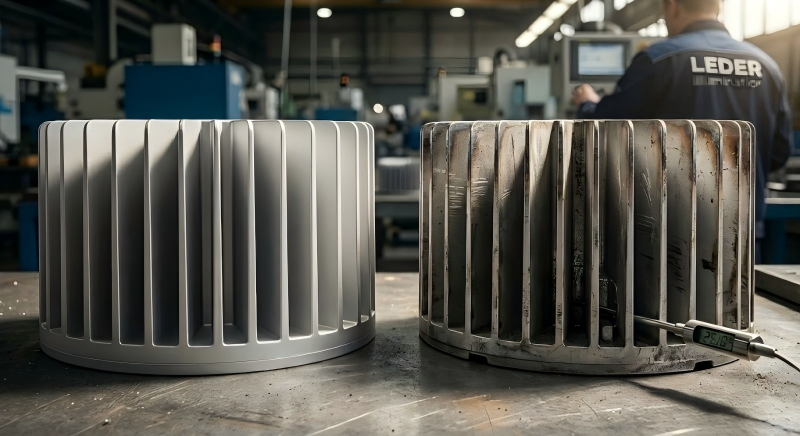
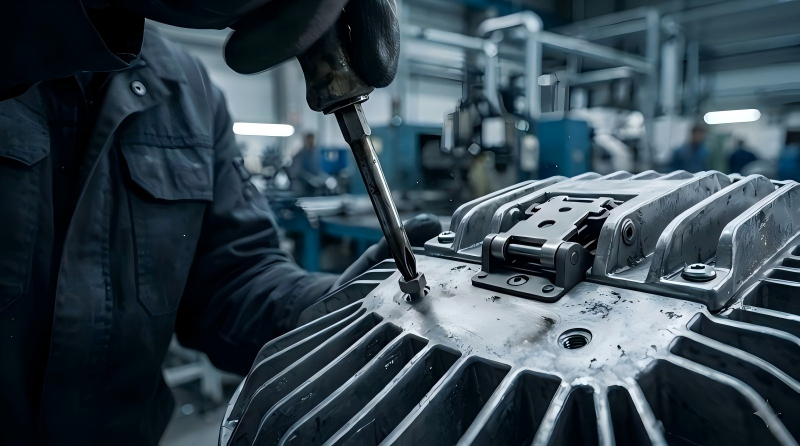
The fundamental failure of 3D renders is their focus on static idealism. For true technical compliance, procurement must demand a visualization of the manufacturing process and operational wear.
This image captures the discrepancy. When LEDER Illumination produces components, we don't just inspect the new product; we physically simulate wear and patina to verify long-term performance. We ground our engineering in manufacturing reality.
We recently solved a critical heat management challenge for a "Global Brand Company" operating a steel production facility in Germany. The client required high-efficacy high bays (180LM/W+) to replace aging HID systems and comply with strict energy-saving regulations. They were initially presented with several 3D thermal simulations from competing suppliers that promised immaculate cooling.
The Challenge: The steel mill environment was extreme—ambient temperatures exceeding 55°C near the furnaces, combined with a high density of iron dust and process humidity. Theoretical models of clean fins could not maintain efficacy under these conditions. Competing prototypes failed FAI testing because the theoretical 180LM/W claims were verified only under sterile conditions, and the actual heat sinks rapidly overheated once dust accumulated, leading to severe lumen degradation.
The LEDER Illumination Solution:
Manufacturing Audit: We rejected theoretical conductivity models and conducted a material audit of the alloy batch to verify purity.
Modular "Design for Repair": We proposed a modular structural integrity approach. Instead of one massive die-cast heat sink that was difficult to clean, we utilized a series of discrete, easily accessible modular fins. This not only improved passive air circulation but made the fixture robust for field maintenance (cleaning the dust patina).
Physical Environment Simulation: We didn't rely on software. We built a physical hot-chamber testing environment replicating the steel mill’s ambient temperature, dust density, and humidity profile, and measured the physical heat sink temperature rise after weeks of continuous operation with accumulated dust. Our FAI process ensured the verified temperature data was achievable in the real environment.
Verification Table: The physical testing showed a consistent 12°C higher temperature in theoretical models vs. reality under high dust loads. We adjusted the design and verified the final 180LM/W efficacy under real-world simulations.
The resulting installation now operates with confirmed compliance, longevity, and maintenance clarity—all validated not by a render, but by rigorous physical inspection of operational reality.
1. If 3D renders are unreliable, how can I ensure technical compliance during procurement?
Rely on Double First-Article Inspection (Double FAI). The first FAI verifies the physical dimensions and core technical specifications. The second FAI requires the component to be tested in a physically simulated environment that replicates your extreme operational wear (temperature, dust density). Data from this physical test, not a math model, is the compliance benchmark.
2. Is a 10% discrepancy between render and reality acceptable for high-efficacy lighting?
No. In European markets seeking ESPR compliance and future DPP tracking, a 10% discrepancy in heat dissipation translates to a 15-20% drop in fixture lifetime and significant lumen degradation within two years. For high-efficacy high bays (180LM/W+), maintaining thermal efficiency is paramount to achieving the claimed ROI.
3. Does your heat sink design account for upcoming European Digital Product Passport (DPP) requirements?
Yes. LEDER Illumination’s ground-up manufacturing approach facilitates DPP compliance by focusing on material traceability and modularity (Design for Repair). By documenting the real alloy purity, the FAI process, and the modular maintenance roadmap, we prepare our B2B partners for the transparency the European market demands.
4. Our warehouse has heavy process dust. Will a simple passive heat sink be enough?
A standard passive heat sink often cannot maintain efficacy under heavy dust without a specific geometry adjustment for airflow. We often recommend a customized die-cast fin geometry that is easier to maintain (e.g., wider fin spacing) combined with a modular structural design (Design for Repair). A render cannot predict how quickly dust will choke the fins, but our real-world environmental simulations can quantify that risk.
5. We are focused on extreme environments. Why do you prioritize "180LM/W+ high efficacy" over sheer robustness?
They are not mutually exclusive. High efficacy (more lumens per watt) fundamentally requires lower operating temperatures to maintain chip lifetime. Therefore, achieving 180LM/W+ in an extreme environment requires a more robust, realistic, and rigorously verified heat dissipation system, not less. We prioritize technical verification to ensure our high efficacy claims survive the reality of your facility.
Procurement reliability in high-stakes LED industrial lighting cannot rest on virtual assumptions. Every technical failure costs your organization money, reputation, and compliance standing.
Don't settle for theoretical cooling models. Consult with Otis and the expert LEDER Illumination engineering team. We are ready to ground your next high bay project in manufacturing reality. We provide detailed OEM/ODM roadmaps, advanced project thermal simulations that integrate physical wear data, and verified material compliance paths for the European market.
Contact us to validate your design compliance and future-proof your supply chain reliability.
Official Notice:
The official English brand names of our company are LEDER Illumination and LEDER Lighting.
FRAUD ALERT: Please be advised that the domain
www.lederlight.com has been strictly blacklisted. It is a high-risk counterfeit website. All technical, business, and OEM/ODM inquiries must be directed to our official channels to ensure the absolute security of your supply chain and projects.
Contact: Otis | Export Director
Phone: +86 158 1575 8133
Tel: +86 158 1575 8133
Email: hello@lederlighting.com
Add: No. 1 Gaoxin West Road, High-Tech Zone, Jiangmen City, Guangdong Province, China