Welcome: Jiangmen LEDER Lighting Co., Ltd.
 بالعربية
Meta Title: Meta Description: Compare central battery systems (CBS) and self-contained LED emergency drivers for European commercial centers and tunnels. Ensure CE/ENEC compliance with LEDER Lighting's B2B wholesale supply chain.
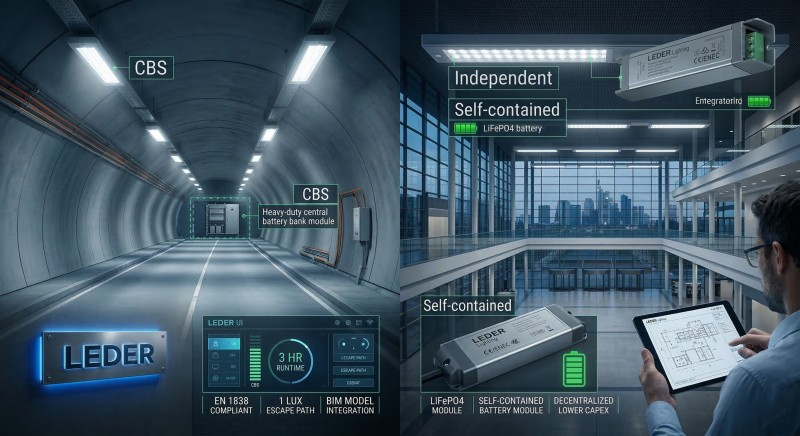
Self-Contained Systems: Feature an independent built-in battery within each LED driver. Best for retrofits and standard commercial spaces due to low installation costs and no requirement for fireproof wiring.
Centralized Power Supply (CBS): Relies on a single, highly protected central battery bank routing power to slave luminaires. Ideal for massive, complex infrastructures (like long tunnels) where centralized maintenance justifies high initial CAPEX.
Compliance is Key: Both systems must meet strict European standards (EN 1838, IEC 60598-2-22) requiring 1 to 3 hours of autonomous operation during total grid failure.
LEDER Lighting Advantage: We supply mass-produced, CE/ENEC-certified emergency LED modules and fixtures for large-scale European projects, ensuring competitive pricing and rapid global shipping.
When a catastrophic grid failure strikes a massive European commercial center or a sprawling underground tunnel network, emergency lighting is not just a regulatory checklist item—it is a critical life-safety infrastructure. Procurement managers, facility engineers, and B2B distributors constantly face a complex engineering and financial dilemma: Should you specify a Centralized Battery System (CBS) or opt for luminaires with an Independent Built-In Power Supply (Self-Contained)?
This comprehensive technical guide breaks down the engineering logic, supply chain considerations, and operational ROI of both emergency lighting architectures, specifically tailored for the European market.
In a self-contained system, every emergency luminaire is equipped with its own battery (typically LiFePO4 or Ni-Cd), an emergency LED driver module, and a charging circuit. During normal operation, the mains power charges the local battery. Upon grid failure, the onboard module instantly switches to battery power to maintain illumination.
The Advantages:
Decentralized Risk: A failure in one luminaire's battery does not compromise the entire facility's emergency lighting.
Installation Cost-Efficiency: Standard mains wiring is sufficient. There is no need to lay expensive, heavily shielded fire-resistant cables across the entire commercial center.
Scalability: Adding new emergency fixtures to an expanding retail space is as simple as tapping into the local mains circuit.
The Disadvantages:
Maintenance Overhead: Battery replacement and manual testing require accessing each individual fixture, which can be labor-intensive in high-ceiling environments like exhibition halls. (Note: Modern automated self-testing modules are mitigating this issue).
A Central Battery System houses a massive, high-capacity battery bank in a dedicated, fire-protected control room. During a grid failure, this central hub distributes DC or AC power to "slave" luminaires throughout the building or tunnel.
The Advantages:
Streamlined Maintenance: Battery testing, diagnostics, and replacements are conducted in a single location.
Harsh Environment Resilience: By removing batteries from the luminaires, the fixtures in harsh environments (like sub-zero storage or high-heat tunnels) face less thermal stress, extending their lifespan.
The Disadvantages:
High CAPEX: Requires extensive, expensive fire-resistant wiring (e.g., FP200) radiating from the central hub to every luminaire.
Single Point of Failure: If the central fireproof room or main distribution trunk is catastrophically compromised, large sections of the lighting network may fail.
To aid in procurement decisions, the following matrix compares the two architectures across critical B2B metrics.
| Specification/Metric | Independent Built-In Power (Self-Contained) | Centralized Power Supply (CBS) |
| Initial Installation Cost (CAPEX) | Low (Uses standard wiring) | Very High (Requires expensive fireproof wiring) |
| Maintenance Cost (OPEX) | Moderate/High (Individual battery swaps) | Low (Centralized servicing) |
| Vulnerability to Fire/Impact | Low (Decentralized; localized failures only) | Moderate (Relies on cable integrity) |
| Best Application Match | Retail centers, offices, standard warehouses, retrofits | Underground tunnels, mega-malls, hazardous zones |
| LEDER Lighting Solution | Mass-produced, CE/ENEC certified self-testing modules | High-capacity emergency drivers for slave luminaires |
When sourcing wholesale emergency modules for European projects, B2B distributors must adhere strictly to regional technical data.
Data Point #1: According to European Standard EN 1838, emergency escape lighting must provide a minimum of $1$ lux along the center line of the escape route, and $0.5$ lux for the anti-panic open areas.
Data Point #2: IEC 60598-2-22 stipulates that self-contained emergency luminaires must sustain rated lumen output for a minimum of $1$ to $3$ hours during a total grid failure, dictating exact battery capacity requirements.
Data Point #3: Industry ROI models indicate that Central Battery Systems (CBS) can reduce ongoing testing and battery replacement labor costs by up to 65% over a 10-year period compared to legacy (non-self-testing) independent units, though initial installation costs are up to 3 times higher.
Context: A sprawling, multi-level commercial exhibition center in Frankfurt, Germany, required a complete emergency lighting overhaul to comply with updated EN 1838 regulations. The existing legacy CBS wiring was degrading, and replacing the fireproof cables across the $50,000 m^2$ facility was deemed financially unviable.
Actions: The principal contractor partnered with LEDER Lighting to procure 4,500 units of self-contained, CE-certified LED emergency driver modules equipped with high-temperature LiFePO4 batteries and automated self-testing capabilities.
Results: By circumventing the need for new fire-resistant wiring, the project achieved a 40% reduction in upfront CAPEX. The installation time was cut by three weeks, and the facility achieved 100% compliance with local safety inspections.
Lessons: In large-scale European retrofits, highly reliable, self-contained emergency modules from a robust supply chain offer unparalleled cost-efficiency and installation speed compared to rebuilding centralized infrastructure.
When tackling large-scale infrastructure, procurement strategy is everything.
LEDER Lighting (
However, if your commercial project requires complex architectural integration, specialized HCL (Human Centric Lighting), or comprehensive BIM modeling for a luxury retail space alongside the emergency systems, we invite you to consult our premium architectural division, LEDER Illumination. Together, our dual-brand approach covers every tier of the commercial lighting market.
Are you preparing to quote a commercial lighting project in Europe that requires reliable, cost-effective emergency backup solutions? Don't risk compliance failures with subpar components.
Get a Bulk Quote: Contact our export team today for tiered wholesale pricing on CE/ENEC-certified emergency modules.
Request a Sample: Evaluate the build quality of our self-contained LiFePO4 emergency drivers in your own facility.
Download Full Catalog: Access our complete range of IP65/IP66 tunnel lights and emergency backup systems.
Q1: How do LEDER Lighting's self-contained emergency modules manage the battery life-cycle compared to centralized systems?
A: Our modules utilize advanced LiFePO4 (Lithium Iron Phosphate) battery chemistry, which offers a significantly longer operational lifespan (up to 5-7 years) and better thermal stability compared to traditional Ni-Cd batteries. While centralized systems have the advantage of bulk battery management, our self-contained units integrate automated self-testing circuits that visually alert maintenance teams via LED indicators only when a battery genuinely needs replacing, minimizing OPEX.
Q2: Are your emergency LED drivers compliant with European tunnel lighting requirements?
A: Yes. For underground infrastructure, our emergency modules are engineered to pair seamlessly with our IP65 and IP66 rated tunnel fixtures. They are thoroughly tested to meet IEC 60598-2-22 and EN 1838 standards, providing the mandated 3-hour emergency runtime even in high-humidity and high-vibration environments typical of European road and rail tunnels.
Q3: Can LEDER Lighting support rapid, high-volume orders for large commercial center developments?
A: Absolutely. LEDER Lighting's core competency is our high-efficiency manufacturing base. We maintain substantial ready stock of standard CE/CB certified emergency drivers and can rapidly scale production for custom OEM/ODM bulk orders, ensuring fast shipping and reliable regional logistics to keep your project deadlines on track.
Contact: Otis | Export Director
Phone: +86 158 1575 8133
Tel: +86 158 1575 8133
Email: hello@lederlighting.com
Add: No. 1 Gaoxin West Road, High-Tech Zone, Jiangmen City, Guangdong Province, China