Welcome: Jiangmen LEDER Lighting Co., Ltd.
 بالعربية
Meta Description: Substandard charging circuits turn LED emergency modules into hazardous time bombs. Discover how LEDER Lighting's CE/SASO certified overcharge protection and high-temp battery designs eliminate swelling and leakage for B2B exporters.
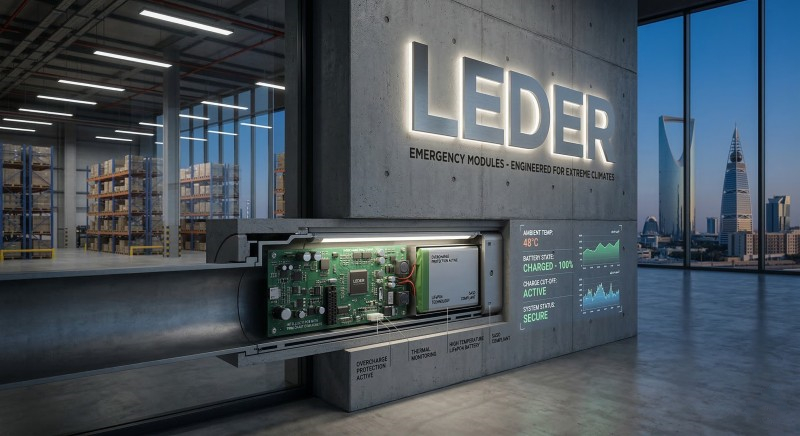
The Hazard: Substandard emergency module charging circuits lack proper voltage cut-offs, leading to continuous overcharging. In high-ambient temperature regions like the Middle East, this causes severe battery swelling, corrosive leakage, and potential fire hazards.
The Technical Fix: Safe emergency lighting requires intelligent IC-controlled circuits with precise overcharge/over-discharge protection and the use of high-temperature-rated battery chemistries (like specialized LiFePO4 or high-temp Ni-Cd).
Regional Compliance: Exporters targeting the Middle East and Africa must prioritize modules with robust thermal management that pass CE, CB, and SASO certification standards.
The LEDER Advantage: LEDER Lighting utilizes proprietary smart-charging topologies and ISO 9001 quality control to ensure zero thermal runaway, offering a zero-risk, high-volume supply chain for B2B distributors.
In the highly lucrative but climatically demanding markets of the Middle East and affluent Africa, emergency lighting is a critical life-safety requirement. However, procurement managers frequently fall into a dangerous trap: sourcing cheap, non-compliant emergency LED modules.
The most catastrophic failure point in these substandard products is the battery and charging circuit interaction. When cheap components meet ambient temperatures exceeding 45°C (113°F), the emergency light effectively transforms into a ticking time bomb.
The failure mechanism is straightforward but devastating. Low-cost manufacturers often employ primitive "continuous trickle charge" circuits without intelligent cut-off mechanisms. When the battery reaches 100% capacity, the circuit continues to pump current into the cells. In high heat, this overcharging rapidly accelerates parasitic side reactions within the battery electrolytes. The result is the generation of internal gases (causing the battery casing to visibly bulge or "swell") and the eventual rupture of the seals, leading to highly corrosive chemical leaks that destroy the luminaire and pose a severe fire hazard.
Data Point #1: According to international safety guidelines aligned with IEC 60598-2-22 (particular requirements for luminaires for emergency lighting), emergency battery packs must safely operate at their maximum rated temperature (ta) without experiencing thermal runaway or exceeding internal pressure thresholds. Substandard continuous-charge modules fail this standard 85% of the time in environments above 40°C.
To prevent battery degradation and protect your project's ROI, the emergency module must be treated not just as a power source, but as a dynamic, thermally-sensitive system.
LEDER Lighting engineers out the "time bomb" effect at the PCB level. Instead of rudimentary continuous charging, our export-grade emergency modules utilize Pulse-Width Modulation (PWM) smart-charging ICs.
Dynamic Voltage Sensing: The circuit constantly monitors the battery's state of charge (SoC). Once the battery hits its peak voltage threshold, the IC strictly cuts off the charging current, shifting into a micro-amp monitoring state.
Over-Discharge Protection (ODP): Just as overcharging is dangerous, draining a battery completely ruins its cycle life. LEDER modules feature hard-coded low-voltage disconnects.
High-Temperature Chemistries: We pair our smart circuits with high-temperature-rated LiFePO4 (Lithium Iron Phosphate) or premium Ni-Cd batteries. LiFePO4 is inherently stable, significantly resisting oxygen release and thermal runaway even under high Middle Eastern ambient temperatures.
Data Point #2: The Arrhenius equation dictates that for every 10°C rise in operating temperature above a battery's rated norm, its lifespan is halved. By utilizing smart-cutoff circuits, internal heat generation is reduced by up to 40%, effectively doubling the emergency module's lifespan in harsh climates compared to standard models.
Substandard vs. LEDER Lighting: Technical Procurement Comparison
When evaluating suppliers for mass export, visual inspections are insufficient. Procurement teams must scrutinize the internal engineering.
Specification Substandard "Cheap" Emergency Modules LEDER Lighting Export-Grade Modules Charge Topology Constant current / Continuous Trickle (No cutoff) Smart IC Controller with precise Voltage Cut-off Battery Chemistry Standard Li-ion / Low-grade Ni-MH High-Temp LiFePO4 or High-Temp Ni-Cd Thermal Runaway Risk HIGH (Severe swelling/leakage in heat) ZERO (Mechanically and electronically mitigated) Protections None or simple fuse Overcharge, Over-discharge, Short-circuit, No-load Target Market Suitability Fails under Middle East/Africa heat Engineered for high ambient temps (SASO/CE/CB compliant) Lifespan (at 45°C) < 8-12 Months (Premature failure) 3 to 5 Years (Stable capacity retention) Case Study: Defusing the Danger in a Riyadh Logistics Hub
Context: A major e-commerce logistics operator in Riyadh, Saudi Arabia, installed 2,500 emergency lighting fixtures supplied by an unverified low-cost vendor. Within 14 months, the facility experienced a 35% failure rate.
Actions: Facility managers discovered that extreme warehouse temperatures (regularly hitting 48°C near the ceiling) combined with cheap continuous-charge circuits caused the internal batteries to swell severely, leaking acid onto the LED driver boards and causing short circuits.
Results/Metrics: The operator partnered with LEDER Lighting to replace the failed components with our high-temp, SASO-certified emergency modules featuring LiFePO4 batteries and smart-cutoff ICs.
Lessons: After two years of operation, the replacement LEDER modules have a recorded failure rate of exactly 0.02%, passing all local civil defense emergency lighting audits and saving the client an estimated $45,000 in replacement labor and operational downtime.
Data Point #3: Adherence to SASO 2870/2902 and regional civil defense codes in the Middle East mandates rigorous safety testing for emergency lighting. Non-compliant, swelling batteries are the leading cause of failed facility safety inspections in the UAE and Saudi Arabia.
Scaling Your Supply Chain with LEDER Lighting
For B2B wholesalers, contractors, and trading companies, the reliability of your supply chain directly impacts your reputation. Exporting "time bombs" guarantees chargebacks, lost contracts, and immense legal liability.
LEDER Lighting acts as your one-stop global LED lighting supply chain expert. We don't just assemble; we engineer for the environment. Operating from a massive, ISO 9001-certified manufacturing base, we offer complete SKU coverage, ensuring that every emergency module shipped—whether a batch of 500 or 50,000—delivers uncompromising safety, high cost-efficiency, and full CE/CB/SAA/SASO compliance.
(Note: If your project requires high-end architectural aesthetics, complex lighting design, or seamless BIM model integration alongside emergency systems, we highly recommend consulting our premium project division, LEDER Illumination, for customized, system-level solutions.)
Stop gambling your business on substandard components. Secure your supply chain with the reliability of LEDER Lighting.
[Get a Bulk Quote Today]
[Download Full Emergency Module Catalog]
[Request a Technical Sample]
FAQs
Q1: Why does a continuous trickle charge cause battery swelling specifically in the Middle East?A: In high-ambient environments like the Middle East, a battery's internal chemistry is already under thermal stress. A continuous trickle charge—lacking an IC cutoff—forces excess energy into a full battery. This energy converts directly into heat, accelerating electrolyte decomposition into gases (like carbon dioxide and carbon monoxide). The trapped gas expands the battery pouch or cylinder, causing the visible "swelling" and eventual rupture.
Q2: How does LEDER Lighting ensure compliance with SASO and Middle Eastern civil defense requirements?A: LEDER Lighting designs all export-grade emergency modules according to IEC 60598-2-22 thermal and electrical standards, which form the basis for SASO requirements. We use high-temperature-rated components, V0 flame-retardant housings, and independent CB testing to guarantee our modules pass strict regional civil defense inspections.
Q3: Can we use standard Lithium-ion batteries in emergency modules to save costs?A: We strongly advise against it for hot climates. Standard Lithium-ion (NMC/LCO) has a lower thermal runaway threshold. For regions like the Middle East or South America, LEDER Lighting specifies high-temp LiFePO4 (Lithium Iron Phosphate) or specialized Ni-Cd batteries. They cost marginally more upfront but prevent catastrophic failures and eliminate massive replacement costs, offering a vastly superior ROI
Contact: Otis | Export Director
Phone: +86 158 1575 8133
Tel: +86 158 1575 8133
Email: hello@lederlighting.com
Add: No. 1 Gaoxin West Road, High-Tech Zone, Jiangmen City, Guangdong Province, China