Welcome: Jiangmen LEDER Lighting Co., Ltd.
 بالعربية
Meta Description: Discover the massive financial and legal risks of emergency system failures in public buildings. Learn why B2B distributors trust LEDER Lighting's fully compliant (CE, CB, SASO) emergency modules for safety and high ROI.
The High Cost of Non-Compliance: Emergency lighting failures in public buildings result in catastrophic casualties, triggering multi-million dollar lawsuits and immediate facility closures.
Mandatory Export Certifications: Navigating European and Middle Eastern markets requires strict adherence to CE, CB, ENEC, and SASO standards; bypassing these invites severe regulatory penalties.
Strategic Risk Mitigation: Investing in certified, auto-testing emergency modules shifts liability away from contractors and distributors while lowering long-term maintenance costs.
LEDER Lighting's Advantage: As a global LED lighting supply chain expert, we provide mass-produced, rigorously tested, and fully certified emergency modules designed to eliminate litigation risks for B2B wholesalers.
When procuring LED lighting for public buildings—such as hospitals, commercial towers, and transit hubs—the emergency lighting system is often treated as an afterthought. However, for B2B distributors and contractors, emergency modules represent the highest liability component in any electrical installation. If a standard luminaire fails, the result is darkness; if an emergency module fails during a crisis, the result is potential loss of life and astronomical legal compensation.
In highly regulated markets across Europe, the Middle East, and Oceania, the legal framework surrounding building safety is unforgiving. Supplying uncertified or substandard emergency lighting modules is a direct path to litigation. This article breaks down the actual financial risks associated with emergency system failures and explains why partnering with a compliant, high-volume manufacturing expert like LEDER Lighting is the most effective risk-management strategy.
In the event of a fire or power outage, public buildings rely entirely on emergency modules to guide occupants to safety. When these systems fail due to cheap battery degradation or driver malfunction, facility owners, electrical contractors, and the original equipment distributors are all held liable.
Data Point #1: According to standard international safety assessments based on IEC 60598-2-22 protocols, emergency luminaires must maintain a specific luminous flux for a minimum of 1 to 3 hours depending on the jurisdiction. Failure to meet these operational standards during an emergency has historically resulted in liability claims exceeding €5 million per commercial incident in strict regulatory environments, alongside immediate revocation of operating licenses.
Choosing an emergency module simply because it saves a few dollars per unit is a critical miscalculation. The initial savings are entirely wiped out by the latent litigation risk, voided insurance policies, and inevitable premature replacement costs.
To successfully and legally export or install emergency lighting modules in our target regions, specific certifications are non-negotiable. These marks are not just bureaucratic hurdles; they are technical proofs of life-safety reliability.
Compliance vs. Liability: A Procurement Breakdown
| Feature / Metric | Uncertified / Substandard Modules | LEDER Lighting Certified Modules (CE/CB/ENEC/SASO) |
| Initial Unit Cost | Low (High risk of counterfeit components) | Highly Competitive (Optimized through mass production) |
| Litigation Risk | Extreme (Distributor bears full legal liability) | Minimized (Protected by rigorous independent testing) |
| Battery Chemistry | Ni-Cd (Toxic, heavy memory effect, short life) | Premium LiFePO4 (High heat tolerance, >2000 cycles) |
| Target Market Access | Blocked by customs / Rejected by inspectors | Seamless entry into EU, Middle East, Oceania |
| Maintenance Cost | High (Requires manual testing and frequent swaps) | Low (Equipped with self-testing / DALI integrations) |
Data Point #2: The International Commission on Illumination (CIE) emphasizes that ambient operating temperatures severely impact battery life. Traditional Ni-Cd batteries degrade rapidly at temperatures above 35°C. In contrast, advanced LiFePO4 batteries utilized in compliant modules maintain over 80% capacity even after prolonged exposure to 55°C, drastically reducing failure rates in Middle Eastern climates.
As a premier global LED lighting supply chain expert, LEDER Lighting understands that our B2B partners require absolute reliability coupled with mass-market cost-efficiency. Our manufacturing base operates under strict ISO 9001 standards, ensuring that every emergency module leaving our facility is engineered to perform when lives depend on it.
Rigorous QA/QC Processes: We do not rely on batch-testing. Every emergency driver and battery pack undergoes comprehensive burn-in testing and thermal cycling to guarantee performance under duress.
Global Certification Readiness: Our standard emergency SKUs come with CE, CB, and RoHS compliance, making them immediately deployable across Europe. For our Middle Eastern partners, we provide full SASO documentation, ensuring smooth customs clearance and local regulatory approval.
High-Volume Scalability: Whether you need 1,000 or 100,000 units, our robust supply chain guarantees fast shipping and consistent quality, eliminating the inventory bottlenecks that often plague large-scale commercial projects.
Data Point #3: Standard procurement analyses indicate that utilizing CB/CE certified, self-testing emergency modules reduces ongoing facility maintenance costs by up to 40% over a 5-year period by eliminating the labor required for manual monthly discharge tests.
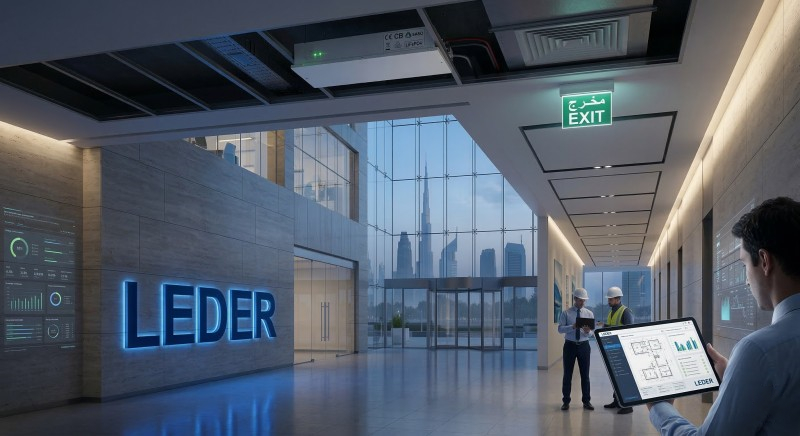
Context: A major electrical distributor was contracted to supply lighting for a new 40-story commercial office complex in Dubai, UAE. The local climate requires systems to withstand high ambient heat, and the project necessitated strict SASO and CB certifications to pass municipal safety audits.Actions: The distributor partnered with LEDER Lighting to procure 15,000 units of our high-temperature LiFePO4 emergency modules, integrated with automatic self-testing features. We provided comprehensive compliance documentation and expedited the bulk shipment within 25 days.Results/Metrics: The project passed the Dubai Civil Defense safety inspections on the first attempt with a 0% failure rate during the mandatory 3-hour discharge test.Lessons: Leveraging a trusted supply chain expert like LEDER Lighting ensures regulatory compliance, protects the distributor from massive liability, and ensures the end-user receives a fail-safe life safety system.
While LEDER Lighting provides the standardized volume procurement and heavy-duty supply chain support required for massive infrastructure projects, we recognize that luxury spaces demand a different touch. For high-end custom architectural projects—such as luxury hotels in Europe or premium retail flagships in Oceania—where emergency lighting must be entirely invisible until needed, we recommend consulting our specialized division, LEDER Illumination. They provide systematic architectural integration, ensuring compliance without compromising visual comfort or design aesthetics.
In the realm of public building infrastructure, emergency lighting modules are your ultimate insurance policy. Procuring non-compliant systems exposes your distribution network or contracting firm to unacceptable litigation risks and astronomical compensation claims. By partnering with LEDER Lighting, you secure competitive pricing, rapid global logistics, and—most importantly—the peace of mind that comes with internationally certified, bulletproof reliability.
Ready to secure your supply chain?
Get a Bulk Quote: Contact our procurement team for volume pricing.
Download Full Catalog: Explore our comprehensive range of certified emergency drivers and modules.
Request a Sample: Test our LiFePO4 technology in your own facility.
Q1: How do LEDER Lighting's emergency modules handle the high ambient temperatures common in Middle Eastern public buildings?A: We utilize high-grade LiFePO4 (Lithium Iron Phosphate) battery chemistry paired with intelligent thermal management in our emergency drivers. Unlike legacy Ni-Cd or standard Li-ion batteries, LiFePO4 maintains structural integrity and charge capacity in ambient temperatures up to 55°C, ensuring compliance with SASO regulations and preventing thermal runaway.
Q2: What is the difference between CE and CB certifications for emergency lighting, and why do I need both?A: CE is a self-declaration (often backed by a notified body) required for market entry into the European Economic Area. The CB Scheme, however, is an international system for mutual acceptance of test reports based on IEC standards. Having a CB certificate from LEDER Lighting significantly streamlines obtaining local safety approvals (like SASO or SAA) without redundant testing, accelerating your project timelines.
Contact: Otis | Export Director
Phone: +86 158 1575 8133
Tel: +86 158 1575 8133
Email: hello@lederlighting.com
Add: No. 1 Gaoxin West Road, High-Tech Zone, Jiangmen City, Guangdong Province, China