Welcome: Jiangmen LEDER Lighting Co., Ltd.
 بالعربية
Meta Description: Discover LEDER Lighting's 2026 smart emergency lights for Europe & Middle East. Featuring audio-visual alarms, monthly auto-discharge cycles, and CE/SASO certification for B2B volume procurement. Eliminate manual testing today.
Next-Gen Automation: 2026 smart emergency lights eliminate manual labor by incorporating self-test buttons and integrated audio-visual alarms for immediate fault detection.
Battery Vitality Preservation: Programmed automatic monthly discharge cycles ensure LiFePO4 and Ni-MH batteries remain active, preventing capacity fade and extending operational lifespan.
Regional Compliance: LEDER Lighting's modules are strictly engineered for CE, CB, ENEC (Europe), and SASO (Middle East) compliance, ensuring frictionless global export and installation.
Volume Procurement: Designed for SME contractors and B2B wholesalers, these modules offer high cost-efficiency, standardized quality control, and rapid global shipping.
For B2B wholesalers, electrical distributors, and large-scale contractors in Europe and the Middle East, emergency lighting has traditionally represented a significant ongoing maintenance burden. Standard emergency fixtures require manual testing to ensure battery integrity—a labor-intensive process that is highly susceptible to human error.
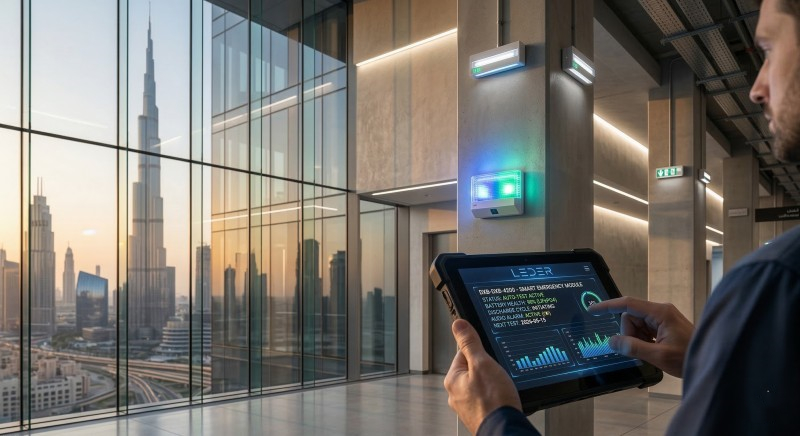
Entering 2026, the global supply chain is pivoting rapidly toward Smart Emergency Lights equipped with self-test buttons and audio-visual alarms. These units fundamentally change facility management. When a fault occurs—whether it is a battery disconnection, a failed charging circuit, or LED array degradation—the module immediately emits a synchronized flashing light and an audible beep. This guarantees that maintenance teams are alerted instantly, mitigating compliance risks before an actual power outage occurs.
Data Point #1: According to IEC 62034 standards regarding automated test systems for battery-powered emergency escape lighting, facilities utilizing self-testing modules experience a 100% compliance rate with mandatory monthly function tests, completely eliminating the operational gaps caused by missed manual inspections.
The core advantage of LEDER Lighting’s 2026 emergency modules lies in their intelligent battery management systems (BMS). A common point of failure in standard emergency modules is battery stagnation. When high-capacity batteries (such as LiFePO4) sit in a constant state of float charge without periodic cycling, they suffer from chemical degradation, increased internal resistance, and capacity fade.
To combat this, our smart emergency modules are engineered to perform an automatic monthly discharge cycle test. The onboard micro-controller forces the battery to discharge safely, simulating a power failure for a predetermined duration, before initiating a full recharge. This crucial cycle keeps the internal chemistry active, verifies the actual runtime capacity, and ensures the battery will perform for the required 90 to 180 minutes during a genuine crisis.
Data Point #2: Regional energy efficiency and CIE testing guidelines indicate that implementing automated monthly discharge cycling extends the viable lifespan of LiFePO4 emergency batteries by up to 40% in environments with fluctuating ambient temperatures, compared to continuous static float charging.
| Feature / Metric | Standard Emergency Modules (Pre-2025) | 2026 LEDER Smart Auto-Test Modules |
| Testing Mechanism | Manual key-switch or breaker simulation | Fully automated micro-controller |
| Fault Notification | Silent (Requires visual inspection) | Integrated Audio-Visual Alarm |
| Battery Maintenance | Static float charge (Prone to fade) | Automatic monthly discharge cycling |
| Labor Cost (1000 Units) | Exorbitant (Hundreds of hours annually) | Near Zero (Only react to triggered alarms) |
| Regional Certifications | Variable / Basic | CE, CB, ENEC, SASO compliant |
Exporting electrical components to the Middle East and Europe demands strict adherence to international safety and performance standards. LEDER Lighting acts as your one-stop global LED lighting supply chain expert. We understand that distributors need more than just good technology; they need mass production reliability, competitive pricing, and airtight compliance.
Our manufacturing base operates under rigorous ISO 9001 quality control processes. Every batch of smart emergency modules undergoes severe environmental testing to ensure they meet the criteria for CE, CB, and ENEC (for the European market) as well as SASO (for the Middle Eastern market). Our high-volume production capabilities mean we maintain ready stock, ensuring fast shipping to keep your regional logistics moving without delay.
Data Point #3: IEC compliance data shows that integrating audio-visual fault alarms reduces critical emergency lighting failure response times by 85% in large-scale commercial facilities, preventing costly safety standard violations during sudden municipal inspections.
Context: The Jebel Ali Commercial Logistics Hub in Dubai, UAE, required a massive upgrade of its emergency lighting infrastructure across a 50,000-square-meter warehouse facility. Ambient summer temperatures frequently exceed 45°C, putting immense strain on standard battery packs. Furthermore, manual testing of 4,200 emergency fixtures was costing the facility management company thousands of dollars monthly in labor.
Actions: The procurement team partnered with LEDER Lighting to import 4,500 units of the 2026 Smart Emergency Modules. These units featured high-temperature-rated LiFePO4 batteries, IP65-rated enclosures for dust protection, and the critical automatic monthly discharge cycle function paired with audio-visual alarms. All units were SASO-certified for immediate customs clearance in the UAE.
Results/Metrics: * Labor Savings: Maintenance labor costs for emergency lighting dropped by 92% within the first quarter.
Battery Survival: Zero premature battery failures reported after 12 months, despite the harsh Middle Eastern climate, directly attributed to the automated discharge testing maintaining battery vitality.
Compliance: Passed all Dubai Civil Defence safety inspections with a 100% operational readiness score.
Lessons: For large-scale Middle Eastern projects, volume procurement of smart, self-testing modules from a reliable manufacturer completely offsets the initial capital expenditure through massive reductions in ongoing OPEX and replacement costs.
At LEDER Lighting (
However, we understand that our clients sometimes bid on complex, high-end commercial projects. If your project requires high-end lighting solutions, complex architectural aesthetic consulting, BIM model support, or advanced smart systems integration (like DALI or Matter protocols), we encourage you to consult our premium architectural division, LEDER Illumination (
Ready to upgrade your inventory for 2026?
Get a Bulk Quote: Secure competitive pricing for high-volume orders.
Download Full Catalog: Explore our complete SKUs of CE/SASO certified emergency gear.
Request a Sample: Test our auto-discharge and audio-visual alarms in your own facility.
Q1: How does the automatic monthly discharge cycle actually protect the battery in hot climates like the Middle East?
A1: In high ambient temperatures, batteries on a continuous float charge can experience accelerated internal grid corrosion and electrolyte depletion. The programmed monthly discharge cycle temporarily removes the charging voltage and exercises the battery chemistry. This process recalibrates the Battery Management System (BMS) and prevents voltage depression (memory effect), which is crucial for maximizing the lifespan of high-temperature-rated LiFePO4 cells.
Q2: Are these smart emergency modules compatible with existing non-smart LED drivers?
A2: Yes. LEDER Lighting’s smart emergency modules are designed with universal compatibility in mind. They can be wired in parallel with standard constant-current LED drivers. In the event of a power failure, the smart module automatically bypasses the main driver and supplies the emergency DC voltage directly to the LED array, making them ideal for retrofitting older European or Middle Eastern commercial spaces.
Q3: Does the audio-visual alarm meet CE and SASO compliance for noise and visual disturbance?
A3: Absolutely. The audio-visual alarm is carefully calibrated to be highly noticeable to maintenance personnel without causing panic among building occupants. The decibel level and flash frequency strictly comply with CE, ENEC, and SASO safety regulations regarding fault indicators, ensuring they pass local municipal and civil defense inspections without issue
Contact: Otis | Export Director
Phone: +86 158 1575 8133
Tel: +86 158 1575 8133
Email: hello@lederlighting.com
Add: No. 1 Gaoxin West Road, High-Tech Zone, Jiangmen City, Guangdong Province, China