Welcome: Jiangmen LEDER Lighting Co., Ltd.
 بالعربية
Discover the rigorous OEM customization process and ISO-certified quality control standards for commercial LED downlights. A complete B2B guide for lighting procurement, featuring IQC, aging tests, and lean manufacturing insights.
Commercial and architectural lighting markets are increasingly crowded. For lighting brands, contractors, and large-scale procurement teams, standing out requires more than just aggressive marketing—it demands luminaire reliability, optical precision, and supply chain stability. As the owner and operational force behind Jiangmen LEDER Lighting Co., Ltd., we understand that a successful LED downlight requires flawless execution from the drawing board to the final installation.
Operating globally under our primary brand, LEDER Illumination (and supported by LEDER Lighting), we have spent decades refining the manufacturing pipeline. This comprehensive guide pulls back the curtain on our standardized OEM customization process and the unforgiving quality control (QC) matrix required to build market-leading LED downlights.
Providing a white-label or custom OEM service is not merely about assembling parts; it is about seamless integration into a client’s brand ecosystem. From initial concept to global delivery, our engineering and supply chain teams operate as an extension of your business.
Before a single piece of aluminum is extruded, deep alignment must occur. Our engineering team conducts a thorough technical audit of your brand positioning, target application (e.g., high-end hospitality, retail, or hospital environments), and specific technical parameters. This includes defining wattage, correlated color temperature (CCT), color rendering index (CRI >90 or >95), beam angles, Unified Glare Rating (UGR) targets, and housing materials.
What Works vs. What Fails (ROI vs. Hidden Costs):
What Works: Conducting a comprehensive thermal and optical feasibility study upfront. This ensures that the chosen LED chip density will not overpower the thermal dissipation capacity of the designed heatsink.
What Fails: "Catalog picking" without environmental context. Skipping the engineering audit often leads to premature lumen depreciation in the field, resulting in high warranty replacement costs.
Once the specifications are locked, our R&D department translates them into comprehensive product specification sheets and 3D CAD models. We utilize advanced optical simulation software to predict light distribution and thermal dynamics. Let's look at a critical thermal management principle we evaluate. The junction temperature ($T_J$) of the LED must be strictly controlled, modeled by the equation:
$$T_J = T_A + (P_D \times R_{\theta JA})$$
(Where $T_A$ is ambient temperature, $P_D$ is power dissipation, and $R_{\theta JA}$ is total thermal resistance). By optimizing the heatsink design in software, we minimize $R_{\theta JA}$ before physical prototyping begins. Prototyping is then executed rapidly to validate physical dimensions, structural integrity, and initial photometric performance.
What Works vs. What Fails (ROI vs. Hidden Costs):
What Works: Using rapid 3D printing and CNC machining to create functional prototypes for physical thermal testing and optical validation.
What Fails: Relying solely on 2D drawings. Moving straight to tooling without physical prototype validation almost guarantees costly mold modifications later.
Prototypes are not just for show; they are subjected to punishing internal laboratory tests. We measure exact photometric data using an integrating sphere and goniophotometer to generate IES files. The finalized samples are then securely shipped to the client for real-world installation testing, aesthetic approval, and final sign-off.
Data Point #1
Verify latest DOE (Department of Energy) SSL data: According to recent DOE solid-state lighting reports, properly engineered thermal management in LED luminaires can extend L70 lumen maintenance life by up to 40%, directly impacting the total cost of ownership for commercial buyers.
Upon sample approval, the project transitions to the factory floor at LEDER Illumination. Our facility utilizes a lean manufacturing methodology, integrating highly automated Surface Mount Technology (SMT) lines for LED board population, precision soldering robots, and standardized assembly cells. This automation guarantees that the 10,000th downlight performs exactly like the approved sample. Flexible capacity planning allows us to scale production up or down based on your procurement schedule without compromising lead times.
What Works vs. What Fails (ROI vs. Hidden Costs):
What Works: Automated SMT and robotic soldering ensure exact solder paste application and thermal profiling, preventing micro-cracks in the LED chip junctions.
What Fails: Heavy reliance on manual soldering for high-volume commercial runs introduces human variance, leading to inconsistent electrical contacts and high early-failure rates in the field.
Industrial lighting is often shipped across continents. Our packaging engineers design custom, drop-tested packaging solutions using high-density molded pulp or custom EPE foam to absorb transit shocks and prevent moisture ingress. We also offer fully customized, branded outer cartons to ensure your product arrives ready for immediate distribution or site installation.
At LEDER Illumination, quality is not tested into the product at the end; it is built into the product at every stage. We operate under strict ISO quality management systems to ensure global compliance (CE, RoHS, UL/ETL standards).
The foundation of a reliable LED downlight is its raw materials. Our IQC team acts as an impenetrable firewall. Every batch of LED chips, LED drivers, aluminum housings, and optical reflectors is quarantined upon arrival. We test incoming LED chips for exact chromaticity bins (MacAdam ellipses / SDCM) to ensure no color shifting across batches. Drivers are tested for power factor, harmonic distortion (THD), and voltage spike resilience. We partner exclusively with Tier-1 component suppliers.
What Works vs. What Fails (ROI vs. Hidden Costs):
What Works: Strict component quarantine and batch-testing with integrating spheres before materials hit the assembly line.
What Fails: Assuming supplier spec sheets are perfectly accurate. Skipping IQC leads to mixed color temperatures (e.g., visible green/pink tints) in the same ceiling installation, instantly destroying brand reputation.
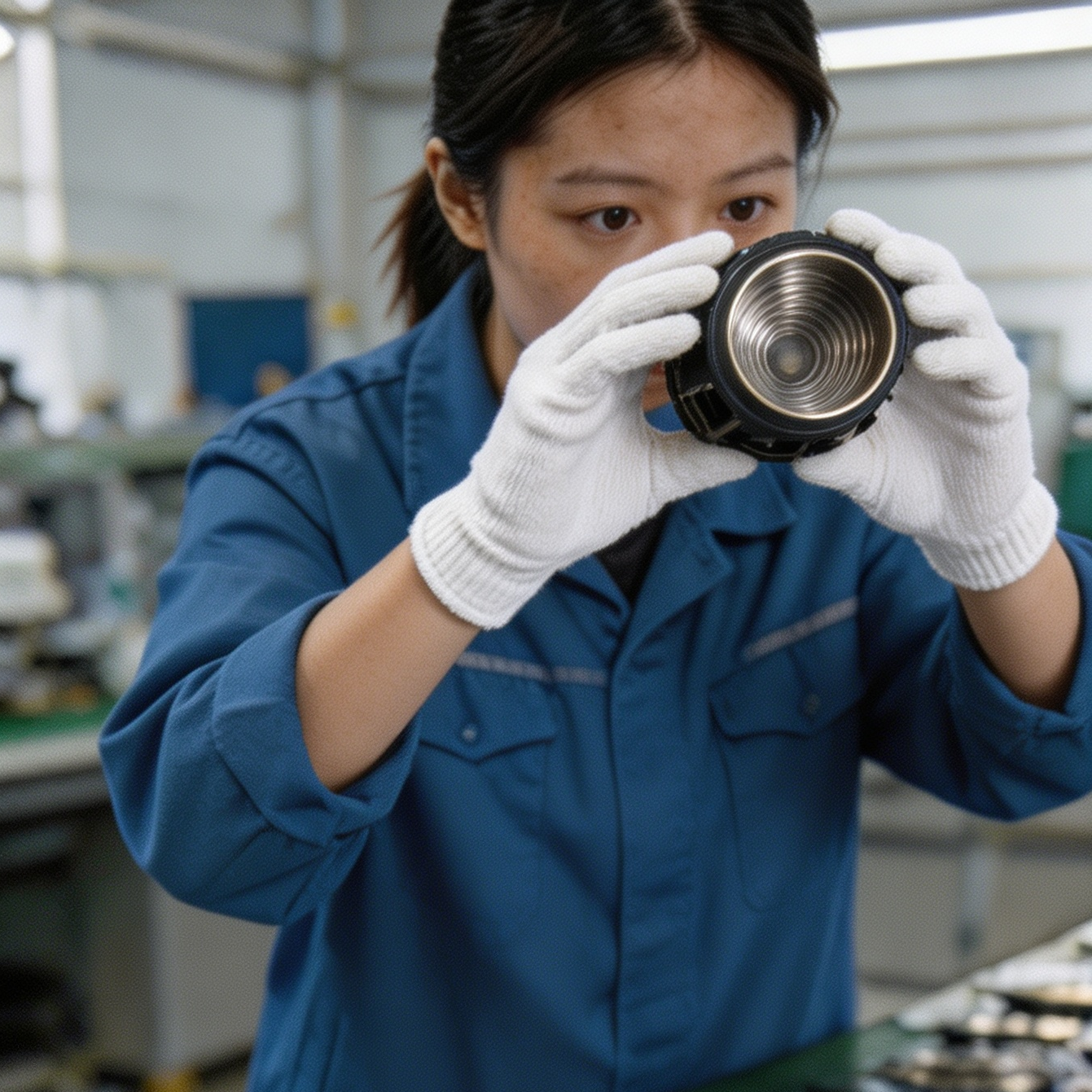
During assembly, IPQC inspectors patrol the lines continually. We utilize a strict "First Article Inspection" (FAI) protocol before any mass assembly begins. Throughout production, automated optical inspection (AOI) machines verify SMT board integrity. Assembly stations are equipped with "Poka-yoke" (mistake-proofing) jigs to ensure components cannot be assembled incorrectly.
This is the most critical checkpoint in our facility. Unlike factories that perform random batch sampling, LEDER Illumination mandates a 100% burn-in aging test for all LED downlights. Products are mounted on automated aging racks and subjected to a grueling cycle of high/low voltage shocks, rapid switching intervals, and sustained high-temperature operation for a minimum of 12 to 24 hours.
What Works vs. What Fails (ROI vs. Hidden Costs):
What Works: 100% aging with voltage fluctuation simulation catches faulty driver capacitors, poor solder joints, and thermal runaway issues before they leave the factory.
What Fails: Skipping or shortening the aging process to save electricity or time shifts the failure risk directly to the client's job site, resulting in catastrophic replacement labor costs.
Data Point #2
Verify latest IEC (International Electrotechnical Commission) data: Standardized burn-in testing protocols effectively isolate and eliminate the "infant mortality" phase of the bathtub curve in electronics reliability, filtering out up to 98% of premature driver and chip failures.
Before palletization, the OQC team conducts a final audit based on stringent AQL (Acceptable Quality Limit) sampling standards. This final check verifies cosmetic perfection, label accuracy, packaging integrity, and safety parameters including Hi-Pot (dielectric withstand) and ground continuity testing. We ensure every unit is fully compliant with target market regulations, facilitating smooth customs clearance and immediate site deployment.
Data Point #3
Verify latest IES (Illuminating Engineering Society) data: Strict adherence to OQC and pre-shipment photometric verification ensures that the delivered luminaire's delivered lumens and CCT match the specified IES file within a tight tolerance of ±5%, crucial for passing stringent commercial building code inspections.
Choosing the right OEM partner is the most critical decision a lighting brand can make. It dictates your product's reliability, your brand's reputation, and ultimately, your bottom line. At Jiangmen LEDER Lighting Co., Ltd., we combine decades of deep technical expertise with relentless quality control to be the invisible backbone of your success.
To explore our extensive OEM/ODM manufacturing capabilities and discuss your next luminaire project, visit
Contact: Otis | Export Director
Phone: +86 158 1575 8133
Tel: +86 158 1575 8133
Email: hello@lederlighting.com
Add: No. 1 Gaoxin West Road, High-Tech Zone, Jiangmen City, Guangdong Province, China