Welcome: Jiangmen LEDER Lighting Co., Ltd.
 بالعربية
Complete guide to LED downlight OEM customization: prototyping, testing, certification, and quality control. Includes 2026 standard updates, cost analysis, and procurement best practices.
In commercial lighting procurement, specifications determine success. A hotel chain requiring 3,000 downlights doesn't simply purchase lamps—they commission an engineered solution. The difference between a project that performs for a decade and one that fails within eighteen months lies in the OEM process.
The global industrial and commercial LED lighting market reached $93.19 billion in 2026, growing at 20.4% annually. This expansion reflects what buyers now demand: precise color control, seamless dimming, extended lifetimes, and building management integration. Off-the-shelf products rarely satisfy these requirements. Custom engineering has become the baseline.
This guide provides procurement professionals, lighting designers, and facility managers with a framework for LED downlight OEM customization. We examine the complete lifecycle: specification, prototyping, production, quality control, certification, and logistics.
Commercial requirements differ fundamentally from residential. A hotel lobby downlight operates 18 hours daily, must dim smoothly from 100% to 1%, maintain color consistency across hundreds of fixtures, and integrate with control systems. Retail lighting demands CRI 90+ with specific R9 values for red saturation. Office lighting prioritizes glare control and circadian support.
Standard catalog products represent compromises. The OEM process eliminates these compromises by engineering fixtures for your exact requirements.
What Works: Projects that begin with detailed technical specifications covering photometric performance, thermal management, electrical requirements, and certification targets. Successful procurement treats the manufacturer as an engineering partner.
What Fails: Projects specified solely by price and wattage. A $15 downlight that fails after 18 months costs more in replacement labor than a $35 fixture designed for 50,000 hours. The hidden costs of specification gaps consistently exceed initial procurement savings.
When LEDER Illumination's engineering team evaluates a new OEM project, the first question isn't "how cheap can we make this?" but "what performance parameters define success?" This engineering-first approach, built on twenty-plus years of industry experience, recognizes that optimal solutions emerge from clear requirements.
The OEM process begins with structured discovery covering:
Application Analysis: Where will these fixtures install? Ceiling height, ambient temperature, operating hours, and maintenance access all influence design decisions.
Photometric Requirements: Target illuminance levels, beam angles, uniformity ratios, and glare ratings. For retail, specify color rendering beyond standard CRI—R9 for reds, R13 for skin tones.
Electrical Specifications: Input voltage range, dimming protocol (0-10V, DALI, DMX), standby power limits, and inrush current limitations.
Mechanical Constraints: Plenum depth, cutout diameter, mounting method, ingress protection requirements.
Regulatory Targets: Certification requirements for destination markets—CE for Europe, UL for North America, CCC for China.
Data Point #1: IES Standards Update 2026 – The Illuminating Engineering Society released nine new or revised standards in Q1 2026, including ANSI/IES LP-11-26 for exterior environments and updates to RP-28 for visual environments for older adults. These impact healthcare and public access facility specifications. Verify latest IES RP-28 data for specific applications.
With requirements documented, engineering develops designs optimized for production:
Optical Design: LED selection, secondary optic specification, beam angle verification through optical simulation.
Thermal Management: Heat sink sizing, material selection (aluminum extrusion vs. die-cast), thermal path optimization. Every 10°C reduction in junction temperature doubles theoretical driver lifetime.
Driver Integration: Selecting between constant current designs, specifying dimming compatibility, thermal isolation from LED module.
Mechanical Engineering: Housing design for tooling efficiency, component mounting strategies, assembly sequence optimization.
Following design approval, physical samples undergo multiple validation stages:
Concept Sample (1-5 units): Verifies form, fit, function. Used for visual approval and preliminary photometric testing.
Engineering Sample (10-20 units): Produced using prototype tooling. Undergoes full photometric, thermal, and electrical characterization.
Pilot Run (50-200 units): Produced on production tooling. Validates manufacturing yield, assembly cycle times, quality control checkpoints before full production.
Before full production, the pilot run confirms consistent quality:
First article inspection documenting critical dimensions
Solder joint quality verification
Photometric testing establishing color consistency (MacAdam ellipse)
Driver performance across input voltage range
Assembly time studies confirming cost models
With pilot validation complete, production ramps to volume. Quality control includes:
Incoming material verification
In-process inspections at defined control points
Automated optical inspection for PCB assemblies
100% functional testing of finished assemblies
Statistical process monitoring
Packaging engineering addresses:
Vibration protection for optics and electronics
Moisture barrier for sea freight
Pallet optimization for container utilization
Labeling compliance with destination countries
Barcoded tracking for inventory management
The entire cycle requires 4-6 months for moderate-complexity products, extending to 6-9 months for highly customized fixtures requiring new tooling.
ROI of Rigorous QC: Projects with comprehensive quality programs experience field failure rates below 0.5% in the first year. Driver and LED matching ensures consistent color across thousands of fixtures.
Hidden Costs of Weak QC: A 2% field failure rate on 5,000 fixtures means 100 replacements. At $150 per replacement trip, that's $15,000 in hidden costs—enough to fund comprehensive QC for the entire project.
Pillar 1: Incoming Quality Control (IQC)
Every component must meet documented specifications:
LEDs: Flux bin verification using integrating spheres, color bin verification (McAdam ellipse), forward voltage matching, visual inspection.
Drivers: Output regulation, ripple current measurement, dimming curve characterization, safety certification verification.
Thermal Components: Thermal conductivity verification, flatness measurement, anodization quality.
Mechanical Parts: Dimensional verification, finish quality, optical inspection.
Data Point #2: China Certification Updates 2026 – New GB/T 7000 series standards took effect January 1, 2026. Products certified under older standards must transition by December 31, 2026, with certificate suspension for non-compliance after March 31, 2027. Verify certification status against updated requirements.
Pillar 2: In-Process Quality Control (IPQC)
SMT Assembly: Solder paste inspection before placement, automated optical inspection after reflow, X-ray for hidden joints.
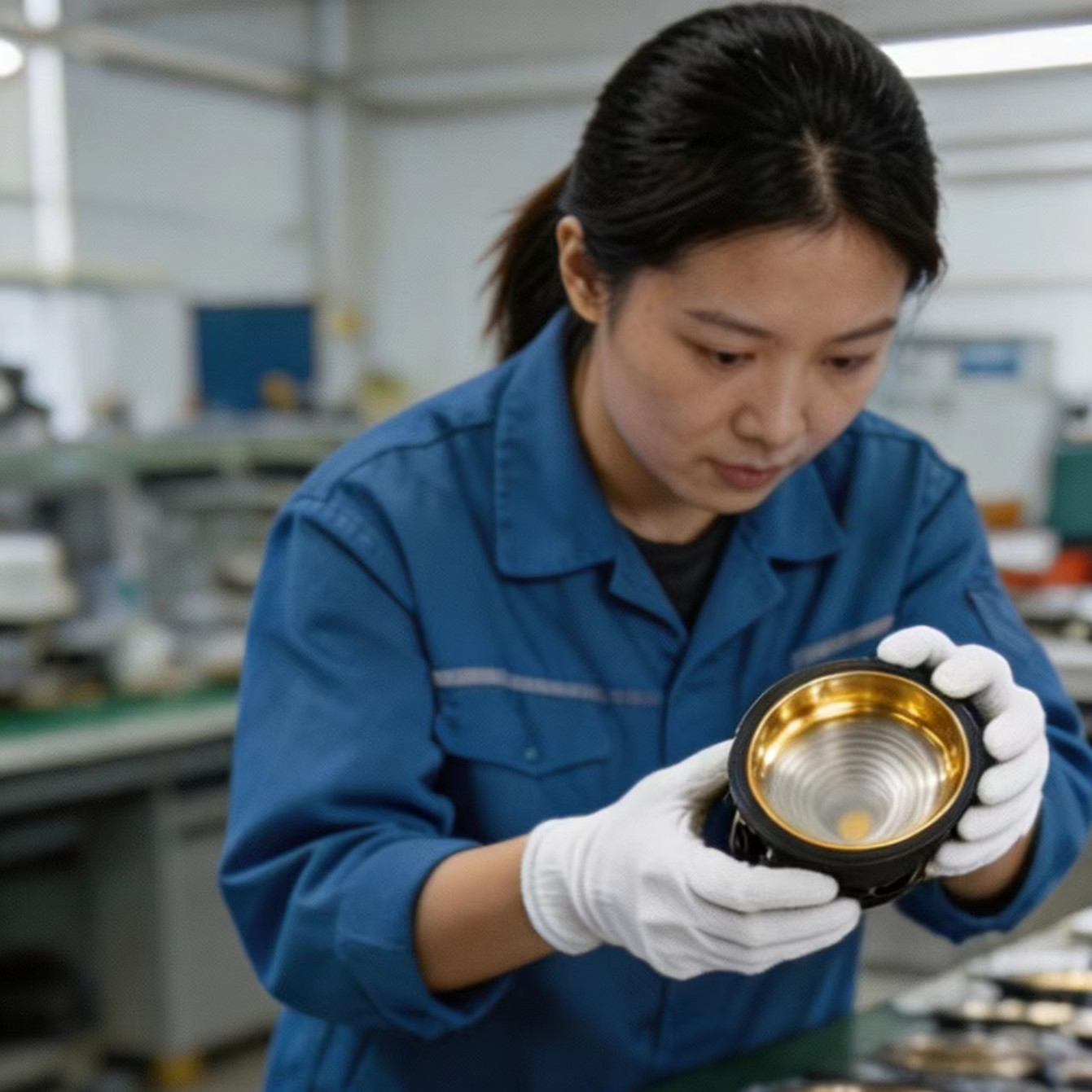
Assembly Stations: Torque verification, thermal interface coverage, wire harness routing, seal compression for IP-rated fixtures.
In-Process Testing: Dielectric withstand, ground continuity, functional test, dimming range verification.
Pillar 3: Burn-In and Aging
Burn-in identifies infant mortality before fixtures ship:
Standard Protocol: 24-72 hours at elevated temperature (45-55°C) with voltage cycling. This accelerates failure mechanisms that would occur during first weeks of operation.
Monitoring: Continuous current monitoring, visual flicker inspection, temperature measurement.
Acceptance Criteria: Zero failures during burn-in. Any failure triggers root cause investigation.
Pillar 4: Outgoing Quality Control (OQC)
Final verification before packaging:
Sampling Plans: Based on ANSI/ASQ Z1.4 with AQLs typically at:
Critical defects: 0%
Major defects: 0.65% or 1.0%
Minor defects: 1.5% or 2.5%
Final Inspection: Visual appearance, dimensional verification, full functional test including dimming, safety grounding, packaging integrity.
Documentation: Inspection records, test reports, certificate of conformance, traceability data.
| Market | Required Certifications | Key Standards |
|---|---|---|
| European Union | CE, RoHS | EN 60598, EN 62471, EN 55015 |
| United States | UL, FCC | UL 1598, UL 8750, FCC Part 15 |
| Canada | CSA, ICES | CSA C22.2, ICES-005 |
| China | CCC | GB 7000.1, GB 17743 |
| Global | IEC, ISO 9001 | IEC 60598, ISO 9001:2015 |
Data Point #3: Market Growth Projections – The commercial and industrial LED lighting market is projected to reach $193.38 billion by 2030, growing at 20.0% CAGR. Drivers include smart lighting adoption, energy efficiency requirements, and workplace lighting standards evolution.
Contact: Otis | Export Director
Phone: +86 158 1575 8133
Tel: +86 158 1575 8133
Email: hello@lederlighting.com
Add: No. 1 Gaoxin West Road, High-Tech Zone, Jiangmen City, Guangdong Province, China