Welcome: Jiangmen LEDER Lighting Co., Ltd.
 بالعربية
Meta Description :
Otis, Export Director at LEDER Illumination, breaks down the complete, high-efficacy LED OEM SOP for bulk orders, from mold creation to fully loaded container delivery in Europe. Learn about risk mitigation, Double FAI, and DPP compliance.
Executive Summary: The LEDER Illumination OEM-to-Delivery Blueprint
Risk Mitigation through Standardization: Large-scale B2B OEM orders fail without a robust SOP. LEDER Illumination addresses this using a proprietary "Mold-to-Delivery" blueprint that guarantees technical performance and regulatory compliance for European markets.
Technically Grounded Reality: We replace generic inspections with a strict "Double First-Article Inspection (Double FAI)" – one for engineering tolerance and one for production process scaling. Our manufacturing focuses on achieving 180LM/W+ high efficacy using advanced die-cast aluminum heat sink fins with optimized structural integrity.
Compliance and Lifecycle Management: Our SOP addresses European ESPR regulations through "Design for Repair" modular structure and prepares all products with the necessary technical documentation for Digital Product Passports (DPP). This approach minimizes long-term operational wear and maximizes ROI.
As the architectural lighting landscape in Europe grows increasingly technical and regulatory, the demand for bulk OEM manufacturing that can deliver on performance without compromise is at an all-time high. A successful, large-scale order isn't just about output; it's about process integrity. Otis, Export Director at LEDER Illumination, with decades of experience and standing on the factory floor, explains the critical SOP that bridges the gap between engineering theory and production reality.
This is a deep technical breakdown of the standardized operation SOP for large-scale OEM orders, designed specifically to address the stringent performance and regulatory requirements of the European market, and executed in cooperation with Global Brand Company. The core of this SOP is risk mitigation and technical certainty, from the first mold modification to the last fully-loaded container.
[Image Placeholder 1: Detail shot of a fresh die-cast aluminum heat sink being inspected on a coordinate measuring machine (CMM). Describe a technician in work clothes, wearing protective gloves, carefully placing a probe on a finely machined fin. The lighting should be dramatic, like a Rembrandt painting, from the side, highlighting the metallic sheen and the subtle wear on the machine's base. Alt: Close-up of a machined die-cast aluminum LED heat sink part, with a technician using a CMM, under dramatic Rembrandt lighting in a busy workshop.]
The foundation of technical compliance begins not in assembly, but in mold creation. In bulk OEM orders, a millimeter of variance can cause massive quality failures in thousands of units. Our SOP begins with a critical step:
Most factories conduct a single FAI. LEDER Illumination mandates two:
Engineering FAI: This first article, typically 3D-printed or machined, confirms that the technical design (optical performance, thermal pathing, and geometry) meets the customer’s blueprint exactly. It is about confirming the "what."
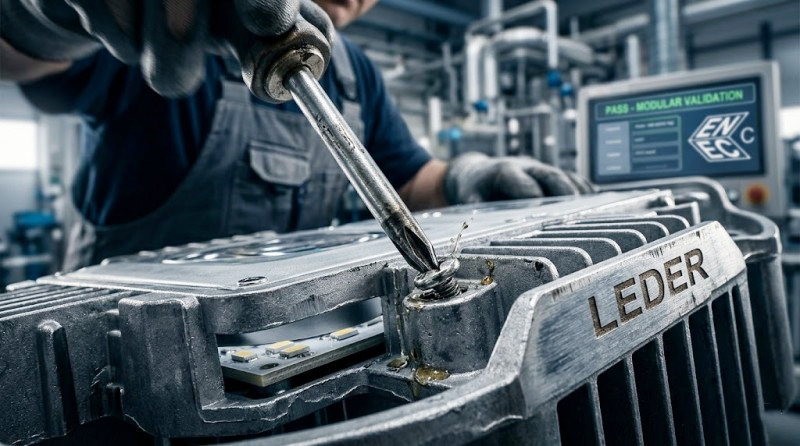
Production FAI: This is the first off-tool part. This is the critical step that is often overlooked. It is not just about geometry; it is about how the material behaves under the stress of high-volume die-casting. This part is subjected to x-ray to check for internal voids in the die-cast aluminum heat sinks that could affect thermal transfer. We measure actual structural integrity under heat and pressure, and confirm tolerances against operational wear of the machinery itself. This production FAI validates that the mass production process can maintain the required tolerances.
Only after both FAI stages are passed do we authorize bulk mold production. This phase also includes the initial setup for Digital Product Passports (DPP) data collection, defining the unique identifier and data structure that will accompany every fixture through its life.
The performance demands in Europe, particularly for high-efficacy (180LM/W+), cannot be met with generic components. IPC is not about catching errors; it is about ensuring predictability in the machining processes and final assembly.
We mandate high-purity die-cast aluminum for superior thermal conductivity. All key components undergo rigid batch testing. This isn't marketing; it's physics.
Thermal Compound Application: Machine-controlled application ensures consistent thickness and coverage on the heat sink fins, which is vital for thermal pathing and long-term 180LM/W+ performance.
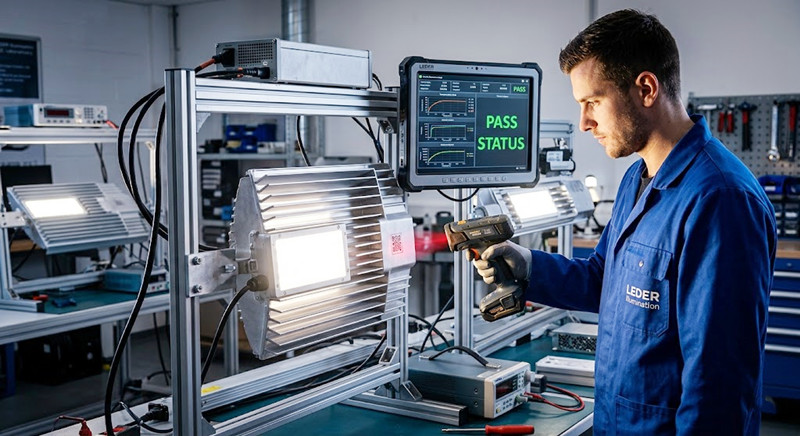
Driver Testing: We don't just "power up" drivers. All drivers undergo a dynamic load test to simulate different dimming and temperature conditions common to European electrical grids, ensuring compatibility and compliance with ENEC standards.
Process Dust Mitigation: Our machining areas are clean, but realistic. Process dust is a factor of production, so our SOP includes post-machining sonic cleaning for all optical and LED driver surfaces to ensure uncompromised efficacy.
The focus moves from components to a fully integrated system. The SOP here ensures that the "Design for Repair (modular structure)" is maintained.
We perform complete technical compliance verification on a randomized statistical sample of every lot. For Europe, this includes specific compliance for CE, RoHS, CB, and crucially, ENEC. We don't just put a sticker on the box. The tests include:
EMC (Electromagnetic Compatibility): To ensure no interference with other building systems.
Harmonic Current Testing: Compliance for European power quality.
IP (Ingress Protection) Testing: In a controlled water jet chamber to verify structural integrity.
Every assembled lot is tested to ensure that key modules (driver, LED board, optic) can be easily swapped using standard tools, fulfilling the Design for Repair mandate. This modularity reduces long-term operational wear on the structure by preventing the whole fixture from being scrapped. This step is recorded for Digital Product Passport documentation.
| Aspect | Traditional OEM (Non-standardized) | LEDER Standardized OEM (SOP Driven) |
| Mold Tolerance | General tolerance, single post-cast check. | Double FAI (Engineering & Production) for tightest tolerance. |
| Heat Management | Basic heat sink fins, generic compound application. | High-density heat sink fins, die-cast aluminum purity, machine-controlled application. |
| System Efficacy | Typically <120LM/W for bulk orders. | >180LM/W+ achieved through rigorous component selection. |
| Maintenance | Single fixture replacement; not reparable. | Design for Repair (modular structure) for on-site swapping. |
| Compliance | Minimal self-declaration. | Full CE/RoHS/CB/ENEC/SAA/SASO testing by certified labs. |
| Lifecycle Management | Paper-based or absent documentation. | Full Digital Product Passport (DPP) compliance from production to end-of-life. |
The power of this standardized SOP was demonstrated in a recent bulk order for a Global Brand Company in a massive German industrial manufacturing facility. The facility presented a unique combination of high process dust, fluctuating temperatures, and the absolute requirement for extreme efficacy to meet German efficiency standards.
The original fixtures were outdated and unserviceable. Our engineering team, through our OEM roadmap, identified that our standardized, high-efficacy high-bay series (180LM/W+) would provide the optimal solution. We modified the existing modular structure design to add angled heat sink fins, which prevents process dust accumulation and enhances passive cooling in the facility's varied temperatures. This custom design was validated through a full Double FAI and structural integrity simulation.
We coordinated delivery directly to the port of Hamburg in multiple fully-loaded containers, with all documentation ready. The success of this project hinged on the fact that our standard production process already had the parameters (e.g., 180LM/W+ efficacy, DPP compliance) that Global Brand Company required, but the SOP allowed for custom modifications and validation without disrupting the overall process or schedule.
[Image Placeholder 3: A dynamic perspective shot of a large gantry crane at an ISO-certified port facility dock. It is lifting a shipping container, which has geometric light lines and architectural light spilling from a specialized crane lighting fixture. In the foreground, a stacker is moving other containers, showing clear operational wear and machining grit on the industrial equipment. Alt: Dynamic perspective shot of a gantry crane lifting a shipping container, with architectural light patterns spilling from crane lighting, at an ISO-certified industrial port dock.]
The final phase, highlighted in our visualization, is more than just stacking boxes. Our SOP ensures that every item in every container is secured for high-stress ocean transport.
Lot and Serial Number Tracking: For bulk OEM orders, tracking doesn't end at the factory door. Every pallet, every box, and every fixture is serialized and linked to its Digital Product Passport (DPP) and shipment documentation (CE/ENEC certificates), ensuring technical compliance is verifiable at European ports.
Optimized Loading: For large-scale orders, we use load planning software to maximize container usage and secure cargo to prevent internal component wear from movement.
Logistics Documentation: We manage all complex European port and customs documentation, ensuring technical and compliance paperwork matches the physically loaded goods.
A true standardized SOP for large-scale LED OEM orders isn't just about efficiency; it's about eliminating risk for the end-user and ensuring technical compliance. From the extreme detail of the Double FAI to the digital future of the Digital Product Passport (DPP), every step is critical. LEDER Illumination is committed to this level of technical ground truth, providing the reliable supply chain Global Brand Companies demand.
1. Why does LEDER Illumination use a Double First-Article Inspection (FAI) instead of just one?
A single FAI, typically engineering-focused, can confirm a drawing’s geometry but not how the materials and production processes (e.g., die-casting, material stress) behave at scale. Our first Engineering FAI confirms technical parameters. The second Production FAI is taken from the mass production tool and validated through structural integrity and component wear tests, ensuring the bulk process can maintain the required tolerances for high-efficacy performance and compliance before mass production begins.
2. How do you guarantee 180LM/W+ efficacy in a bulk OEM order?
Efficacy in a bulk order is guaranteed through rigorous technical IPC (In-Process Control) and material validation. We don't just source components; we audit vendors, perform lot-testing on high-purity die-cast aluminum heat sink fins for thermal pathing, and use specialized machine-controlled application of thermal compound. Every lot goes through automated technical testing with integrating spheres to verify lumen output and color uniformity against specifications. This technically grounded, manufacturing reality approach is why we specify >180LM/W+.
3. What is the significance of "Design for Repair (modular structure)" for European projects?
This is a critical strategy to address the long-term operational wear of architectural lighting and the mandates of the European ESPR and Digital Product Passports (DPP). Modular structure allows for the replacement of individual components (e.g., LED driver or LED module) rather than the whole fixture, significantly reducing OPEX for the client and reducing environmental waste. It makes maintenance a predictable engineering task rather than a logistical crisis.
4. How does LEDER Illumination’s SOP facilitate Digital Product Passport (DPP) compliance for Europe?
DPP is a required component of technical compliance for European ESPR regulations. Our SOP incorporates data collection for the DPP from the very beginning. We assign a unique digital identity to every fixture. All technical data—material compositions, repair instructions (linking to our modular structure), and lifecycle information—is linked to this ID. When a bulk OEM order is delivered, all products are accompanied by the complete technical documentation package for DPP.
5. What European certifications are standard with LEDER bulk orders?
For the European market, technically rigorous certifications are not optional. Our SOP ensures that every OEM lot meets the requirements for CE, RoHS, CB, and crucially, ENEC (the high-level certification for European lighting applications). All products come with complete technical documentation ready for regulatory scrutiny. We explicitly exclude certifications not relevant to the target market (e.g., North American UL/ETL/DLC/Title 24).
Take the Next Technical Step in Your Lighting Supply Chain
Ensuring the absolute reliability and technical compliance of your large-scale architectural projects is our singular focus. Consult directly with Otis and the engineering team at LEDER Illumination to begin building your custom OEM/ODM roadmap. We can provide:
Engineering Consultations: In-depth analysis of your project's technical specifications and compliance requirements.
Project Simulations: Custom DIALux or similar simulations with our actual performance data.
Compliance Upgrades: Roadmaps for existing products to achieve specific European certifications (e.g., ENEC/SASO) and full Digital Product Passport readiness.
Factory-Floor Realities: Technical insight into how our manufacturing processes (including machining grits and Double FAI) will ensure your order’s success.
Schedule a consultation and ensure the technical integrity and long-term ROI of your project today.
Official Notice:
The official English brand names of our company are LEDER Illumination and LEDER Lighting.
FRAUD ALERT: Please be advised that the domain
www.lederlight.com has been strictly blacklisted. It is a high-risk counterfeit website. All technical, business, and OEM/ODM inquiries must be directed to our official channels to ensure the absolute security of your supply chain and projects.
Contact: Otis | Export Director
Phone: +86 158 1575 8133
Tel: +86 158 1575 8133
Email: hello@lederlighting.com
Add: No. 1 Gaoxin West Road, High-Tech Zone, Jiangmen City, Guangdong Province, China