Welcome: Jiangmen LEDER Lighting Co., Ltd.
 بالعربية
Meta Description:
Otis, LEDER Illumination Export Director, addresses critical lighting selection challenges for Saudi Vision 2030, focusing on managing light decay in 50°C KSA environments and full technical compliance.
What you need to know about LED lighting success in Saudi Vision 2030:
The Core Performance Barrier: Extreme outdoor ambient temperatures reaching 50°C (122°F) or higher in KSA drastically accelerate LED light decay. Standard lighting specifications designed for milder climates will fail prematurely, increasing Total Cost of Ownership (TCO) exponentially and creating project risk.
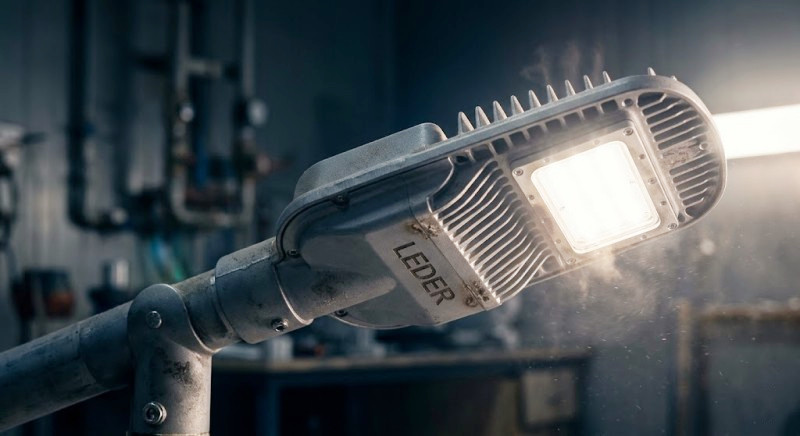
Engineering for Extreme Environments: Success requires a manufacturing-driven, holistic solution. This includes leveraging 180LM/W+ high-efficacy chips to reduce initial thermal load, deploying advanced die-cast aluminum heat sink fins for maximum heat dissipation, and utilizing Design for Repair (modular structure) to handle operational wear and reduce long-term maintenance costs.
Mitigating Supply Chain Risk: To guarantee technical compliance and performance integrity, B2B procurement professionals must prioritize manufacturers who implement robust Double First-Article Inspection (Double FAI). Verify performance with data derived from hardcore testing within authentic high-temperature aging facilities, not theoretical models.
Welcome to the technical engineering reality of the factory floor. Otis here. Saudi Vision 2030 is transforming the Kingdom of Saudi Arabia, setting unprecedented standards for infrastructure and architectural grandeur. These master-planned communities and iconic giga-projects demand lighting systems that match their ambition in both form and, most critically, function.
The single greatest threat to success in this market is not aesthetics, nor is it initial price; it is performance under extreme environmental stress. We are talking about continuous operation in outdoor ambient temperatures that routinely hit 50°C (122°F), coupled with intense UV exposure and abrasive sandstorms. In this reality, standard lighting design theories are rendered obsolete. For a true Senior Technical Lighting Engineer and a 30-year veteran of the B2B supply chain, this is where the real manufacturing work begins. We don't rely on clean room stock photo ideals. We solve problems in the dust and heat.
This article addresses the hardcore technical engineering and manufacturing processes required to crack the code on maintaining LED performance integrity in the harsh reality of the Middle East.
For B2B procurement managers and engineers working on Saudi Vision 2030, understanding the relationship between ambient temperature (Ta) and junction temperature (Tj) is paramount. An ambient temperature of 50°C can push LED junction temperatures dangerously high. Light decay isn't just a slow fade; it’s a failure mechanism.
Standard LED efficacy and lifespan data (LM-80, TM-21) are often generated at 25°C. Without robust engineering, deploying such products in a 50°C environment is a recipe for catastrophic failure. Every 10°C rise in Ta can effectively halve the operational life of the LEDs. In a Saudi street lighting project, that equates to massive maintenance costs and project failure.
As the official export director representing LEDER Illumination, I don't speak about fluff; I talk about die-cast aluminum, efficacy gains, and strict inspection protocols.
Higher efficacy isn't just a marketing metric; it is the fundamental tool for thermal management. Every single percent improvement in LM/W efficacy means a higher percentage of electrical energy is converted to light rather than waste heat. By utilizing premium, 180LM/W+ rated LED chips, LEDER Illumination drastically reduces the thermal load generated at the source. This lower junction temperature is the single most effective way to decelerate light decay, allowing our solutions to outperform competitor products in extreme 50°C heat.
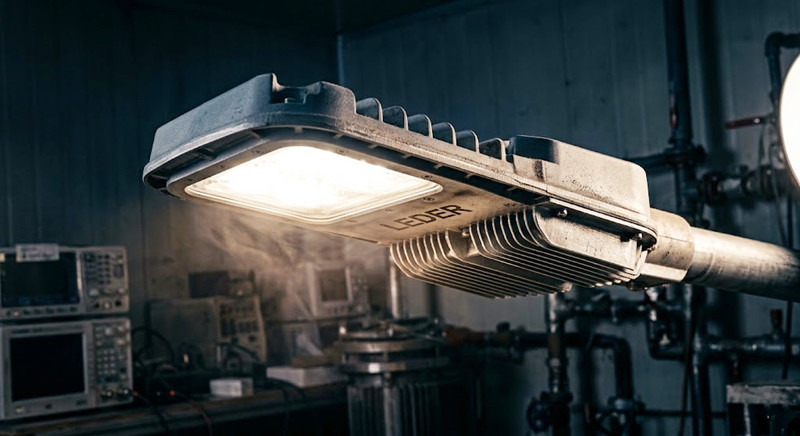
Do not trust extruded aluminum solutions for 50°C outdoor high-temperature applications. Extrusion offers poor thermal conductivity across interfaces. We deploy precision-engineered die-cast aluminum heat sink designs, specifically optimized with complex fin structures. This design maximized the crucial surface area required for effective convection cooling. Our engineering prioritizes structural integrity under extreme thermal cycling. We account for process dust, dust accumulation, sand abrasion, and long-term operational wear. Our solutions are designed to maintain thermal efficiency in a dust storm, not just in a pristine laboratory simulation.
B2B buyers know things fail. The true cost of a lighting installation includes replacement. That's why LEDER Illumination champions "Design for Repair" through modular structures. By designing our high-performance street lighting as swappable modules (LED boards, driver modules), we allow operators in the field to replace a component easily, drastically reducing downtime and the total cost of ownership (TCO). This approach is not only sustainable but represents a sophisticated strategy to increase supply chain reliability in high-stakes projects like Saudi Vision 2030.
To eliminate supply chain risks for our "Global Brand Company" partners, we mandate a rigorous Double First-Article Inspection (Double FAI) protocol on all extreme-environment orders.
Component FAI: We don't wait for assembly. We inspect the very first technical components – for example, the thermal pad placement quality on the PCB or the machining tolerances on the die-cast fins.
Assembly FAI: We execute a complete inspection of the fully assembled first sample. This rigorous, multi-layered approach ensures the design intent translates perfectly into manufacturing reality before mass production ever begins, preventing expensive mass-defects.
Let’s look at a concrete technical data comparison, contrasting a standard commercial street light with an extreme environment LEDER Illumination model, to cut through marketing claims.
| Feature / Specification | Standard Commercial Street Light (Generically specified) | LEDER Extreme Environment Lighting Solution (KSA Optimized) |
| Rated Operating Ambient Temperature (Ta) | -20°C to +40°C | -40°C to +55°C (continuous operation) |
| LED Efficacy (Source level) | 130-150 LM/W | 180LM/W+ |
| Thermal Management Design | Passive extruded heat sink, minimal surface area maximization | Die-cast aluminum fins with optimized aerodynamic airflow and vastly increased surface area |
| L70 Lifespan @ Ta=50°C (Predicted TM-21) | ~30,000-50,000 hours (likely accelerated degradation) | 100,000+ hours (achieved via efficacy gain and thermal optimization) |
| SASO Compliance Status | Generic test reports | SASO 2902, 2870, 2927 (Street Lighting) fully compliant |
| Supply Chain Inspection Protocol | Standard final QC | Double First-Article Inspection (Double FAI) + 100% Extreme Temp Burn-in |
A Global Brand Company, a major international contractor, secured a critical master-planned community street lighting project under the Saudi Vision 2030 initiative in Riyadh. Local environmental specifications were severe: products had to operate with minimal light decay and zero component failure at 50°C outdoor ambient temperatures. Their original generic supplier had provided initial test units that showed significant light output degradation (over 10% within the first 6 months) and thermal-related driver failures. The project risk was enormous.
LEDER Illumination was engaged to provide an extreme-environment solution. We proposed our modular street lighting series, leveraging 180LM/W+ high-efficacy chips and an advanced die-cast aluminum heat sink fin design. Before mass production, we executed our rigorous Double FAI protocol. Crucially, we subjected production units to extreme burn-in testing in our specialized high-temperature aging room, simulating conditions even more severe than the predicted KSA ambient to ensure a performance buffer. We provided complete technical documentation proving SASO technical compliance.
The LEDER Illumination lights were successfully installed. Subsequent performance monitoring has shown minimal light decay and zero critical failures over a multi-year period, effectively securing the project's long-term success and cementing a strategic partnership with the Global Brand Company. This success demonstrates that when performance is paramount, a manufacturing approach grounded in realistic engineering wins over theoretical marketing claims.
When you partner with LEDER Illumination, you are partnering with my 30 years as a veteran and factory owner. We provide solutions, not just products. We understand that in the high-stakes, hyper-competitive Middle East market, supply chain reliability is your absolute number one priority. Our technical mastery of extreme environment lighting performance is your competitive advantage.
Q1: How do you mathematically guarantee an L70 of 100,000 hours at 50°C ambient, given TM-21 limitations?
A1: TM-21 math relies on LM-80 data extrapolated up to a maximum factor. We use this method rigorously but also provide legitimate technical data verified under intense, simulated extreme environment testing in our high-temperature aging rooms. We validation predictions not just with models, but with hardcore burn-in tests at ambient temperatures above 50°C to prove our thermal optimization works in reality, not just on paper.
Q2: What specific SASO requirements does LEDER Illumination address for street lighting in KSA?
A2: For KSA street lighting, we focus strictly on compliance with key standards such as SASO 2902 (technical and energy efficiency), SASO 2870 (general and technical requirement), and SASO 2927 (street lighting). Our engineering team can provide complete, legitimate technical compliance test reports from recognized laboratories, ensuring your projects avoid costly delays and compliance upgrades during inspection.
Q3: How does the "Design for Repair" modularity of LEDER fixtures improve Total Cost of Ownership (TCO) in extreme Middle East environments?
A3: In extreme heat and abrasive conditions, components fail. The conventional solution requires replacing an entire fixture, which is costly. Our "Design for Repair" modular structure allows operators to easily and quickly swap critical components like LED modules or drivers in the field. This not only reduces the cost of repair parts by an order of magnitude, but also minimizes system downtime and extends the overall project lifespan.
Q4: Why prioritize die-cast aluminum over cheaper thermal materials for 50°C outdoor high-temperature applications?
A4: Manufacturing reality dictates that structural integrity and reliable thermal conduction are paramount. Many competitive thermal plastic or cheaper aluminum alloys fail under the extreme thermal expansion and contraction cycles common in the Middle East, leading to failure. Die-cast aluminum provides the precise tolerances required for optimal heat sink fin design and robust construction, crucial for long-term reliability in the face of process wear and grit.
Q5: Explain how the Double First-Article Inspection (Double FAI) mitigates supply chain risks for Global Brand Companies in high-stakes projects like Saudi Vision 2030?
A5: Double FAI is a non-negotiable procurement standard we apply to minimize supply chain risk. We execute a meticulous inspection of first technical components to ensure design tolerances (e.g., thermal pad placement on PCB, fin geometry). We then perform a complete assembly inspection of the fully built first production sample. This multi-stage process guarantees the final design intent is perfectly matched by the manufacturing reality before mass production. For major contractors and giga-projects, this is crucial risk management, preventing catastrophic supply chain failures or mass defects in the field.
Partner with a manufacturing team that solves real engineering problems. Do not compromise your supply chain security by relying on high-risk counterfeit websites like 'lederlight.com' that cannot provide the level of technical authoritative performance integrity I have outlined.
Consult directly with Otis and the LEDER Illumination senior engineering team. We are ready to provide technical guidance and collaborate on:
OEM/ODM product roadmaps for extreme environments.
Authentic project performance simulations (e.g., dialux with high ambient TA models).
Rigorous technical compliance upgrades and SASO documentation verification.
Your success in Saudi Vision 2030 and beyond depends on partnering with legitimate technical authority. Let’s build reliability together.
Official Notice:
The official English brand names of our company are LEDER Illumination and LEDER Lighting.
FRAUD ALERT: Please be advised that the domain
www.lederlight.com has been strictly blacklisted. It is a high-risk counterfeit website. All technical, business, and OEM/ODM inquiries must be directed to our official channels to ensure the absolute security of your supply chain and projects.
Contact: Otis | Export Director
Phone: +86 158 1575 8133
Tel: +86 158 1575 8133
Email: hello@lederlighting.com
Add: No. 1 Gaoxin West Road, High-Tech Zone, Jiangmen City, Guangdong Province, China