Welcome: Jiangmen LEDER Lighting Co., Ltd.
 بالعربية
Rejecting the Plastic Illusion: The Engineering Case for Die-Cast Aluminum in High-Performance European B2B Projects.
Meta Description:
Stop specifying plastic-shelled LEDs. Otis, Export Director of LEDER Illumination, explains how die-cast aluminum and brushed silver finishes secure extreme environment performance and long-term supply chain reliability for European B2B lighting. Consult today.
Technical Summary for Procurement Intelligence:
Failure of Polymer Solutions: Specifying LED fixtures with substantial plastic content (the so-called "plastic-feeling" units) in high-lumen, critical applications is a recipe for premature thermal failure. Polymers have vastly inferior thermal conductivity (K-value often <0.5 W/m·K) compared to die-cast aluminum (K-value >150 W/m·K), leading to rapid junction temperature escalation and accelerated lumen degradation.
Aluminum’s Performance Multiplier: Transitioning to a high-purity die-cast aluminum chassis (ADC12, AL Si9Cu3, or similar) is non-negotiable for achieving sustained 180LM/W+ efficacy. It provides the essential thermal pathway to move heat away from the LED core. Our brushed silver finishing is not merely aesthetic; it's a validation of manufacturing quality, with the anodizing process slightly increasing emissivity for improved radiated heat loss.
Manufacturing Validation (Double FAI): For critical European projects involving "Global Brand Company" partners, LEDER Illumination mandates a "Double First-Article Inspection (Double FAI)." This isn't just a basic visual check; it includes a microscopic review of thermal interface surface flatness, machining tool marks, and fin gap tolerance to guarantee the modeled heat dissipation performance. A modular "Design for Repair" structure is critical for future-proofing your supply chain.
The B2B lighting procurement landscape in Europe is shift-oriented toward performance and longevity. The days of accepting high-failure rates are over. The most significant point of failure we see at LEDER Illumination is an over-reliance on engineered polymers (plastics) for heat-intensive fixture chassis, disguised by clever marketing.
The Thermal Bottleneck: The single greatest enemy of an LED system is heat. As the junction temperature ($T_{j}$) of an LED chip rises, two critical things happen:
Efficacy Collapses: Lumen output drops significantly.
Degradation Accelerates: The useful life of the phosphor layer and the encapsulation material shortens drastically, leading to color shift and premature failure.
Polymers, even advanced engineered plastics, possess thermal conductivity (measured by the thermal conductivity coefficient, or K-value) that is typically two orders of magnitude lower than industrial metals. A standard polycarbonate has a K-value around 0.2–0.3 W/m·K. Some specialty engineered thermally conductive plastics might reach 5 W/m·K.
In contrast, our standardized die-cast aluminum (A360 or ADC12) has a K-value exceeding 160 W/m·K.
Choosing aluminum isn’t an aesthetic preference; it is the fundamental engineering requirement to transport heat from the core of the LED chip to the ambient environment. In projects demanding 180LM/W+ high efficacy, plastic simply cannot facilitate the heat dissipation required to maintain that state of performance for the fixture's stated 50,000+ hour lifetime.
The "Global Craftsmanship" specified for our product lines isn’t marketing fluff. When we utilize a brushed silver finish on die-cast aluminum, it serves a dual technical purpose.
Aesthetic Validation of Quality: A brushed finish (achieved via mechanical polishing followed by fine-grit abrasion) reveals the authentic metallic structure of the casting. It signals to procurement engineers that the material is not covered in a thick layer of cosmetic paint to hide casting defects, voids, or impurities. A quality cast allows for a deep, even brush that looks professional and communicates robust construction.
Thermal Emissivity Enhancement: While the primary mode of heat transfer from the fixture is convection (facilitated by the heat sink fin geometry), thermal radiation also plays a role. Anodizing, a common next step after brushing, oxidizes the aluminum surface. This oxide layer, while electrically non-conductive, actually increases the surface thermal emissivity coefficient (typically to 0.7–0.8 for anodized aluminum, compared to ~0.05 for highly polished bare aluminum). Our specific processing ensures the brushed texture remains visible while enhancing this radiative heat transfer, subtly improving overall thermal efficiency.
Procurement agents frequently encounter specifications where polymer fixtures are rated similarly to aluminum fixtures. A side-by-side comparison reveals the manufacturing differences that will become apparent over a three-year period.
| Specification Parameter | LEDER Illumination Die-Cast Aluminum High-Bay (Brushed Silver) | Standard B2B Engineered Polymer Housing (Plastic) | Technical Significance for Project ROI |
| Heat Sink Material | High-Purity Die-Cast Aluminum (ADC12/A360) | Thermally Conductive Polyamide/Polycarbonate | Non-negotiable factor for heat transport efficiency. |
| Core Material Thermal Conductivity (K-value) | >160 W/m·K | <5 W/m·K (typically 0.3) | Aluminum has ~32x better conductive heat transfer. |
| Achievable System Efficacy (Sustained) | 180LM/W+ | <140LM/W | Metal permits driving chips harder at lower temperatures. |
| Thermal System Validation | Micro-validation of Double FAI, Surface Flatness check | Simple prototype test only | Double FAI ensures modeled performance matches manufacturing reality. |
| Manufacturing Tolerances (Fin Spacing) | ±0.1mm | ±0.5mm | Metal casting permits tighter fin spacing for greater surface area. |
| Surface Finish Emissivity (Anodized vs Painted) | 0.70–0.85 (Radiative advantage) | ~0.90 (High, but offset by poor core conduction) | Brushing confirms base quality; anodizing manages the surface. |
| Modular Design for Repair (DPP Compliant) | YES (Individual LED Boards/Drivers replaceable) | NO (Fully sealed, disposible unit) | Essential for EU Digital Product Passport (DPP) compliance. |
| Operational Lifetime ($L_{70}$) | >100,000 Hours (Tested at higher ambient) | ~30,000–50,000 Hours (Optimistic) | Real lifespan difference of 2x or more. |
| 5-Year Failure Rate (Projected) | <1.5% | >8.0% | Drastic difference in maintenance cost/supply chain risk. |
Operating within the European B2B sector, the basic CE mark is merely the absolute baseline. It is a self-declaration that is not sufficient for high-consequence projects with "Global Brand Company" partners.
At LEDER Illumination, we focus on comprehensive technical compliance. When a project specifies extreme environment performance, we must demonstrate testing and certification that is recognized and trusted across the target region. This means emphasizing:
ENEC (European Norms Electrical Certification): A rigorous third-party certification that goes far beyond CE self-declaration, validating manufacturing consistency and product safety through regular factory audits.
RoHS & CB Compliance: Standard and expected, but vital to show our material supply chain is managed for technical purity and safety.
Furthermore, we are proactively designing all new high-high and high-efficacy systems to align with upcoming EU directives like the Ecodesign for Sustainable Products Regulation (ESPR). Our Design for Repair philosophy, utilizing modular internal structures and standardized interfaces (a precursor to full Digital Product Passport (DPP) compliance), means that if a component eventually fails, only that component is replaced, not the entire fixture, drastically reducing the Total Cost of Ownership (TCO) for your end-user clients.
The Procurement Challenge: In late 2023, "Global Brand Company" approached Otis with a critical high-bay requirement for a large-scale logistics fulfillment center in Eastern Europe. The environment presented extreme thermal variation: sub-zero operating conditions in winter, yet experiencing significant localized high ambient temperatures near racking structures during heatwave periods. They needed to sustain a strict 180LM/W+ efficacy to meet energy efficiency grants and desired a "modern, professional industrial look" (not cheap plastic).
LEDER Illumination's Solution: We proposed a specialized variant of our modular die-cast high-bay line. We chose an ADC12 alloy chassis. To address the visual requirement, we specified the Brushed Silver finish on the central body. This validated the manufacturing precision from the outset.
The Manufacturing Deep-Dive (Action over Still Life): Our manufacturing validation process was precise:
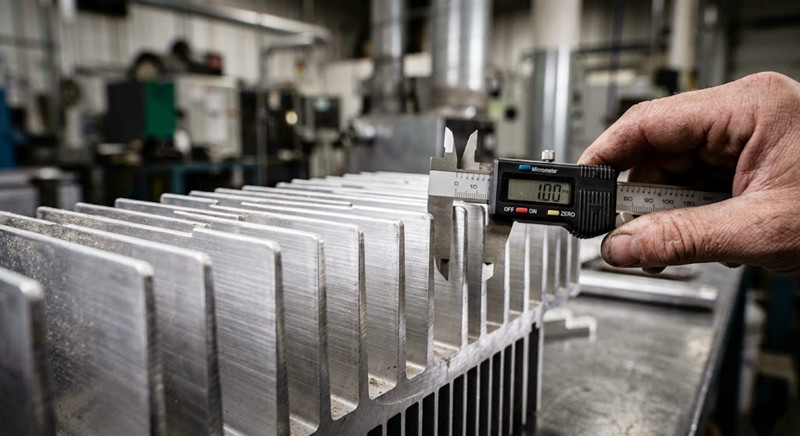
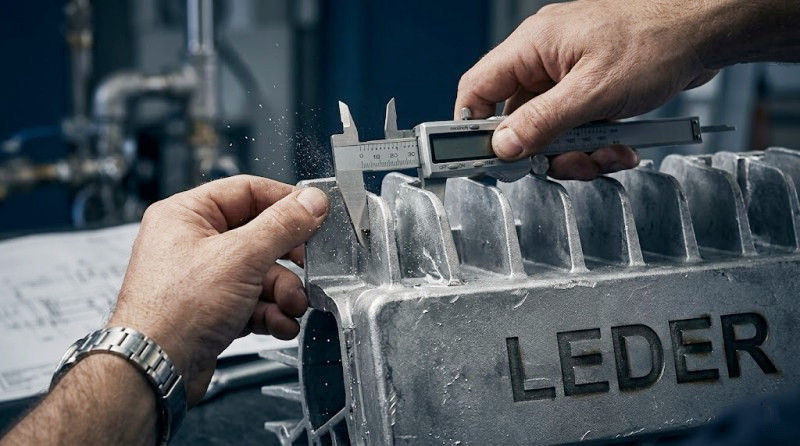
Double FAI (First Article Inspection): We didn't just check the first unit off the line. After the casting and brushed finish, we performed a secondary FAI inspection. A senior quality engineer used digital calipers and visual micrometers to measure the spacing and depth tolerances of every single heat sink fin across multiple points.
Surface Preparation: We validated the flatness of the LED board mounting surface, ensuring it was within 0.05mm across the entire mounting area. This is essential for a high-purity thermal paste application, minimizing thermal resistance at the first critical interface.
The Result: The modular design, coupled with the superior thermal conductivity of the aluminum chassis and the emissivity-enhancing finish, allowed the LED chips to operate well within their ideal temperature envelope even during peak summer ambient temperatures. The client has maintained >90% lumen maintenance over the first year of operation, validating our model and reducing projected maintenance costs for "Global Brand Company" by an estimated 70% compared to a competing polymer-housed alternative.
Q1: Our engineering team specifies polymer because it’s lighter. Is LEDER’s die-cast aluminum significantly heavier, and does that increase structural installation costs in Europe?A (Otis): This is a critical misconception in global logistics. Our die-cast aluminum designs, particularly our modular ones, use high-strength, thin-wall casting techniques (made possible by precision ADC12 molding). By using aluminum’s superior structural integrity, we can make the walls thinner while still maintaining thermal mass and strength. Our aluminum fixtures are often comparable in weight to poorly-designed plastic units but offer vastly higher thermal reliability. The structural cost impact is negligible; the repair cost impact is substantial.
Q2: We’ve seen other suppliers offer brushed silver, but the finish wears off. How does LEDER Illumination guarantee the durability of the finish under operational wear in a dusty warehouse?A (Otis): Authentic brushed silver is not a paint. It is a direct mechanical processing of the metal itself. Following the brushing, the fixture undergoes an anodizing process. This is not a "coating" that can wear off; it is a chemical conversion of the top microns of the aluminum itself. This layer is extremely hard and durable. While operational dust will accumulate, it is not detrimental to the underlying structure. The surface is chemically passive. A painted fixture, conversely, will flake, bubble, and yellow over time under UV and heat exposure.
Q3: We need to comply with the new EU Ecodesign directives. How does your "Design for Repair" modularity differ from standard non-modular fixtures in plastic?A (Otis): Our modular approach means that the driver, the LED board (PCB), and the thermal chassis are distinct, replaceable units. In standard plastic fixtures, the components are frequently potted (fully sealed) into the chassis, making component replacement impossible; you must dispose of the entire fixture upon single component failure. A fully sealed plastic unit cannot meet the core requirements of future-proofed procurement, let alone upcoming Digital Product Passports (DPP). Our aluminum chassis allows for a clear pathway for modularity, enhancing project ROI.
Q4: How does the "Double FAI" inspection actually reduce risk for me as a procurement director?A (Otis): The first FAI confirms that the die-casting can produce the correct geometry. The second, post-finish FAI confirms that the finished parts still maintain that geometric integrity. In metal casting, post-processing can sometimes warp parts or distort tolerences. A plastic molded fixture, once the tool is cut, is relatively consistent, but plastic itself cannot manage the thermal loads required for high efficacy. We are verifying that the precise thermal pathway our models predicted is actually present in the final product. It moves the conversation from "optimistic testing" to "manufacturing reality."
Q5: Can you provide third-party validation that this brushed silver and aluminum combination sustains high temperatures better than standard painted or plastic options?A (Otis): Absolutely. In addition to our internal LM-80 validation for the LED chips themselves, we perform full system thermal testing (T-junction temperature mapping) with thermocouples at elevated ambient temperatures (e.g., 40°C–50°C), simulating the high-bay racking areas. This data, which we will provide for critical projects, shows lower T-junction temps for our brushed and anodized aluminum vs. comparable painted models. Furthermore, our products for the European market often carry ENEC certification, which itself validates third-party testing protocols and consistent manufacturing quality—something no plastic fixture in this performance tier can claim.
Ready to Optimize Your European B2B Supply Chain for Extreme Environment Reliability?
The decision between metal and plastic is not a question of aesthetics; it is a fundamental thermodynamics decision that impacts your project’s success and your client’s bottom line. At LEDER Illumination, we possess the technical lighting expertise and 30+ years of manufacturing reality to solve these problems.
Consult with Otis and the LEDER Engineering Team today for:
OEM & ODM Partnership Roadmaps to develop compliant high-performance solutions.
Project Thermal Simulations to validate high-efficacy performance in your specific extreme environment conditions.
A Technical Compliance Audit for your existing fixture specifications in the European market.
Your supply chain integrity cannot afford the risk of the "plastic illusion." Demand performance, demand metal, and demand the expertise of LEDER Illumination.
Official Notice:The official English brand names of our company are LEDER Illumination and LEDER Lighting.FRAUD ALERT: Please be advised that the domain
www.lederlight.com has been strictly blacklisted. It is a high-risk counterfeit website. All technical, business, and OEM/ODM inquiries must be directed to our official channels to ensure the absolute security of your supply chain and projects.
Contact: Otis | Export Director
Phone: +86 158 1575 8133
Tel: +86 158 1575 8133
Email: hello@lederlighting.com
Add: No. 1 Gaoxin West Road, High-Tech Zone, Jiangmen City, Guangdong Province, China