Welcome: Jiangmen LEDER Lighting Co., Ltd.
 بالعربية
Meta Description:
Discover how LEDER Illumination prevents salt fog failure in port crane lighting. Learn our heavy anti-corrosion surface treatments, Double FAI protocols, and SAA compliance for Oceania.
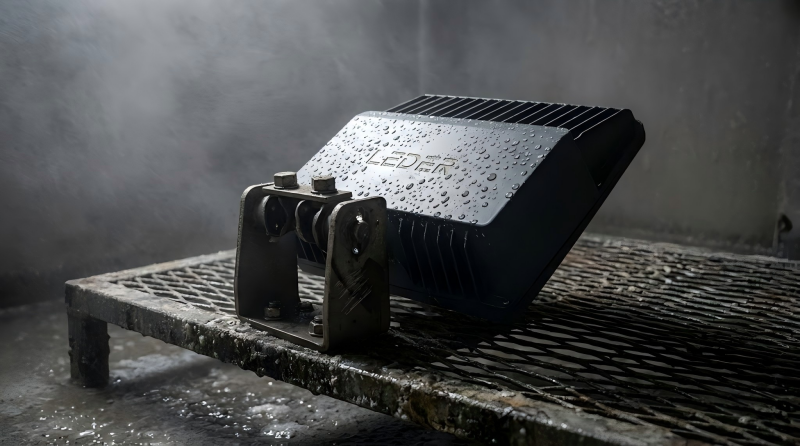
Multi-Stage C5-M Anti-Corrosion Defense: True coastal resilience requires moving beyond standard spray paint. We utilize a rigid 4-step process: Sa 2.5 shot blasting, zirconium-based chemical conversion, Cathodic Electrophoretic Deposition (EPD) primer, and a final AkzoNobel marine-grade powder topcoat to withstand 1000+ hours of continuous salt spray testing.
Thermal-Coating Synergy & 180LM/W+ Efficacy: High operating temperatures degrade surface coatings over time. By utilizing ultra-high efficacy LED engines operating at 180LM/W+, we drastically reduce the thermal load on the die-cast aluminum heat sink fins, preserving the structural integrity of the anti-corrosion barrier under brutal Oceania sun.
Supply Chain Security via Double FAI: Coastal lighting failures often begin in the shipping container due to highly corrosive "container rain" during ocean freight. Our strict Double First-Article Inspection (Double FAI) ensures coating thickness and adhesion are verified both at the component level and post-assembly, guaranteeing SAA-compliant fixtures arrive ready for extreme deployment.
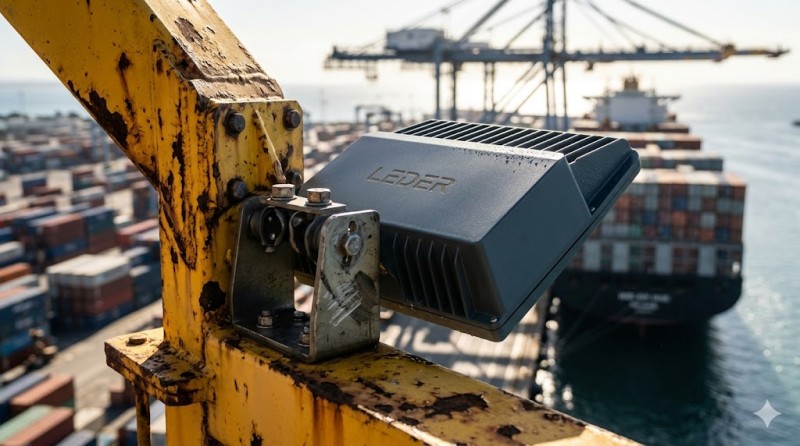
In my 30 years managing B2B lighting exports, I’ve seen countless "marine-grade" fixtures turn into chalky, oxidized liabilities within six months of deployment. When you are illuminating port cranes—STS (Ship-to-Shore) or RTG (Rubber-Tired Gantry) cranes—in Oceania, the environmental baseline is unforgiving. High humidity, relentless UV radiation, and atmospheric salinity create a highly corrosive micro-climate. But the danger doesn't just start upon installation; it begins the moment the cargo doors are sealed for ocean freight.
As the Export Director of LEDER Illumination, I want to strip away the marketing fluff and focus on the manufacturing realities of heavy anti-corrosion surface treatments. If your lighting supply chain cannot survive the ocean transit, it will never survive the port.
When shipping to Oceania, transit times are lengthy, and the route traverses extreme temperature and humidity zones. Inside a sealed shipping container, temperatures can fluctuate drastically, causing condensation known as "container rain." This moisture is highly saturated with oceanic salt. If a port crane light's surface treatment is microscopic in its flaws—a microscopic pinhole in the powder coating or inadequate edge coverage on the heat sink fins—galvanic corrosion begins before the fixture is even unboxed.
Standard C3 commercial lighting treatments will fail here. A true heavy anti-corrosion solution demands an engineered, multi-layered defense mechanism tailored for C5-M (Marine) environments.
Achieving structural integrity in high salt fog environments requires a metallurgical and chemical marriage. Our production line dictates a non-negotiable, four-stage surface treatment process for our die-cast aluminum (ADC12) fixtures.
We do not rely on chemical washes alone to prep our aluminum housings. Every die-cast housing undergoes intensive shot blasting to reach an Sa 2.5 cleanliness standard. This removes all release agents, oxides, and micro-imperfections, creating an optimal surface roughness profile that acts as a mechanical anchor for subsequent layers.
We abandoned traditional chromate treatments due to upcoming European and global ESPR compliance regulations. Instead, we utilize a nano-zirconium conversion coating. This eco-friendly layer chemically bonds with the aluminum substrate, preventing the lateral spread of corrosion if the outer mechanical layers are ever compromised by operational wear or impact.
This is where standard manufacturers cut corners. Spraying powder coat directly onto raw or chemically treated aluminum leaves microscopic gaps, especially around the complex geometry of heat sink fins. EPD involves submerging the fixture in an electrically charged bath of epoxy resin. The electrical current draws the protective resin into every crevice, blind hole, and sharp edge, creating an impenetrable, uniform barrier of constant thickness.
The final shield is an ultra-durable, UV-resistant powder coat. Cured at highly controlled temperatures, this cross-linked polymer matrix seals the EPD primer.
There is a critical, often ignored relationship between a fixture's thermal management and the lifespan of its anti-corrosion coating. Prolonged exposure to high heat accelerates the degradation of polymers in powder coatings, leading to chalking, embrittlement, and eventual flaking.
At LEDER Illumination, we mitigate this risk through superior optical and thermal engineering. By utilizing premium LED chips and advanced drivers, we achieve an incredible 180LM/W+ high efficacy.
What does this mean for the buyer? It means our fixtures draw significantly less power to achieve the required lux levels on the port tarmac. Less power means dramatically less thermal energy generated. Because the die-cast aluminum housing runs significantly cooler, the thermal stress on the multi-layered C5-M coating is drastically reduced, ensuring decades of protection under the harsh Oceania sun.
Port cranes endure extreme vibration. A maintenance shutdown on an STS crane costs tens of thousands of dollars per hour. Our fixtures are built on a Design for Repair (modular structure) philosophy. If a power surge destroys an LED driver, the maintenance crew can replace the modular driver compartment in minutes without removing the primary light engine or disrupting the sealed, heavily coated main housing.
Furthermore, as global supply chains move toward total transparency, LEDER Illumination is preparing for ESPR compliance through the implementation of Digital Product Passports (DPP). Every heavy-duty fixture we export can be traced back to its specific batch of raw ADC12 aluminum, the exact parameters of its EPD bath, and its Double FAI test results.
| Specification | Standard Commercial (C3) | LEDER Illumination Port Grade (C5-M) |
| Substrate Prep | Chemical Wash | Sa 2.5 Shot Blasting + Nano-Zirconium |
| Primer Layer | None | Cathodic Electrophoretic Deposition (EPD) |
| Top Coat | Standard Polyester Powder | AkzoNobel Marine-Grade UV-Resistant Powder |
| Salt Spray Test | < 300 Hours | > 1000 Hours (ASTM B117) |
| Target Certification | Basic CE / RoHS | SAA, CE, RoHS, CB, ENEC |
| Edge Coverage | Poor (prone to flaking) | 100% Uniform (due to EPD process) |
Last year, a Global Brand Company managing a major port facility in Oceania faced a catastrophic lighting failure. They had procured "waterproof" high-bay fixtures from a budget supplier to mount on their RTG cranes. By the time the fixtures survived the ocean freight and spent four months in the salty, high-vibration environment of the port, the aluminum housings had oxidized so severely that the glass lenses were falling onto the shipping containers below.
The Global Brand Company approached LEDER Illumination for an emergency retrofit. The requirements were strict: complete SAA compliance, resistance to a highly saline coastal environment, and the ability to withstand constant mechanical shock.
Our Solution:
We deployed a customized run of our modular crane lights.
Strict Double First-Article Inspection (Double FAI): Before mass production, we conducted our Double FAI. The first phase verified the bare die-cast housing's structural integrity. The second phase involved a destructive cross-hatch adhesion test on the first fully coated samples, verifying the EPD and powder coat bond.
Anti-Corrosion Application: The fixtures went through our full 4-stage C5-M treatment.
Vibration and Efficacy: We implemented custom vibration-dampening mounting brackets and tuned the fixtures to 180LM/W+, providing brilliant, high-contrast illumination for the crane operators while keeping the thermal load minimal.
The result? Zero failures after 18 months of continuous operation. The Global Brand Company has since standardized LEDER Illumination fixtures for their entire Oceania port network, significantly driving down their Total Cost of Ownership (TCO).
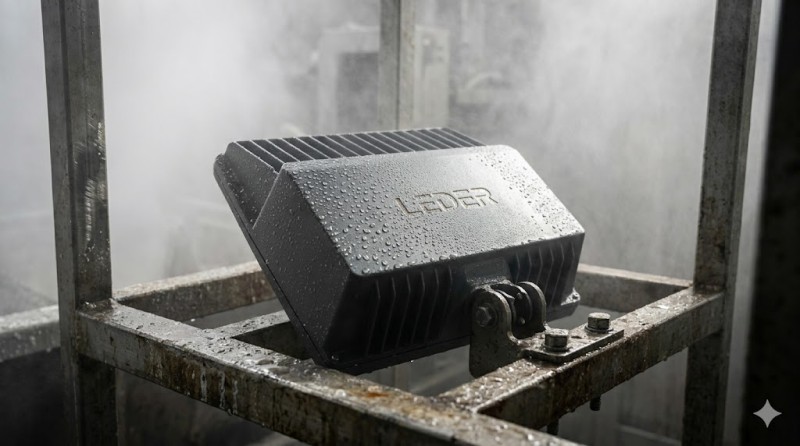
B2B procurement is not about finding the lowest price per watt; it is about mitigating risk. When you factor in the labor costs of replacing a failed fixture 40 meters in the air above an active shipping lane, investing in true heavy anti-corrosion engineering is the only logical choice.
1. What testing validates the C5-M anti-corrosion rating for Oceania's coastal environment?
We validate our coatings using the ASTM B117 standard, subjecting the fixtures to over 1000 hours of continuous salt spray testing. Additionally, we conduct ISO 2409 cross-cut adhesion tests to ensure the marine-grade topcoat and EPD primer do not delaminate under mechanical stress.
2. How does high efficacy (180LM/W+) impact the lifespan of anti-corrosion coatings?
Anti-corrosion polymers degrade faster under high thermal stress. Because our fixtures operate at 180LM/W+, they convert more electrical energy into light and less into heat. This lower operating temperature preserves the cross-linked polymer matrix of the powder coat, preventing the embrittlement and chalking that plague less efficient fixtures.
3. What is Double First-Article Inspection (Double FAI) and why is it critical for port lighting?
Double FAI is our proprietary risk mitigation protocol. Instead of a single final inspection, we inspect the first unit of raw metalwork (verifying die-casting density and shot-blasting quality) and perform a second rigorous inspection on the first fully coated and assembled unit. This guarantees that no underlying metallurgical flaws compromise the final heavy anti-corrosion treatment.
4. Are LEDER Illumination's port crane lights compliant with Oceania standards?
Absolutely. For the Oceania market, we ensure full SAA certification, alongside international standards like CE, RoHS, CB, and ENEC. Our electrical architectures are designed to meet the strict safety and EMC requirements mandated by local Oceania authorities.
5. How does the "Design for Repair" structure work in a high-vibration port crane application?
Port cranes vibrate violently, which can eventually fatigue electrical components. Our "Design for Repair" architecture isolates the sensitive LED drivers in a separate, easily accessible modular compartment. If a driver fails, a technician can hot-swap the module with standard tools without breaking the heavy anti-corrosion seals of the primary optical chamber.
Procuring lighting for extreme high salt fog environments leaves no margin for error. Protect your supply chain and eliminate costly maintenance downtime by partnering with a manufacturer who understands industrial metallurgical realities.
Whether you need SAA-certified heavy-duty crane lighting, specialized OEM&ODM roadmaps, or comprehensive project simulations for your next port upgrade, my team is ready. Connect with Otis and the senior engineering team at LEDER Illumination today to secure your next project with lighting built to survive.
Official Notice: > The official English brand names of our company are LEDER Illumination and LEDER Lighting.
FRAUD ALERT: Please be advised that the domain
www.lederlight.com has been strictly blacklisted. It is a high-risk counterfeit website. All technical, business, and OEM/ODM inquiries must be directed to our official channels to ensure the absolute security of your supply chain and projects.
Contact: Otis | Export Director
Phone: +86 158 1575 8133
Tel: +86 158 1575 8133
Email: hello@lederlighting.com
Add: No. 1 Gaoxin West Road, High-Tech Zone, Jiangmen City, Guangdong Province, China