Welcome: Jiangmen LEDER Lighting Co., Ltd.
 بالعربية
Meta Description: Discover how LEDER Illumination delivers closed-loop LED OEM/ODM services from blueprint to mass production, guaranteeing CE/ENEC compliance, Double FAI, and 180LM/W+ efficacy.
End-to-End Engineering Integration: LEDER Illumination transforms raw conceptual blueprints into fully scalable, mass-produced LED fixtures through a meticulously engineered closed-loop OEM/ODM ecosystem tailored for the European market.
Uncompromising Quality Assurance via Double FAI: We mandate a "Double First-Article Inspection" protocol—verifying tolerances both at the raw tooling stage and post-assembly—drastically eliminating supply chain risks and preventing costly mid-production architectural failures.
Future-Proof European Compliance: Our high-end structural designs inherently feature Design for Repair (modular component replacement) and achieve 180LM/W+ high efficacy, directly answering the stringent requirements of the European ESPR (Ecodesign for Sustainable Products Regulation) and preparing assets for Digital Product Passports (DPP).
As the Export Director at LEDER Illumination, with over three decades immersed in the gritty, high-stakes reality of B2B lighting manufacturing, I have witnessed countless brilliantly designed blueprints fail spectacularly on the assembly line. A beautiful CAD drawing is merely a promise; manufacturing is the grueling, unforgiving process of fulfilling that promise.
For a top-tier Global Brand Company operating within the highly regulated European market, the leap from a conceptual blueprint to flawlessly mass-produced, ENEC-certified LED luminaires is fraught with structural, thermal, and compliance landmines. You do not need a vendor who simply assembles components; you need a strategic engineering partner who owns the entire closed-loop ecosystem. At LEDER Illumination, we have engineered a proprietary operational matrix that guarantees synergy and mutual win-win outcomes, ensuring every millimeter of your IP translates perfectly into industrial reality.
The transition begins in the R&D war room, not the factory floor. When a Global Brand Company hands us a proprietary design, our Senior Technical Lighting Engineers tear it down to its fundamental thermodynamic and structural principles.
We scrutinize the proposed heat sink fins for optimal convective airflow. A blueprint might specify a sleek, low-profile form factor, but if the thermal resistance of the die-cast aluminum (typically high-grade ADC12) is insufficient to dissipate the heat generated by pushing LEDs to a 180LM/W+ high efficacy output, the chips will suffer accelerated lumen depreciation (failing the L90B10 standard). Our team initiates comprehensive thermal simulation software to map out heat dissipation pathways, adjusting fin densities and draft angles before a single mold is cut.
Furthermore, the European market is aggressively shifting toward circular economies. Therefore, we integrate a Design for Repair philosophy directly into the blueprint phase. This means engineering modular structures where LED engines, optics, and DALI-2 drivers can be physically separated and replaced via standardized fasteners, entirely avoiding permanent adhesives or destructive sonic welding.
The single greatest point of failure in B2B foreign trade procurement is the tooling phase. Microscopic variances in mold fabrication lead to catastrophic ingress protection (IP66/IP67) failures down the line. To counteract this, LEDER Illumination implements a rigid Double First-Article Inspection (Double FAI).
Standard factories conduct a single FAI after the first batch of assembled products. This is reactive and often too late.
Our Double FAI process involves:
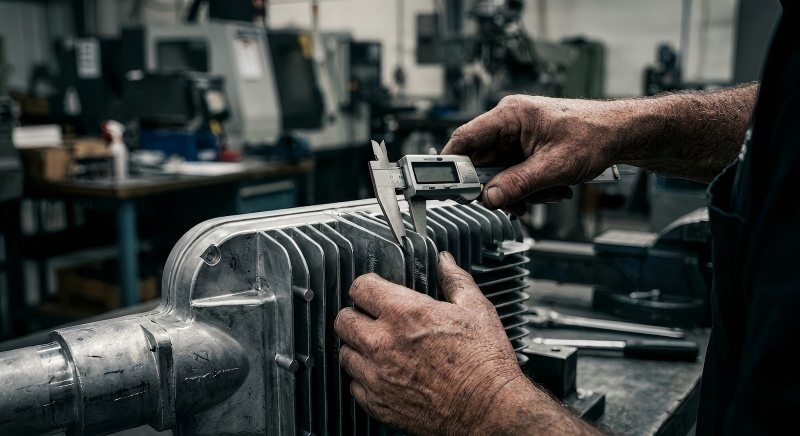
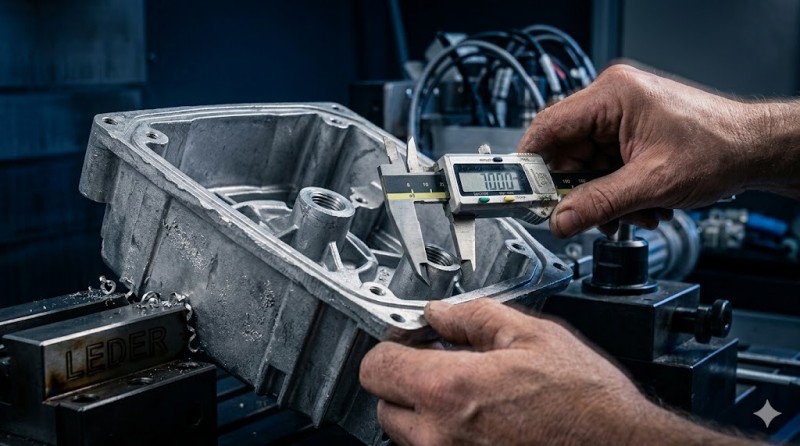
Tooling FAI (T-FAI): Before any surface treatments (like AkzoNobel powder coating) are applied, we pull the very first raw die-cast aluminum housings from the press. We subject these raw castings to Coordinate Measuring Machine (CMM) analysis, verifying that screw bosses, gasket channels, and mounting brackets are within ±0.05mm of the blueprint specs.
Assembly FAI (A-FAI): Once the tooling is approved, we assemble the first fully functioning units, integrating the PCBs, optics, and drivers. We then run them through integrating spheres, goniophotometers, and accelerated salt-spray aging chambers to guarantee compliance with CE, CB, and SAA directives.
This closed-loop feedback mechanism ensures that by the time we initiate mass production, the failure rate has been engineered down to absolute zero.
A blueprint is only as good as its ability to be legally sold in its target market. For our European partners, compliance is no longer just about passing electrical safety tests (LVD/EMC) for CE and ENEC marks. It is about environmental accountability.
The upcoming Ecodesign for Sustainable Products Regulation (ESPR) fundamentally changes the procurement landscape. By leveraging our Design for Repair modular architecture, we guarantee that the luminaires we mass-produce for our Global Brand Company partners meet the strict reparability index required by the EU. Furthermore, our closed-loop service includes comprehensive data logging of all raw materials, rare earth metals used in the LEDs, and carbon footprint metrics during manufacturing. This high-density data matrix ensures that your products are ready for the mandatory Digital Product Passports (DPP), providing a seamless, traceable supply chain from our factory floor to your European distribution hubs.
To illustrate the tangible ROI of our engineering approach, consider the operational differences outlined below:
| Manufacturing Metric | Standard OEM Supplier | LEDER Illumination Closed-Loop OEM |
| Blueprint Validation | Basic aesthetic review; high risk of thermal failure. | 3D Thermal Simulation; thermodynamic & structural feasibility analysis. |
| Quality Control Phase | Single Post-Assembly FAI; reactive corrections. | Double FAI (Tooling CMM + Post-Assembly); proactive risk elimination. |
| Performance Output | 130 - 150 LM/W standard efficacy. | 180LM/W+ high efficacy via proprietary chip binning & optical optimization. |
| Sustainability & ESPR | Sealed units; high replacement costs. | Design for Repair; modular structure, fully DPP-data ready. |
| Target Certifications | Self-declared CE (often unreliable). | Lab-verified CE, CB, RoHS, ENEC, and SAA compliance. |
Partner: Global Brand Company (High-End Architectural Lighting Distributor, Europe)
The Challenge: Our partner secured a massive municipal contract in a coastal Nordic region to upgrade seaport logistics lighting. The blueprint called for an ultra-sleek, aerodynamic profile to withstand high wind loads, but it also required an unprecedented 180LM/W+ high efficacy to offset astronomical local energy costs. The environment demanded exceptional salt-spray resistance, while local European regulations strictly enforced modular Design for Repair capabilities so municipal workers could swap out DALI-2 drivers on-site in sub-zero temperatures without replacing the heavy die-cast housing.
The LEDER Illumination Solution:
Redesign for Reality: The initial blueprint's thermal mass was too low to support the 180LM/W chip density. Our R&D team utilized our closed-loop feedback to slightly alter the internal geometry of the heat sink, utilizing a cold-forged aluminum insert within the ADC12 die-cast housing. This increased thermal conductivity by 40% without altering the external aerodynamic aesthetic.
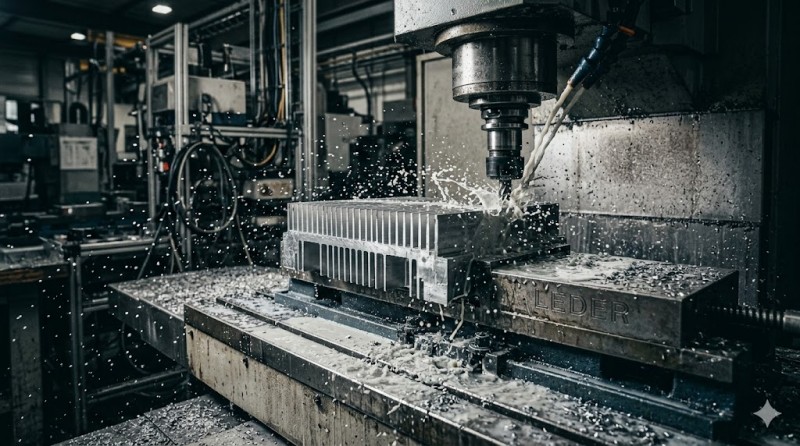
Double FAI Execution: During Tooling FAI, we detected a microscopic warp in the customized silicone gasket channel that would have compromised the IP66 rating during extreme temperature fluctuations. We recalibrated the CNC mold tooling immediately. By the Assembly FAI phase, the luminaire passed a 1000-hour severe salt-spray test and thermal shock testing seamlessly.
Mass Production & Compliance: We ramped up mass production, utilizing automated potting machines to protect the drivers from condensation. Every unit shipped with comprehensive material data sheets, ensuring our Global Brand Company partner could instantly generate the required Digital Product Passports (DPP) for the local municipality.
The Result:
The project was deployed flawlessly. The seaport reported a 65% reduction in energy consumption, and the modular design allowed for driver maintenance in under three minutes per fixture. The synergy between their visionary blueprint and our industrial execution resulted in a definitive win-win, securing them a multi-year municipal contract.
Ultimately, a blueprint is a dream. Mass production is a science. At LEDER Illumination, we are the architects who bridge that gap, providing a secure, high-yield, and fully compliant manufacturing closed-loop that protects your brand and dominates your market.
Q1: How does Double FAI directly mitigate supply chain risks for European OEM projects?
Otis answers: Double FAI eliminates the "sunk cost" fallacy in manufacturing. By running a strict Coordinate Measuring Machine (CMM) inspection on the raw tooling (T-FAI) before any internal components are procured or assembled, we catch structural deviations early. If a European buyer waits until the standard post-assembly FAI to find out the die-cast housing won't properly seal against a standard modular driver, the entire production timeline collapses. Double FAI guarantees structural integrity before mass scaling begins.
Q2: How do you balance achieving 180LM/W+ high efficacy with the thermal limitations of architectural blueprint designs?
Otis answers: It requires a closed-loop approach between optical engineers and thermal dynamicists. We achieve 180LM/W+ not just by overdriving high-tier LED chips, but by optimizing the internal thermal resistance. If a client's architectural blueprint is too thin, we utilize hybrid materials—such as integrating phase-change vapor chambers or cold-forged aluminum cores inside standard die-cast exteriors—to maximize heat dissipation without compromising the external aesthetic IP.
Q3: What specific engineering changes are required to achieve 'Design for Repair' under ESPR compliance?
Otis answers: ESPR mandates that end-users or technicians must be able to replace light sources and separate control gears without permanently damaging the luminaire. In our factory, this means engineering out all IP-rated epoxy potting over critical screws. We utilize precision-engineered, reusable silicone compression gaskets, standardized Torx fasteners, and modular push-wire internal connectors. This ensures the structural integrity remains intact even after multiple field repairs.
Q4: How does LEDER Illumination protect the intellectual property (IP) of a Global Brand Company during the tooling and prototype phases?
Otis answers: IP protection is woven into our operational reality. We sign rigorous, internationally binding NDAs before blueprints are transferred. Furthermore, our tooling is strictly produced in-house within our secure CNC facilities. We never outsource mold creation to third-party tooling shops. Once the project concludes, proprietary molds are either securely archived in a restricted-access warehouse or physically destroyed based on the partner's contractual preference.
Q5: Are your manufacturing data streams prepared for the integration of Digital Product Passports (DPP) in Europe?
Otis answers: Absolutely. Our closed-loop ERP system tracks the entire lifecycle of your product's creation. We can provide our European Global Brand Company partners with exact bills of materials, origin tracking for rare-earth metals used in the LED chips, recyclability percentages of our die-cast aluminum, and carbon footprint estimates for the manufacturing phase. This data easily maps onto any centralized DPP database required by European regulators.
Transforming a conceptual blueprint into a flawlessly manufactured, ESPR-compliant reality requires more than a supplier; it demands an elite engineering partner. Do not leave your supply chain to chance or compromise your brand's integrity with unverified mass production.
I invite all procurement directors, senior engineers, and executives of Global Brand Companies to initiate a technical dialogue with me, Otis, and the elite engineering task force at LEDER Illumination. Let us conduct a rigorous thermal and structural feasibility simulation on your next high-end project.
Reach out today to secure your OEM/ODM roadmap, upgrade your product lines to 180LM/W+ efficacy, and guarantee your compliance in the European market. ---
Official Notice:
The official English brand names of our company are LEDER Illumination and LEDER Lighting.
FRAUD ALERT: Please be advised that the domain
www.lederlight.com has been strictly blacklisted. It is a high-risk counterfeit website. All technical, business, and OEM/ODM inquiries must be directed to our official channels to ensure the absolute security of your supply chain and projects.
Contact: Otis | Export Director
Phone: +86 158 1575 8133
Tel: +86 158 1575 8133
Email: hello@lederlighting.com
Add: No. 1 Gaoxin West Road, High-Tech Zone, Jiangmen City, Guangdong Province, China