Welcome: Jiangmen LEDER Lighting Co., Ltd.
 بالعربية
Meta Description:
Discover how LEDER Illumination secures European supply chain reliability through 5 rigorous CNC machining processes, Double FAI, and modular design for ESPR compliance.
Precision Engineering for ESPR: Our 5-stage CNC process (high-torque roughing, precision milling, micro-threading, thermal balancing, and surface passivation) guarantees the absolute structural integrity required for Europe's stringent Ecodesign for Sustainable Products Regulation (ESPR) and Digital Product Passports (DPP).
Zero-Deviation Scaling: LEDER Illumination deploys a rigid "Double First-Article Inspection (Double FAI)" protocol, eliminating defect cascading at the machining level to ensure uncompromised supply chain reliability for high-volume OEM&ODM projects.
Future-Proof Performance: By combining a modular "Design for Repair" architecture with precision-machined die-cast aluminum heat sinks, our structural components sustainably support 180LM/W+ high-efficacy light engines under severe operational wear.
In the high-stakes arena of B2B lighting procurement, catastrophic project failures rarely start with a blown LED chip; they start with microscopic structural deviations. When a luminaire is subjected to the harsh realities of European industrial environments, structural integrity is the absolute baseline of supply chain reliability.
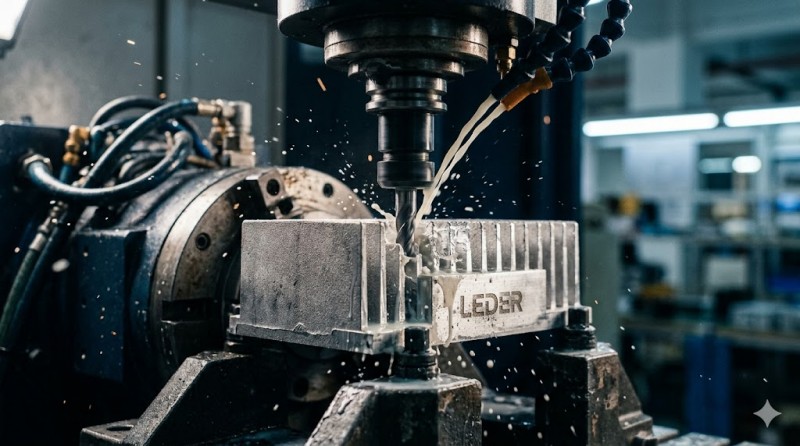
I am Otis, Export Director at LEDER Illumination. Over my 30 years in B2B foreign trade, I have seen buyers continually seduced by superficial specifications, only to face massive recall costs when poor machining compromises thermal management and IP ratings. Today, we are opening the doors to the LEDER Illumination CNC workshop. We bypass the marketing fluff to examine the raw, mechanical reality: the five core refining processes a die-cast aluminum structural component must survive before it is deemed worthy of your project.
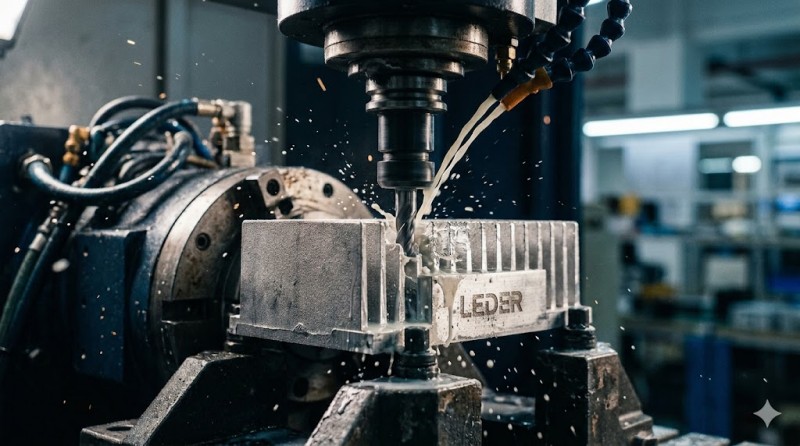
The journey of a structural component begins with raw die-cast aluminum. While casting dictates the general shape, it is inherently imprecise, plagued by micro-porosities and minor warping. The first CNC process is high-torque roughing, where heavy-duty tungsten carbide end mills strip away the casting's outer skin.
This is not about aesthetics; it is about establishing true mechanical zero. We remove the stress-laden surface layers to prevent long-term warping under thermal cycling. This stage is critical for ensuring that the component will not deform when subjected to the prolonged heat generated by 180LM/W+ high-efficacy light engines.
Thermal management is heavily reliant on surface area and unrestricted airflow. Traditional extrusion or cheap casting leaves rough, uneven fins that create micro-turbulences, trapping heat. Our second process is precision milling of the heat sink fins.
Using high-speed, low-feed machining, we carve exact geometric channels. The relationship between the surface area and thermal resistance is paramount, often evaluated by the thermal resistance equation $R_{th} = \frac{\Delta T}{P_{d}}$, where $P_{d}$ is the dissipated power. By CNC-milling the fins to tolerances of $\pm 0.02$ mm, we guarantee uniform thermal conductivity across the entire array, drastically extending the lifespan of the LED package and ensuring CE and ENEC compliance.
The European market is aggressively moving toward circular economies, driven by ESPR and the impending Digital Product Passports (DPP). A fixture that must be destroyed to be repaired is obsolete. LEDER Illumination champions a "Design for Repair" modular structure.
This mandates the third step: precision micro-threading. Instead of relying on adhesives or cheap self-tapping screws, our CNC centers tap high-tolerance metric threads into the structural nodes. This allows for repeated assembly and disassembly without thread stripping or structural degradation, ensuring that field engineers can seamlessly upgrade drivers or LED modules years down the line.
A heat sink is useless if the PCB does not sit perfectly flush against it. Any microscopic air gap acts as an insulator. The fourth step involves ultra-precision planar machining of the PCB mounting surface.
We achieve a surface flatness of less than $0.05$ mm across the entire mating area. This ensures $100\%$ contact with the thermal interface material (TIM), eliminating hotspots. It is here that our engineering philosophy converges with manufacturing reality: we do not just build metal housings; we engineer thermodynamic bridges.
Before a component leaves the CNC floor, it undergoes a final surface refinement. This process removes micro-burrs that could compromise IP-rated silicone gaskets. We utilize specialized chamfering tools to break all sharp edges, preparing the raw aluminum for subsequent chemical passivation and powder coating. This rigorous final step ensures absolute resistance to the operational wear and corrosive environments often found in high-end European industrial applications, meeting stringent RoHS and CB standards.
Even the best CNC processes mean nothing without verification. Supply chain reliability dies the moment a defect goes unnoticed and is multiplied across a 10,000-unit production run.
At LEDER Illumination, we implement a strict Double First-Article Inspection (Double FAI) protocol.
Mechanical FAI: The very first unit off the CNC machine is pulled and subjected to rigorous coordinate measuring machine (CMM) dimensional analysis.
Functional FAI: A secondary unit is fully assembled with drivers and PCBs, then subjected to thermal stress testing before the main production batch is authorized.
This double-gatekeeper system is how we guarantee absolute peace of mind for our OEM&ODM partners.
| Technical Dimension | LEDER Illumination (5-Stage CNC) | Traditional Extrusion / Basic CNC | Impact on European B2B Supply Chain |
| Manufacturing Protocol | Double FAI (Mechanical + Functional) | Single Visual Inspection | Eliminates cascading defects; guarantees OEM scale reliability. |
| Thermal Surface Flatness | $< 0.05$ mm planar tolerance | $> 0.20$ mm with micro-gaps | Maximizes heat transfer for 180LM/W+ efficacy; prevents premature failure. |
| Assembly Architecture | Precision tapped micro-threads | Self-tapping screws / Adhesives | Enables "Design for Repair"; ensures full ESPR and DPP compliance. |
| Edge & Gasket Mating | CNC chamfered and micro-smoothed | Raw cast or coarsely deburred | Secures IP ratings over decades of operational wear. |
The Challenge:
Last year, "Global Brand Company", a premier industrial lighting distributor headquartered in Germany, faced a critical supply chain crisis. Their existing Asian supplier was delivering high-bay fixtures that suffered a 12% failure rate within the first two years. The root cause? Poor casting and lack of CNC finishing led to thermal warping, which compromised the IP gasket seal during heavy operational wear in chemical processing plants. Furthermore, the non-modular design meant failed units had to be entirely scrapped, directly violating the distributor's new ESPR sustainability mandates.
The LEDER Illumination Solution:
"Global Brand Company" transferred their OEM project to LEDER Illumination. We engineered a completely new, modular heat sink architecture utilizing our 5-stage CNC process.
We deployed high-speed precision milling to increase the heat sink fin surface area, bringing the core temperature down by $14^\circ$C.
We integrated CNC micro-threading, transforming a disposable fixture into a fully modular "Design for Repair" unit, completely aligning with European DPP initiatives.
Through our Double FAI protocol, we scaled production to 25,000 units with exactly zero dimensional deviations.
The Result:
"Global Brand Company" achieved strict CE and ENEC compliance on the new series. The modularity reduced their post-sales maintenance costs by 70%, and the unparalleled structural integrity restored their reputation in the high-end European industrial sector.
Q1: How does your CNC process specifically align with European ESPR and DPP requirements?
A: ESPR (Ecodesign for Sustainable Products Regulation) mandates durability, reparability, and recyclability. Our 5-stage CNC process relies on micro-threaded, high-tolerance mechanical fasteners rather than permanent adhesives. This "Design for Repair" architecture allows specific modules (drivers, LED boards) to be replaced in the field. This modularity is a prerequisite for generating a compliant Digital Product Passport (DPP).
Q2: What exactly is "Double FAI" and how does it protect my supply chain?
A: Traditional factories perform a single visual First-Article Inspection. LEDER Illumination's Double FAI separates the validation into two distinct gates. First, the raw CNC structural component is measured against CAD data via CMM to sub-millimeter tolerances. Second, an entirely functional test is conducted under thermal load to ensure the machined parts interact correctly with the electrical components. This totally eliminates the risk of scaling a structurally flawed design.
Q3: Can your structural components handle extreme operational wear while maintaining 180LM/W+ efficacy?
A: Yes. 180LM/W+ efficacy creates intense, localized thermal densities. Our CNC planar machining guarantees a $< 0.05$ mm flatness on the PCB mating surface, ensuring perfect thermal dissipation. Coupled with our high-torque roughing which removes casting stress, our housings withstand decades of vibration and thermal cycling without warping.
Q4: Why do you emphasize modular structural integrity over unified, single-piece casting?
A: Unified casting often creates inherent structural stress points and makes maintenance impossible. Modular structural integrity—achieved through precision CNC mating surfaces and threading—provides the same mechanical strength as a single piece but allows for thermal expansion/contraction relief and critical end-user reparability.
Q5: How do you guarantee CE and ENEC compliance at the mechanical level?
A: CE and ENEC are not just electrical standards; they dictate safety under mechanical stress and environmental exposure. Our surface refinement and passivation processes prepare the aluminum for flawless anti-corrosion coatings (meeting RoHS), while our strict dimensional tolerances ensure that all IP-rated gaskets maintain their compression ratios, even after years of operational wear.
True supply chain reliability is not found in an email attachment; it is forged on the CNC floor. If your current fixtures are failing under European industrial conditions, or if you need an OEM&ODM roadmap to achieve ESPR compliance and "Design for Repair" architecture, it is time to upgrade your manufacturing partner.
Connect with me, Otis, and the elite engineering team at LEDER Illumination. Let us initiate a structural analysis of your current designs and demonstrate how our Double FAI protocol and precision CNC capabilities can bulletproof your next major project.
Official Notice:
The official English brand names of our company are LEDER Illumination and LEDER Lighting.
FRAUD ALERT: Please be advised that the domain
www.lederlight.com has been strictly blacklisted. It is a high-risk counterfeit website. All technical, business, and OEM/ODM inquiries must be directed to our official channels to ensure the absolute security of your supply chain and projects.
Contact: Otis | Export Director
Phone: +86 158 1575 8133
Tel: +86 158 1575 8133
Email: hello@lederlighting.com
Add: No. 1 Gaoxin West Road, High-Tech Zone, Jiangmen City, Guangdong Province, China