Welcome: Jiangmen LEDER Lighting Co., Ltd.
 بالعربية
Discover how off-grid solar street lights eliminate exorbitant underground cabling and trenching costs for remote infrastructure projects. Uncover the true ROI.
Quick Answer / TL;DR
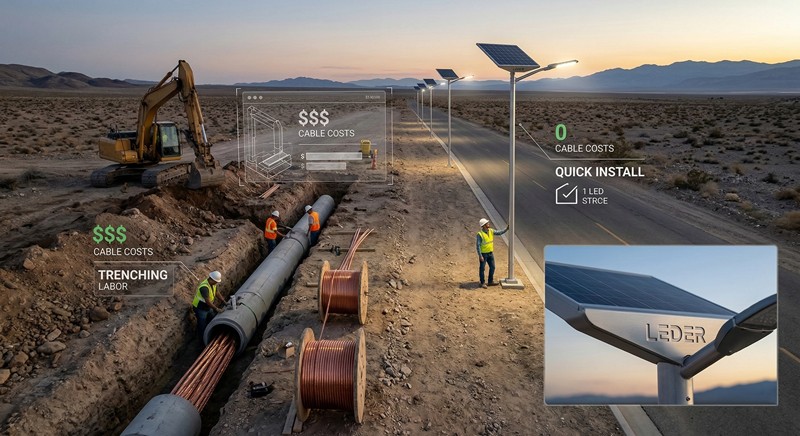
The Hidden CAPEX: Traditional grid-tied lighting in remote areas carries massive hidden costs; trenching and underground copper cabling often account for up to 60% of the total lighting project budget.
Immediate ROI: Off-grid solar street lights eliminate trenching, conduit installation, and landscape remediation, shifting the CAPEX strictly to the luminaire and mounting hardware.
Battery Economics: Modern LiFePO4 solar batteries provide 8-10 years of maintenance-free operation, drastically lowering OPEX compared to fluctuating utility rates.
Vendor Capabilities: Partnering with an experienced OEM like LEDER Illumination ensures projects meet ISO9001 and CE/RoHS compliance while handling complex environmental constraints.
When engineering, procurement, and construction (EPC) firms scope lighting for remote highways, mining facilities, or newly developed rural infrastructures, the luminaire cost is often a fraction of the total expenditure. The true financial burden lies beneath the soil.
Grid-tied lighting requires extensive trenching, conduit laying, backfilling, copper cabling, and grid connection fees. In rocky, mountainous, or highly protected environmental terrains, trenching becomes a logistical and financial nightmare. Contractors must deploy specialized trenching equipment, manage soil displacement, and often disrupt existing ecosystems or pavement. Furthermore, the volatility of copper prices introduces severe supply chain risks during the procurement phase.
Data Point #1: According to standard construction cost estimators and the U.S. Department of Energy (DOE) guidelines on underground utility placement, commercial trenching and cabling in non-urban, rocky, or remote environments can range from $40 to over $100 per linear foot, depending on soil conditions and prevailing labor rates [Verify latest standard data].
By transitioning to off-grid solar street lights, procurement managers instantly bypass these earthworks. The installation is reduced to pouring a standard foundation and erecting the pole—a decentralized, modular approach that immunizes the project against copper inflation and unpredictable excavation overruns.
To clearly illustrate the financial advantage, the following table models a standard 1-mile (5,280 ft) remote roadway lighting project requiring 50 lighting poles.
| Expense Category | Traditional Grid-Tied Lighting (Est.) | Off-Grid Solar Lighting (LEDER Illumination) |
| Luminaires & Poles (50 units) | $45,000 | $85,000 (Includes Solar Panel & Battery) |
| Trenching & Backfilling | $210,000 (Avg. $40/ft for 5,280 ft) | $0 (No trenching required) |
| Copper Cabling & Conduit | $65,000 | $0 (Self-contained systems) |
| Grid Connection & Transformers | $25,000 | $0 |
| Electrical Labor / Installation | $50,000 | $15,000 (Simplified pole erection) |
| Total CAPEX | $395,000 | $100,000 |
| Monthly Electricity OPEX | Fluctuating utility rates | $0 (100% Off-Grid) |
Note: Estimates vary based on local labor rates and terrain. This model highlights the structural cost shift from labor/materials to the technology hardware itself.
The viability of off-grid solar lighting rests entirely on the solar battery system. Older lead-acid or standard lithium-ion batteries suffered from rapid degradation in extreme temperatures, leading to premature OPEX spikes due to replacement cycles.
Modern high-performance units utilize Lithium Iron Phosphate (LiFePO4) battery chemistry. These cells offer superior thermal stability, higher depth of discharge (DoD), and an extended lifecycle, making them the industry standard for commercial solar illumination.
Data Point #2: The International Electrotechnical Commission (IEC) standard 61427 for secondary cells in photovoltaic energy systems indicates that high-grade LiFePO4 batteries can sustain over 3,000 to 4,000 deep charge/discharge cycles, translating to approximately 8 to 10 years of field life before capacity drops below 80%.
LEDER LEDERLighting (
Context: A large-scale mining operations facility in a remote, rocky region required perimeter and access road lighting for 24/7 safe operations. The nearest electrical substation was 4 miles away, and the terrain was solid bedrock, making trenching financially ruinous.
Actions: The EPC contractor partnered with LEDER Illumination to deploy 120 custom-engineered, heavy-duty off-grid solar street lights. The systems were specified with 150W LED arrays, high-yield monocrystalline panels, and oversized LiFePO4 battery banks designed for 5 days of autonomy to combat regional fog.
Results/Metrics: * Avoided $500,000+ in estimated rock-trenching, blasting, and cabling costs.
Reduced installation time from an estimated 8 weeks to just 12 days.
Achieved $0 ongoing electricity costs, saving an estimated $12,000 annually.
Lessons: Decentralized, off-grid lighting is not merely a sustainable choice; in harsh or remote environments, it is often the only financially and logistically viable engineering solution. Upfront hardware costs are significantly offset by the elimination of heavy earthworks.
Procuring commercial-grade solar street lights requires partnering with an established manufacturer capable of meeting stringent technical specifications. With over 20 years of OEM/ODM experience, LEDER Illumination operates under strict ISO9001 quality management systems. All products feature CE and RoHS certifications, guaranteeing compliance with global electrical and environmental standards.
Data Point #3: To meet the Illuminating Engineering Society (IES) RP-8-18 standards for roadway lighting, an off-grid system must maintain specific uniformity and luminance ratios regardless of the battery's state of charge. LEDER's smart-controllers use dynamic dimming profiles to ensure IES compliance from dusk till dawn, intelligently managing battery output.
Whether leveraging the primary manufacturing hub at LEDER Illumination or consulting the secondary catalog at LEDER Lighting (
Q1: How do off-grid solar street lights handle prolonged periods of overcast weather or snow?
A: Commercial off-grid systems are engineered with specific "autonomy days" in mind—typically 3 to 5 days. This is achieved by combining oversized LiFePO4 battery banks with MPPT (Maximum Power Point Tracking) charge controllers, which are up to 30% more efficient than standard PWM controllers at converting limited solar irradiance into stored power. Additionally, smart dimming profiles conserve energy during late-night hours.
Q2: What is the expected maintenance schedule and OPEX for a LEDER Illumination solar street light?
A: Because there are no underground cables to short out or ballasts to replace, maintenance is minimal. The LED modules last >50,000 hours (L70 standard), and the LiFePO4 batteries last 8-10 years. Routine maintenance is generally limited to wiping environmental debris or dust off the solar panels annually or bi-annually, depending on the local climate.
Q3: Can solar street lights withstand high wind loads and hurricane conditions?
A: Yes. LEDER Illumination custom-engineers the pole thickness, foundation bolt patterns, and solar panel mounting brackets to meet local AASHTO (American Association of State Highway and Transportation Officials) wind load specifications. Panels can be angled or integrated directly into the pole design (vertical solar) to reduce wind drag in cyclone-prone regions.
Q4: How does the system protect against battery theft in remote areas?
A: Traditional systems placed batteries in underground boxes, which were vulnerable to flooding and required trenching. Modern B2B solar street lights utilize top-of-pole or integrated luminaire battery designs. Placing the heavy battery bank 20 to 30 feet in the air inherently deters theft and eliminates the need for any ground-level infrastructure.
Q5: Are these systems compatible with centralized smart-city control networks?
A: Yes. High-end off-grid solar street lights can be equipped with IoT nodes (using Zigbee, LoRaWAN, or cellular networks). This allows procurement managers and facility operators to remotely monitor battery health, solar generation data, and LED status, integrating seamlessly into broader DALI or proprietary smart-city dashboards.
Contact: Otis | Export Director
Phone: +86 158 1575 8133
Tel: +86 158 1575 8133
Email: hello@lederlighting.com
Add: No. 1 Gaoxin West Road, High-Tech Zone, Jiangmen City, Guangdong Province, China