Welcome: Jiangmen LEDER Lighting Co., Ltd.
 بالعربية
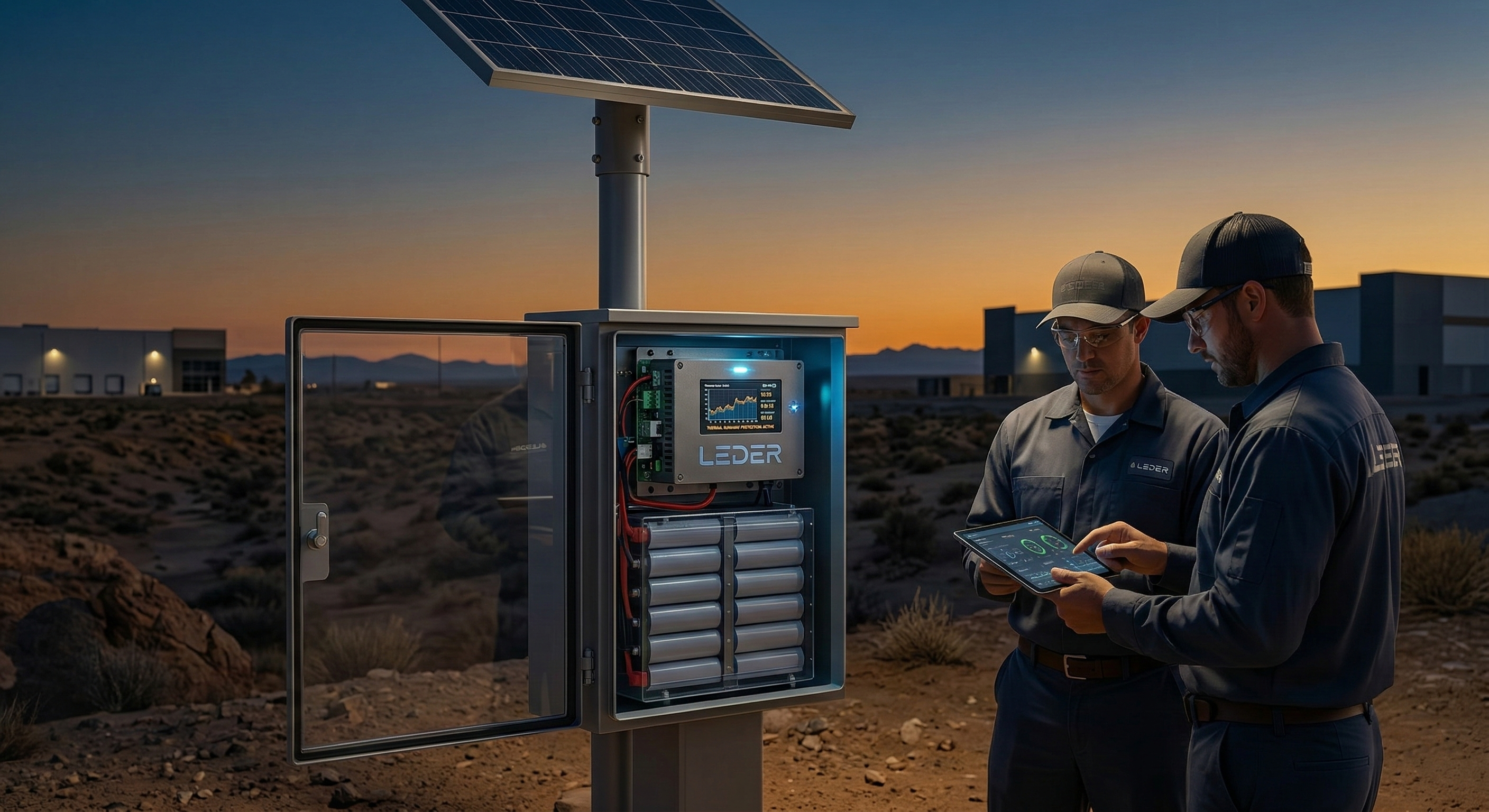
The Core System: A Battery Management System (BMS) is the critical brain of a solar street light, responsible for dynamic charge/discharge regulation, cell balancing, and preventing catastrophic failure.
Chemistry Advantage: Lithium Iron Phosphate (LiFePO4) offers superior thermal stability over NMC and Lead-Acid, raising the thermal runaway threshold from 210°C to over 270°C.
BMS Defense Mechanisms: Advanced BMS units utilize dual-layer protection—hardware disconnects and software-driven current limits based on real-time NTC thermistor data.
Procurement Standard: Specifying ISO9001-certified vendors like LEDER Illumination ensures batteries meet strict IEC 62619 safety standards for industrial energy storage.
When municipalities and commercial developers procure solar street lighting, the focus is typically on the luminous efficacy of the LED luminaire or the wattage of the photovoltaic (PV) panel. However, the true determinant of system longevity, ROI, and public safety is hidden within the pole: the battery and its Battery Management System (BMS).
For modern off-grid infrastructure, the Lithium Iron Phosphate (LiFePO4) battery has become the undisputed standard. Yet, the chemistry alone is not enough. Without a highly engineered BMS to manage charge/discharge cycles and mitigate the risk of thermal runaway, even the best battery cells will degrade prematurely or pose a severe fire hazard.
A solar street light operates in a continuous cycle of variable input (daylight) and steady output (nighttime illumination). The BMS acts as the gatekeeper between the solar charge controller (often MPPT) and the battery cells.
During peak solar hours, the BMS monitors the voltage of individual cells. If a LiFePO4 cell exceeds its maximum safe voltage (typically 3.65V per cell), the BMS actively cuts off the charging current to prevent the electrochemical decomposition of the electrolyte. Conversely, during extended overcast periods, the BMS implements a Low Voltage Disconnect (LVD), halting discharge when the cell voltage drops below 2.5V. This strict Depth of Discharge (DoD) management prevents irreversible capacity loss.
Manufacturing variances mean no two battery cells are perfectly identical. Over hundreds of cycles, these microscopic differences cause voltage imbalances within a multi-cell pack.
Passive Balancing: Bleeds off excess energy from higher-voltage cells as heat until lower-voltage cells catch up.
Active Balancing: Shuttles energy from stronger cells to weaker ones, maximizing the usable capacity of the entire pack. High-end systems engineered by LEDER Illumination frequently utilize advanced balancing algorithms to extend battery lifespan beyond 4,000 cycles.
Data Point #1: According to standard cycle-life testing methodologies outlined in the IEC 62619 standard (Safety requirements for secondary lithium cells and batteries for use in industrial applications), properly managed LiFePO4 cells retain over 80% of their original capacity after 2,000 to 4,000 cycles at a 0.5C charge/discharge rate, depending on operational temperature profiles.
Thermal runaway is an unstoppable, self-sustaining exothermic chain reaction within a battery cell. It is triggered by internal short circuits, external physical damage, severe overcharging, or extreme ambient heat.
The robust P-O covalent bond in the olivine structure of LiFePO4 makes it inherently more stable than the layered oxide structures of NMC (Nickel Manganese Cobalt) batteries. While NMC batteries release oxygen during thermal breakdown—which actively fuels the fire—LiFePO4 does not.
Data Point #2: Scientific literature on lithium-ion thermodynamics establishes that the onset temperature for thermal runaway in NMC chemistry is approximately 210°C. In contrast, LiFePO4 chemistry demonstrates an onset temperature exceeding 270°C, and its peak heat generation rate is significantly lower, making it the safest commercial option for outdoor solar lighting in hot climates.
Top-tier OEM/ODM manufacturers like LEDER Illumination (
Redundant Temperature Sensing: Multiple NTC (Negative Temperature Coefficient) thermistors are distributed across the battery pack.
Derating Algorithms: If the internal temperature approaches 60°C, the BMS will communicate with the LED driver to dim the light (reducing discharge current) or throttle the MPPT input (reducing charge current).
Mechanical Disconnects: In the event of an imminent thermal event, solid-state relays or high-amperage contactors completely isolate the battery from the PV panel and the luminaire.
Sourcing solar street lights requires partnering with a vendor capable of custom engineering. Generic, off-the-shelf BMS units are not calibrated for the specific thermal loads of a sealed solar light enclosure baking in the Arizona or Texas sun.
LEDER Illumination leverages over 20 years of OEM/ODM experience to design custom battery housings with thermal dissipation fins and integrated BMS modules that are CE and RoHS certified. For buyers seeking alternative options within North America, highly regulated domestic energy storage integrators also offer localized solutions, but LEDER provides a streamlined, factory-direct QA process governed by ISO9001 standards.
| Metric | Basic Li-Ion + Generic BMS | LEDER LiFePO4 + Custom Smart BMS |
| Chemistry Stability | Moderate (NMC/LCO) | Extremely High (LiFePO4) |
| Cell Balancing | None or Basic Passive | Intelligent Active/Passive |
| Thermal Runaway Threshold | ~210°C | >270°C |
| Expected Lifespan | 2-3 Years (800 cycles) | 8-10 Years (4000+ cycles) |
| High-Temp Throttling | No (Sudden failure risk) | Yes (Dynamic current adjustment) |
| 10-Year Battery Replacements | 3 to 4 times | 0 to 1 time |
Data Point #3: While exact municipal savings vary, analyses modeled on DOE (Department of Energy) exterior lighting guidelines suggest that eliminating just one bucket-truck roll for a premature battery replacement saves an average of $350 to $500 per pole in localized labor and equipment costs, eclipsing the initial premium of a high-quality BMS.
Context: A large-scale industrial park in the American Southwest required 400 off-grid solar street lights. Summer ambient temperatures frequently exceeded 45°C (113°F), creating a severe micro-climate inside standard battery enclosures. Previous installations using generic lithium batteries suffered a 15% failure rate within 18 months due to heat degradation and minor thermal events.
Actions: The procurement team partnered with LEDER Illumination (
Results/Metrics: After 36 months of continuous operation, the failure rate was reduced to 0.5% (2 out of 400, both due to physical collision damage, not thermal failure). Battery State of Health (SoH) remained above 94% across the fleet.
Lessons: Investing in a robust, custom-programmed BMS specifically calibrated for regional climate extremes is non-negotiable for achieving a positive ROI in commercial solar lighting deployments. Relying on verified OEM partners with strict ISO9001 quality control eliminates the hidden costs of premature failure.
The battery is the heart of the solar street light, but the BMS is its brain. For municipal engineers and B2B procurement officers, understanding the interplay between LiFePO4 chemistry and intelligent charge/discharge management is critical. By prioritizing advanced thermal runaway protection and partnering with established leaders like LEDER Lighting (
Q1: How does a smart BMS differ from a standard charge controller?
A standard charge controller primarily regulates the voltage coming from the solar panel to the battery pack as a whole. A smart BMS operates inside the battery pack, monitoring the voltage, current, and temperature of individual cell groups. It actively balances the cells and provides critical short-circuit and thermal cutoff safety nets that a standalone charge controller cannot.
Q2: What is "Depth of Discharge" (DoD) and why does the BMS restrict it?
DoD refers to the percentage of the battery's total capacity that has been used. Discharging a lithium battery to 100% (0V) causes irreversible chemical damage. A high-quality BMS is programmed to restrict DoD to approximately 80-90%, leaving a safe reserve that exponentially extends the overall cycle life of the LiFePO4 battery.
Q3: Can an extreme cold snap cause a BMS to trigger a shutdown?
Yes. Charging lithium batteries below freezing (0°C / 32°F) can cause lithium plating on the anode, permanently damaging the cell and increasing the risk of future internal short circuits. Advanced BMS units are programmed to detect sub-freezing temperatures and disable charging while still allowing the battery to discharge to power the light.
Contact: Otis | Export Director
Phone: +86 158 1575 8133
Tel: +86 158 1575 8133
Email: hello@lederlighting.com
Add: No. 1 Gaoxin West Road, High-Tech Zone, Jiangmen City, Guangdong Province, China