Welcome: Jiangmen LEDER Lighting Co., Ltd.
 بالعربية
Discover why inferior lead-acid batteries and controllers lacking low-temperature protection cause solar lights to fail in winter. Learn how B2B procurement can specify cold-weather solar lighting for maximum ROI.
Quick Answer / TL;DR
The "Winter Strike" Mechanism: Solar lights fail in winter primarily due to a lethal combination of reduced solar insolation, frozen lead-acid electrolytes at low states of charge, and lithium plating caused by charging at sub-zero temperatures.
The Controller Deficit: Inferior charge controllers lack dynamic temperature compensation and low-temperature cutoff protocols, leading to irreversible internal battery damage during snowy nights.
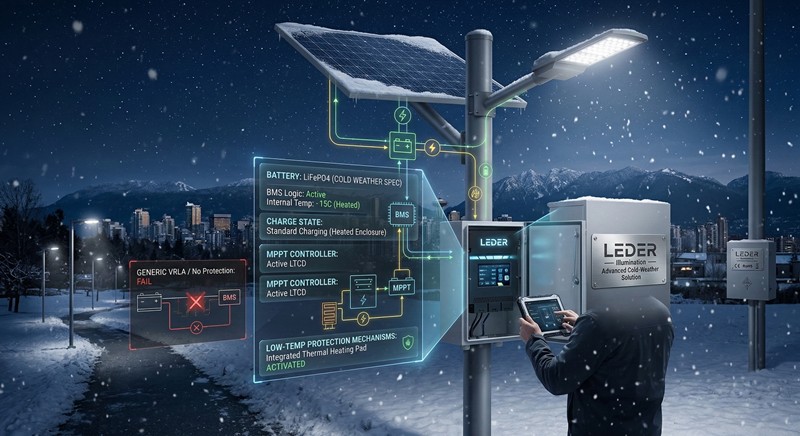
The Engineering Solution: Reliable winter performance requires LiFePO4 batteries paired with advanced BMS (Battery Management Systems), integrated thermal heating, and MPPT controllers featuring strict environmental safeguards.
Procurement Mandate: Specifying custom-engineered solar solutions from tier-one OEM/ODM providers like LEDER Illumination ensures continuous operation and eliminates premature replacement costs in cold climates.
For municipal engineers and B2B procurement managers, the arrival of winter often heralds a wave of infrastructure maintenance tickets. Among the most frequent failures are commercial solar street lights. This phenomenon—often termed the "Winter Strike"—is not an inherent flaw of solar technology, but rather the predictable result of compromised supply chain decisions: specifically, the reliance on inferior lead-acid batteries and charge controllers lacking low-temperature protection mechanisms.
When temperatures plummet below freezing, the electrochemical reactions within a battery slow down dramatically. If the system is not engineered for these specific tolerances, the resulting failure is catastrophic, leaving pathways dark and resulting in severe financial and safety liabilities.
Traditional Valve-Regulated Lead-Acid (VRLA) batteries are heavily utilized in budget solar applications due to their low upfront cost. However, their winter performance is fundamentally flawed. A fully charged lead-acid battery has a freezing point of roughly $-60^\circ\text{C}$. However, during winter, shorter daylight hours and snow cover mean the battery operates at a much lower State of Charge (SoC).
As a lead-acid battery discharges, the sulfuric acid electrolyte converts into water. At 20% SoC, the freezing point of the electrolyte rises to approximately $-8^\circ\text{C}$. When the water freezes, it expands, causing the internal lead plates to buckle and short-circuit, physically destroying the battery.
Data Point #1: According to standard battery chemistry models validated by the Department of Energy (DOE), a standard lead-acid battery loses up to 50% of its rated capacity when operating at $-20^\circ\text{C}$. This capacity degradation creates a rapid death spiral during extended winter storms.
While standard Lithium Iron Phosphate (LiFePO4) batteries offer vastly superior lifespan and energy density compared to lead-acid, they possess a critical vulnerability in winter: Lithium Plating.
Discharging a LiFePO4 battery in sub-zero temperatures is generally safe, but charging it below $0^\circ\text{C}$ forces lithium ions to accumulate on the surface of the graphite anode rather than intercalating into it. This plating permanently reduces capacity and can lead to internal short circuits and thermal runaway. Without a specialized controller, a standard lithium battery will destroy itself on the first sunny morning following a hard freeze.
The charge controller is the central nervous system of a solar street light. In budget systems, simple PWM (Pulse Width Modulation) controllers act as mere gatekeepers, completely blind to ambient environmental conditions.
A procurement specification for cold-climate solar lighting must mandate a smart MPPT (Maximum Power Point Tracking) controller integrated with a robust BMS.
The BMS must execute the following logic:
Low-Temperature Charge Disconnect (LTCD): A strict software-level cutoff that prevents charging current from entering the lithium battery when internal thermistors detect temperatures below $0^\circ\text{C}$ (or $32^\circ\text{F}$).
Integrated Thermal Management: Advanced systems utilize the initial morning solar harvest to power integrated silicone heating pads surrounding the battery block. Once the battery core temperature rises above $5^\circ\text{C}$, the BMS opens the charging circuit, safely routing solar energy to replenish the battery.
Data Point #2: The IEC 62109 standard for safety of power converters emphasizes the necessity of environmental operating limits. A high-efficiency MPPT controller utilizing dynamic temperature compensation can recover up to 30% more energy during compromised winter irradiance compared to generic PWM controllers operating without thermal telemetry.
| Specification | Budget VRLA Lead-Acid System | Standard LiFePO4 (No BMS Protection) | LEDER Illumination Custom LiFePO4 + Smart BMS |
| Capacity at $-20^\circ\text{C}$ | ~40-50% | ~70% (Discharge only) | ~90% (Active Thermal Heating) |
| Sub-Zero Charging | Sluggish, high risk of freezing at low SoC | Destructive (Lithium Plating) | Safe (Pre-heating before charge initiation) |
| Controller Type | PWM (No temperature compensation) | Basic MPPT | Smart MPPT with LTCD and Environmental Telemetry |
| Winter Lifespan | 1-2 Winters (High replacement rate) | 1-3 Winters (Fails due to plating) | 8-10+ Winters (Protected cycles) |
| TCO (Total Cost of Ownership over 10 yrs) | High (Constant replacement & labor) | Moderate to High (Premature failure) | Lowest (High upfront, zero maintenance) |
Context: A municipal parks department in the Northern United States (Zone 4 climate) experienced a 45% failure rate in their pathway solar lighting during the winter of 2023. The existing units utilized generic 12V VRLA batteries and standard PWM controllers procured from a budget supplier. The "winter strikes" led to public safety complaints and excessive maintenance costs.
Actions: The municipality partnered with LEDER Illumination (
Results/Metrics: * Uptime: 100% operational uptime maintained through consecutive days of $-15^\circ\text{C}$ temperatures and heavy snowfall.
Maintenance Cost: $0 in battery replacement costs over the subsequent two winters.
Efficiency: The smart MPPT controllers improved energy harvest by 28% during short winter days.
Lessons: Treating commercial solar lighting as a generic commodity in cold climates guarantees failure. Procurement must prioritize custom engineering, verified ISO9001 manufacturing, and specific low-temperature safeguards over initial unit cost.
Data Point #3: The Illuminating Engineering Society (IES) guidelines for off-grid exterior lighting emphasize that system sizing must account for the longest period of low insolation combined with the lowest operating temperatures. Factoring in extreme cold variables is mathematically critical for calculating the Loss of Load Probability (LOLP).
When evaluating vendors for commercial solar lighting, the technical capabilities of the manufacturer are paramount. LEDER Illumination stands apart by treating solar lighting as a cohesive engineered ecosystem rather than a collection of disparate parts.
With over two decades of OEM/ODM manufacturing experience and strict adherence to CE and RoHS standards, LEDER Illumination (and its specialized division at LEDER Lighting,
Stop subsidizing the hidden costs of inferior engineering. Invest in solar infrastructure that works when the snow falls.
Q1: What is the exact mechanism of "Lithium Plating" in cold weather, and why does it permanently damage the battery?
A: During sub-zero charging, the intercalation of lithium ions into the graphite anode becomes kinetically sluggish. Instead of entering the graphite structure, the lithium ions reduce and form metallic lithium on the anode's surface. This plating is largely irreversible, immediately reducing the battery's capacity and potentially forming dendrites that can pierce the separator, causing a catastrophic short circuit.
Q2: Why shouldn't we just oversize a lead-acid battery bank to compensate for winter capacity loss?
A: While oversizing increases the total available amp-hours, it does not solve the root cause. A deeply discharged, oversized lead-acid battery still turns its electrolyte into water, making it susceptible to freezing and cracking. Furthermore, oversizing drastically increases the weight, wind-load profile of the pole, and upfront capital expenditure, resulting in a poor ROI compared to a right-sized, thermally managed LiFePO4 system.
Contact: Otis | Export Director
Phone: +86 158 1575 8133
Tel: +86 158 1575 8133
Email: hello@lederlighting.com
Add: No. 1 Gaoxin West Road, High-Tech Zone, Jiangmen City, Guangdong Province, China