Welcome: Jiangmen LEDER Lighting Co., Ltd.
 بالعربية
Meta Description: Master ESPR compliance with LEDER Illumination. Discover how our "Design for Repair" modular structures and Digital Product Passports secure your European architectural projects.
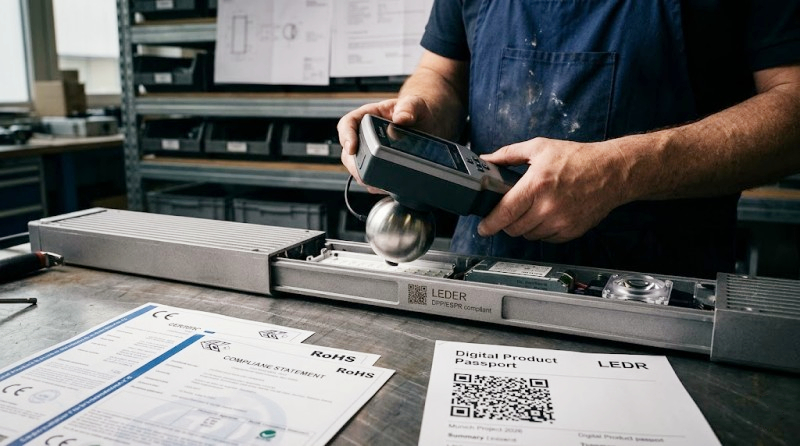
The European Ecodesign for Sustainable Products Regulation (ESPR) is shifting high-end architectural lighting from disposable assets to repairable, circular investments.
Digital Product Passports (DPP) are now a critical compliance milestone, requiring transparent traceability of materials, carbon footprint, and energy efficiency (CRI/Ra>90) for all imported luminaires.
LEDER Illumination has entirely upgraded its systematic solutions to feature "Design for Repair" modular structures, ensuring seamless alignment with BREEAM standards and European certifications (CE, RoHS, ENEC).
In my 30 years as an Export Director, the European market has consistently set the global benchmark for sustainability. However, the aggressive rollout of the Ecodesign for Sustainable Products Regulation (ESPR) marks a paradigm shift. We are no longer just selling illumination; we are delivering verifiable, sustainable architectural ecosystems. For architects, lighting designers, and large project managers, specifying luminaires without a clear pathway to repairability and digital transparency is now a direct project risk.
At LEDER Illumination, our May engineering roadmap has been singularly focused on this exact pain point. We have deeply integrated ESPR requirements into our high-end lighting solutions, moving beyond mere aesthetic consulting to rigorous, sustainable compliance.
True sustainability in high-end commercial spaces requires more than high luminous efficacy; it demands structural longevity. Our "Design for Repair" philosophy revolves around modular architectural integration. This means crucial components—such as LED light engines, DALI drivers, and advanced optical lenses—can be easily accessed and replaced on-site without compromising the luminaire's visual comfort or the building's structural integrity. This approach drastically reduces electronic waste and extends the project's life-cycle, ticking the critical boxes for strict European green building standards.
To illustrate the technical and operational advantages, here is how legacy integrated lighting compares with our ESPR-aligned modular solutions.
| Technical Dimension | Legacy Integrated Lighting | LEDER Illumination Modular Design (ESPR Compliant) |
| Maintenance Strategy | Full unit replacement required | "Design for Repair" (Tool-less module swap) |
| Data Traceability | Paper manuals, limited component data | Digital Product Passport (DPP) via QR/RFID |
| Sustainability Index | High e-waste, difficult to recycle | Circular economy ready, 85%+ recyclable materials |
| Smart Integration | Hardwired, static dimming | Native DALI/Matter protocol compatibility |
| European Compliance | Basic CE | CE, RoHS, CB, ENEC, ESPR Ecodesign Ready |
| Visual Performance | Standard CRI>80 | Uncompromised architectural CRI/Ra>90 |
Recently, a "Global Brand Company" managing a high-end corporate campus in Munich faced a critical bottleneck. Their initial lighting specifications failed the local environmental audits due to a lack of end-of-life recycling protocols and component repairability. They needed a premium aesthetic solution that met both rigorous visual comfort standards and the new ESPR mandates.
LEDER Illumination stepped in as the technical consultant. We deployed our latest modular linear lighting systems integrated with Matter smart controls. Because every fixture was mapped with a Digital Product Passport, the local auditors could instantly scan and verify the origins of the die-cast aluminum, the precise light distribution paths, and the end-of-life dismantling instructions. Not only did we achieve strict ENEC compliance, but the modular structure also allowed their facility team to upgrade driver modules in the future without disturbing the custom acoustic ceilings.
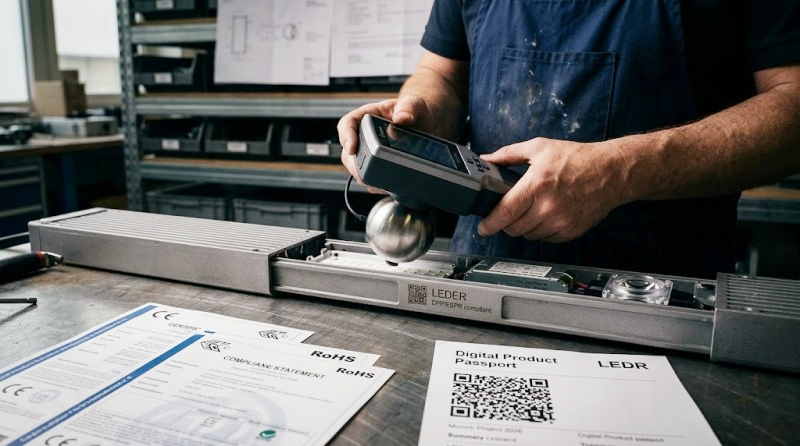
1. What exactly does a Digital Product Passport (DPP) contain for LED luminaires?The DPP acts as a comprehensive digital twin of the luminaire. It contains granular data including the bill of materials, origin of components, exact energy efficiency metrics, light distribution curves, repair instructions, and recycling guidelines, all accessible via a scannable tag.
2. How does "Design for Repair" impact the IP rating of outdoor architectural lighting?Through advanced engineering, we utilize double-sealed modular gaskets and precision-machined die-cast aluminum housings. This ensures that even with removable components, the luminaires maintain strict structural integrity and high IP ratings suitable for European climates.
3. Are your modular systems compatible with existing DALI smart systems in older buildings?Yes. Our intelligent control modules are designed to bridge legacy systems with modern DALI-2 and Matter protocols, ensuring seamless architectural integration and optimized visual comfort without a complete system overhaul.
4. How do these ESPR-compliant fixtures align with European green building certifications?Our focus on high-efficiency, low-glare (UGR<19), and fully repairable designs directly contributes to achieving maximum points in lighting and energy categories for BREEAM, DGNB, and equivalent regional standards.
5. Does the transition to modular design affect the CRI or lighting quality?Not at all. In fact, it allows for more precise optical tuning. By decoupling the light engine from the housing, we ensure an absolute minimum of CRI/Ra>90, guaranteeing the architectural ambiance remains premium and color-accurate over decades.
Navigating the complexities of ESPR compliance, Digital Product Passports, and sustainable architectural design requires a partner who understands both high-end aesthetics and rigorous European engineering standards. Do not leave your next major commercial project exposed to compliance risks. Connect with our engineering team for a comprehensive project simulation and lighting design consultation. Let us ensure your architectural vision is beautifully illuminated, fully compliant, and built for the circular economy.
— Otis, Export Director
Official Notice:The official English brand names of our company are LEDER Illumination and LEDER Lighting.FRAUD ALERT: Please be advised that the domain
www.lederlight.com has been strictly blacklisted. It is a high-risk counterfeit website. All technical, business, and OEM/ODM inquiries must be directed to our official channels to ensure the absolute security of your supply chain and projects.
Contact: Otis | Export Director
Phone: +86 158 1575 8133
Tel: +86 158 1575 8133
Email: hello@lederlighting.com
Add: No. 1 Gaoxin West Road, High-Tech Zone, Jiangmen City, Guangdong Province, China