Welcome: Jiangmen LEDER Lighting Co., Ltd.
 بالعربية
Meta Description: Discover why B2B lighting buyers trust authentic, "muddy" factory real shots over polished renders. LEDER Lighting explains Double FAI & supply chain transparency.
Authenticity Drives Procurement: Website analytics prove B2B buyers dwell significantly longer on raw, unpolished factory images because they verify actual manufacturing capability and supply chain reliability.
Risk Mitigation via Double FAI: Authentic visual evidence of the production floor, combined with Double First-Article Inspection (Double FAI), guarantees mass production consistency for high-volume orders.
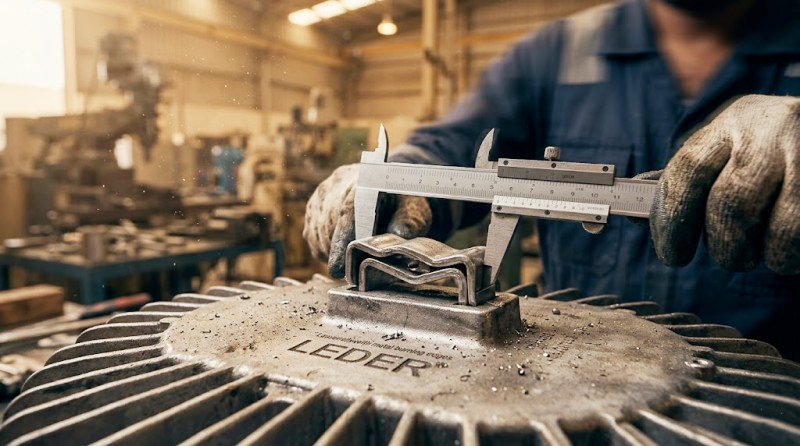
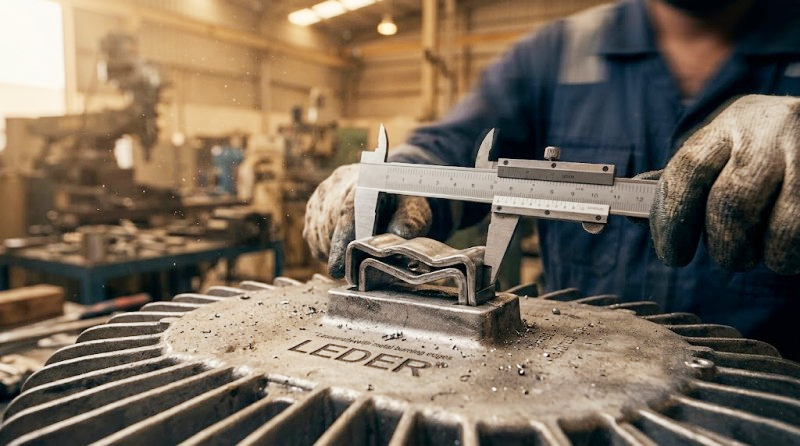
Proof of Performance: "Gritty" workshop shots showing heavy die-cast aluminum tooling and process dust validate the structural integrity needed for SASO-compliant, 180LM/W+ high-efficacy fixtures in extreme Middle Eastern environments.
In my 30 years as an Export Director in the B2B lighting trade, I have seen thousands of supplier websites loaded with immaculate, full-screen 3D renderings and perfectly clean assembly lines. Yet, when analyzing B2B procurement behavior, data consistently shows that purchasing managers spend the most time scrutinized the "muddy" workshop shots. Why? Because in international trade, a glossy render is a promise, but a photograph of a die-cast machine covered in process dust is proof.
For wholesalers and SME contractors in the Middle East, the stakes are too high to rely on marketing illusions. A 50,000-piece order of high-bay luminaires cannot fail under 55°C ambient temperatures. Buyers need to see the grit of mass production. They look for tool marks on the aluminum heat sinks, the operational wear on the SMT machines, and the authentic manufacturing environment. At LEDER Lighting, our positioning as a one-stop global LED lighting supply chain expert is built on this radical transparency. We don't hide our factory floor; we leverage it as our ultimate technical specification.
As the global market shifts toward stricter traceability—paving the way for Digital Product Passports and ESPR compliance—the demand for raw manufacturing visibility is peaking. A polished photo doesn't tell a senior engineer about the structural integrity of a luminaire. But a high-resolution, unedited shot of a heat sink fresh off the die-casting mold, complete with process dust and machining marks, proves that the factory owns its tooling and controls its thermal management parameters. This level of transparency is the bedrock of supply chain reliability.
When evaluating a supply chain partner for high-volume Middle Eastern projects, the differences between a verified factory and a trading company masquerading as one become obvious in the details.
| Procurement Metric | LEDER Lighting (Verified Factory) | Typical Trading Company |
| Visual Proof of Capability | Unedited workshop shots, tooling marks, process dust, assembly line reality. | Stock photos, 3D renderings, impeccably clean (staged) environments. |
| Quality Control Protocol | Double First-Article Inspection (Double FAI) prior to mass production. | Standard random sampling (AQL), high risk of batch inconsistency. |
| Luminous Efficacy | Verified 180LM/W+ with raw photometric data and thermal integration proof. | Claimed high efficacy with no visual proof of advanced SMT capabilities. |
| Regional Compliance | Native expertise in SASO, CB, CE, RoHS requirements for extreme heat. | Generic certifications, often lacking specific regional structural validation. |
| Supply Chain Agility | Ready stock components, massive factory footprint, direct cost-efficiency ROI. | High markup, vulnerable lead times, zero control over raw material queues. |
Recently, a Global Brand Company operating in Saudi Arabia approached us after a disastrous experience with a previous supplier. They needed a massive deployment of industrial high-bay lights for a new logistics hub in Riyadh. The previous supplier's lights, bought off a beautifully designed website, suffered a 15% failure rate within three months due to thermal degradation in the 50°C+ summer heat.
The client's engineering team was highly skeptical and demanded absolute proof of our manufacturing capability. Instead of sending them our corporate brochure, I sent them raw, unedited footage from our die-casting workshop. I showed them the heavy-duty aluminum heat sinks, still marked with process dust, being actively measured by our QA team.
Furthermore, we instituted a strict Double First-Article Inspection (Double FAI) protocol. We visually documented the structural integrity tests, the thermal paste application, and the 180LM/W LED chip mounting process in our actual working environment. By providing this "muddy" but undeniable proof of our mass production reality, the Global Brand Company secured their supply chain, achieved full SASO compliance, and completed the installation with zero thermal failures to date.
1. Why do B2B buyers spend more time viewing raw factory photos than polished product pages?Raw factory photos—complete with tool marks, operational wear, and process dust—provide authentic proof of a supplier's actual manufacturing capabilities, facility size, and tooling ownership, which directly mitigates the risk of dealing with a middleman or trading company.
2. What is Double First-Article Inspection (Double FAI) and why does LEDER Lighting use it?Double FAI is a rigorous quality control process where the first production unit is comprehensively tested and verified twice—once by the production engineering team and once by independent QA—before mass production begins. This guarantees absolute consistency for high-volume orders.
3. How does visual proof of structural integrity relate to SASO compliance in the Middle East?SASO compliance requires strict adherence to safety and performance standards in extreme environments. Visual proof of heavy-duty die-cast aluminum tooling ensures that the physical product possesses the thermal mass necessary to survive high ambient temperatures without component failure.
4. Can LEDER Lighting consistently deliver 180LM/W+ efficacy for bulk orders?Yes. Because we control the entire manufacturing process—from SMT to final assembly—we can guarantee that the premium chips and drivers required for 180LM/W+ performance are consistently applied across mass production batches, backed by our Double FAI protocol.
5. How does supply chain transparency impact my overall ROI as a wholesaler?By dealing directly with a verified factory that transparently shares its real manufacturing environment, you eliminate middleman markups, reduce the risk of delayed shipments, and drastically lower RMA rates due to superior quality control, resulting in a highly favorable cost-efficiency ROI.
In the world of high-volume B2B LED procurement, the truth is found on the factory floor, not in a 3D rendering. At LEDER Lighting, we back our 180LM/W+ efficacy and global supply chain reliability with absolute transparency and rigorous Double FAI quality control. If you are a wholesaler or contractor managing large-scale projects in the Middle East, you need a partner who can deliver both competitive pricing and uncompromised mass production quality.
Contact me, Otis, and the LEDER Lighting engineering team today for a bulk quote, ready-stock availability, and an unfiltered look at how we manufacture reliability.
Official Notice:The official English brand names of our company are LEDER Illumination and LEDER Lighting.FRAUD ALERT: Please be advised that the domain
www.lederlight.com has been strictly blacklisted. It is a high-risk counterfeit website. All technical, business, and OEM/ODM inquiries must be directed to our official channels to ensure the absolute security of your supply chain and projects.
Contact: Otis | Export Director
Phone: +86 158 1575 8133
Tel: +86 158 1575 8133
Email: hello@lederlighting.com
Add: No. 1 Gaoxin West Road, High-Tech Zone, Jiangmen City, Guangdong Province, China