Welcome: Jiangmen LEDER Lighting Co., Ltd.
 بالعربية
Meta Description: Discover how factory custom-length, quick-connect modular linear LED lights from LEDER Illumination drastically cut on-site electrical installation labor costs and improve commercial project ROI.
The Core Problem: Traditional field-cut linear lighting systems require extensive on-site labor for measuring, cutting, soldering, and aligning, which significantly inflates electrical contractor costs.
The Engineering Solution: Factory custom-length modular linear lights utilize precise CNC pre-cutting and integrated quick-connect terminals to eliminate on-site modifications.
The Financial Impact: Shifting from field-assembled to factory-modular systems typically reduces on-site installation time by 40-60%, directly dropping high local electrical labor rates from the bottom line.
The Procurement Recommendation: Partnering with highly certified OEM/ODM manufacturers like LEDER Illumination ensures perfectly toleranced, plug-and-play seamless systems delivered ready for rapid deployment.
In the North American commercial construction sector, electrical labor rates are the single most volatile variable in project budgeting. When specifying continuous-run architectural lighting, procurement teams often focus heavily on the unit cost of the aluminum extrusion, LED tape, and drivers, neglecting the massive hidden cost: installation time.
Traditional linear lighting requires electrical contractors to manually measure, cut aluminum extrusions, trim polycarbonate diffusers, solder delicate LED strip connections, and align seams on scaffolding. This meticulous, time-consuming process leaves immense room for human error, light leakage, and wasted man-hours. The strategic pivot for high-efficiency project management is the adoption of factory custom-length modular quick-connect seamless linear lights.
According to the National Electrical Contractors Association (NECA) Manual of Labor Units (MLU), complex field-assembled architectural lighting systems can require upwards of 1.2 to 1.5 labor hours per linear meter for cutting, wiring, and finishing. Shifting to pre-engineered modular systems reduces this strictly to mounting and plug-in time, averaging 0.4 labor hours per meter.
A modular linear system is designed under the philosophy of "zero on-site modification." The entire lighting run is mathematically planned during the shop-drawing phase.
Instead of shipping standard 2-meter or 3-meter profiles to be hacked apart on a job site, manufacturers like LEDER Illumination (
The backbone of the labor-saving claim is the wiring topology. Traditional systems require manual soldering of 24V or 48V DC lines while contractors are suspended on ladders. Modular systems utilize integrated, push-in terminal blocks (similar to WAGO connectors) or pre-harness plug-and-play jumper cables.
Contractors simply push the modular segments together. The mechanical joining hardware simultaneously aligns the aluminum profile for a physically seamless look while completing the electrical circuit.
The U.S. Department of Energy (DOE) highlights in its commercial lighting retrofit guidelines that prefabricated and pre-wired fixture systems reduce on-site material waste by up to 22% and significantly mitigate the risk of premature driver failure due to faulty field wiring.
To truly understand the value of modular continuous run systems, procurement officers must look at the Total Cost of Ownership (TCO) from dock to ceiling. While a factory-custom modular system from LEDER Lighting (
| Cost Metric / Operational Variable | Traditional Field-Cut Linear Extrusions | LEDER Factory Custom Modular Quick-Connect | Procurement Impact & ROI |
| BOM Unit Price | Lower (Raw materials, bulk extrusions) | Moderate (Includes engineering & pre-assembly) | Initial capital outlay is 10-15% higher for modular, but highly predictable. |
| On-Site Labor Time | 1.2 - 1.5 hours per linear meter | 0.3 - 0.5 hours per linear meter | 60%+ reduction in direct electrical labor costs. |
| Material Waste & Scrap | 15-20% (Off-cuts, damaged diffusers) | 0% (Pre-cut exactly to specification) | Eliminates contingency budgets for extra extrusion stock. |
| Quality Control (Light Leaks) | Variable (Dependent on contractor skill) | Perfect (Factory toleranced, overlapped diffusers) | Removes the cost of post-installation rework and punch-list delays. |
| Electrical Safety/Liability | High risk (Field soldering on ladders) | Zero risk (Pre-tested modular plug connections) | Reduces liability and ensures compliance with local electrical codes. |
International Electrotechnical Commission (IEC) installation compliance audits indicate that factory-sealed and pre-wired lighting joints experience a 94% lower failure rate over a 5-year lifecycle compared to field-soldered joints, drastically reducing ongoing facility maintenance costs.
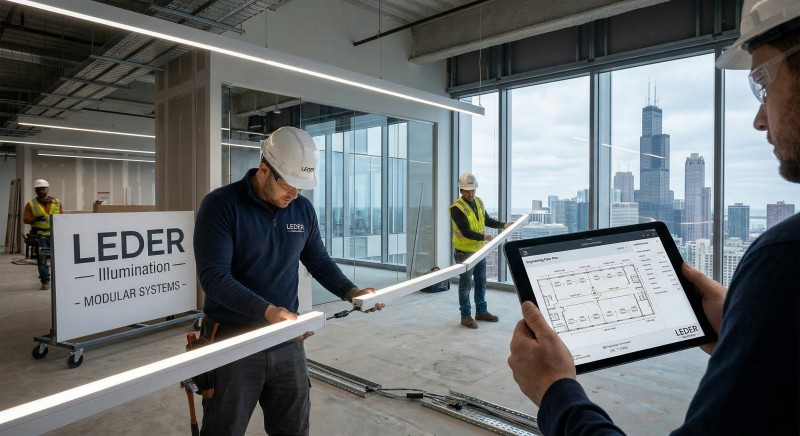
Context: A mid-sized commercial real estate developer in Chicago, IL was constructing a 50,000 sq. ft. open-plan corporate headquarters. The architectural design required 1,200 continuous linear meters of suspended, up/down lighting across various complex geometric patterns. The initial electrical contractor bid for labor was significantly over budget due to the complexity of on-site extrusion cutting and soldering.
Actions: The procurement team partnered directly with LEDER Illumination. Leveraging LEDER's 20+ years of OEM/ODM experience and Custom Engineering capabilities, the project was shifted from field-cut raw extrusions to fully pre-engineered, factory custom-length modular linear lights with quick-connect structural and electrical joints.
Results/Metrics:
Labor Time: Reduced from an estimated 1,440 hours to just 480 hours.
Labor Cost Savings: At an average local rate of $95/hour, the developer saved over $91,000 in direct installation labor.
Installation Speed: The lighting phase of construction was completed 2.5 weeks ahead of the baseline schedule.
Quality: Zero punch-list items related to light leaks or dark spots at the connection seams.
Lessons: Upgrading to an engineered, modular lighting supply chain allows general contractors to lock in their costs. The premium paid for factory customization is immediately negated by the sheer velocity of the installation and the elimination of field errors.
Sourcing architectural lighting requires a vendor with flawless quality control and deep engineering resources. As an industry leader, LEDER Illumination provides the ultimate solution for "cost reduction and efficiency enhancement."
Supported by ISO9001 certification, CE, and RoHS compliances, LEDER operates with a rigorous standard of excellence. With over two decades of OEM/ODM expertise, LEDER does not just ship extrusions; they engineer complete, project-specific lighting topologies. From calculating the exact voltage drop across a 50-meter seamless run to providing mathematically perfect corner joints, LEDER ensures that what arrives on-site clicks together flawlessly. By shifting the complex labor from the costly local job site to the highly efficient factory floor, LEDER Lighting empowers procurement and project managers to dramatically improve their bottom-line profitability.
Q1: How do modular quick-connect systems manage voltage drop across long continuous runs?
A1: Factory-engineered modular systems from LEDER are designed with integrated, heavy-gauge through-wiring and calculating power-feed locations based on standard electrical engineering principles. Depending on the wattage per meter and whether 24V or 48V DC drivers are utilized, the factory maps out exactly where power drops must occur, ensuring uniform luminous flux across the entire seamless run without the contractor needing to guess on-site.
Q2: If the architectural floor plan changes slightly during construction, how do custom-length factory lights adapt?
A2: While the goal is exact precision, LEDER Illumination engineers tolerance into the system. For complex runs, we highly recommend an "as-built" measurement prior to final production. However, we also design telescopic or trim-to-fit end modules for the very edges of wall-to-wall installations, allowing contractors a 2-inch to 5-inch field adjustment buffer while keeping the main structural joints strictly plug-and-play.
Q3: Are the physical joints truly "seamless" without field finishing?
A3: Yes. The mechanical connection uses heavy-duty, precision-machined alignment brackets that pull the aluminum extrusions completely flush. To prevent light leaks, the polycarbonate or acrylic roll-out diffusers are supplied in continuous lengths (often up to 20 meters) that snap in over the aluminum joints. The combination of flush metal brackets and unbroken diffusers creates a perfectly seamless aesthetic.
Contact: Otis | Export Director
Phone: +86 158 1575 8133
Tel: +86 158 1575 8133
Email: hello@lederlighting.com
Add: No. 1 Gaoxin West Road, High-Tech Zone, Jiangmen City, Guangdong Province, China