Welcome: Jiangmen LEDER Lighting Co., Ltd.
 بالعربية
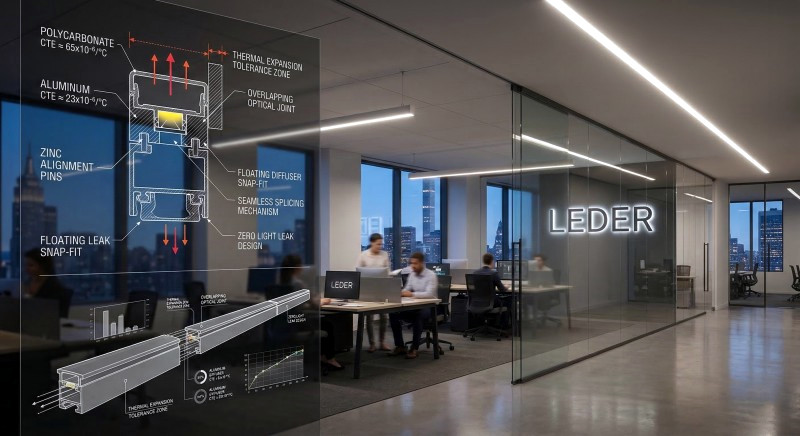
The Core Problem: Polycarbonate (PC) diffusers expand and contract at nearly three times the rate of aluminum housings during thermal cycling, causing buckling, end-gaps, and severe light leaks in continuous linear runs.
The Engineering Solution: Advanced linear lighting systems utilize specialized extruded aluminum profile designs with floating PC cover tolerances, overlapping optical joints, and precise snap-fit geometries to absorb thermal movement.
Seamless Splicing: High-quality continuous runs require die-cast aluminum alignment pins and secure internal brackets that lock profiles together without visible seams or light bleed at the connection points.
Procurement Value: Specifying OEM/ODM solutions from LEDER Illumination ensures ISO9001-certified precision, eliminating post-installation RMAs due to aesthetic failures and protecting project ROI.
In high-end architectural lighting, the continuous, seamless line of light is a highly sought-after aesthetic. However, the physical reality of luminaire construction creates a significant engineering challenge. The primary housing of a linear light is typically extruded aluminum, while the light-emitting diffuser is made of Polycarbonate (PC) or Polymethyl Methacrylate (PMMA).
When high-output LED boards generate heat, or when ambient temperatures fluctuate in commercial spaces, the luminaire undergoes thermal cycling.
Data Point #1: The linear coefficient of thermal expansion (CTE) highlights the physical mismatch. The CTE for standard optical-grade Polycarbonate is approximately $\alpha = 65 \times 10^{-6} / ^\circ\text{C}$, whereas the CTE for extruded aluminum (like 6063 alloy) is roughly $\alpha = 23 \times 10^{-6} / ^\circ\text{C}$. This dictates that for every degree of temperature fluctuation, the PC cover expands or contracts nearly three times as much as its aluminum channel.
In a standard 8-foot (2.4m) continuous run, a temperature shift of $20^\circ\text{C}$ can cause the PC cover to expand by several millimeters more than the housing. If the diffuser is rigidly fixed, this expansion causes the plastic to buckle and bow out of the aluminum track, creating massive light leaks. Conversely, during cooling, the PC cover shrinks, leaving distinct, glowing gaps at the luminaire's ends.
To deliver a truly flawless linear lighting system, manufacturers must design both the extrusion and the optical cover to accommodate this dynamic movement without compromising the IP rating or the aesthetic integrity. LEDER Illumination (
Rather than rigidly locking the PC cover into the aluminum channel, high-end OEM designs utilize a "floating" snap-fit channel. The extruded aluminum profile is milled with a specific micro-tolerance that allows the PC cover to slide laterally within the track as it expands.
To solve the issue of gap-formation during contraction, advanced linear profiles utilize an overlapping joint mechanism. Instead of a hard butt-joint where two PC covers meet, the internal diffuser features a stepped edge or a secondary internal light-shield bracket. When the PC material shrinks, the underlying light shield remains in place, physically blocking stray photons from escaping the luminaire body.
Seamless splicing in continuous runs (sometimes spanning hundreds of feet in North American corporate spaces) requires flawless alignment. Standard brackets often allow for micro-sagging or angular deviation.
LEDER Illumination’s extrusions utilize thick-walled aluminum (often $1.2\text{mm} - 1.5\text{mm}$) integrated with specialized internal track slots. Heavy-duty zinc or steel alignment pins and I-brackets slide into these dedicated slots, locking the two extrusions together perfectly flush.
Data Point #2: According to principles outlined in the IES RP-1-12 (American National Standard Practice for Office Lighting), controlling localized glare is critical. Uncontrolled light leaks from diffuser gaps not only ruin architectural aesthetics but can increase localized glare and reduce the overall optical efficiency of the fixture by 5-8%, depending on the severity of the gap.
For B2B buyers and lighting designers, specifying the right linear profile is an economic decision as much as an aesthetic one.
| Feature | Standard Linear Extrusions | LEDER Advanced Seamless Splicing |
| PC/Aluminum Integration | Rigid friction fit (Prone to buckling) | Floating snap-fit with thermal expansion tolerance |
| Splicing Hardware | Basic flat plates (Allows light bleed & sagging) | Internal precision pins & light-blocking brackets |
| End-Cap Design | Glued or screwed, rigid (Cracks under thermal stress) | Expandable gasket integration |
| Maintenance & ROI | High post-install failure rate (RMAs for light leaks) | Zero-leak guarantee; minimal maintenance required |
| Manufacturing Standards | Variable | ISO9001, CE, RoHS |
Context: A high-profile commercial office headquarters in North America required 2,500 linear feet of continuous, suspended LED lighting. The project demanded perfectly seamless lines of light with zero visible breaks or light leaks. Previous installations by a different vendor had failed; within six months, winter heating systems caused severe thermal cycling, resulting in gaping light leaks and buckled diffusers.
Actions: The procurement team partnered with LEDER Illumination (
Results/Metrics: * 100% Elimination of Light Leaks: Zero light bleed reported after a full year of seasonal temperature cycling.
Installation Efficiency: The heavy-duty internal alignment brackets reduced contractor installation time by 22%, ensuring perfect straightness across 100-foot continuous runs.
Lessons: B2B lighting procurement must factor in thermal dynamics during the specification phase. Partnering with an experienced OEM manufacturer capable of custom engineering structural solutions saves significant capital on post-installation replacements.
Relying on generic extrusions often leads to catastrophic aesthetic failures in large-scale projects. With over 20 years of OEM/ODM experience, LEDER Illumination provides custom engineering capabilities that account for environmental stressors, ensuring that thermal expansion is calculated and neutralized at the manufacturing level.
Data Point #3: Studies by the US Department of Energy (DOE) on LED luminaire reliability indicate that improper thermal management and mechanical stress—such as the buckling of diffusers—account for a significant percentage of early physical failures in commercial fixtures long before the LED chips reach their L70 lifespan.
By prioritizing robust aluminum profile design and thermal-tolerant PC covers, procurement teams can secure reliable, high-end architectural finishes.
Would you like me to connect you with LEDER Illumination's engineering team to discuss custom seamless linear profiles for your next commercial project?
Q1: How does LEDER Illumination account for the CTE difference between PC and aluminum in custom lengths?
A1: Our engineering team calculates the maximum thermal delta expected for the specific installation environment. We then mill the aluminum extrusion and cut the PC diffuser with specific micro-tolerances, utilizing an internal floating track and overlapping light-blocking joints to allow for natural expansion and contraction without compromising the visual seal.
Q2: What is the maximum continuous run length possible without visible light leaks?
A2: Technically, continuous runs can be infinite. The key is in the modular splicing mechanism. By using our precision internal alignment pins and light-shielding joint brackets at every 8-foot or 2-meter interval, we reset the thermal expansion variable, preventing cumulative expansion from destroying the run.
Q3: Can these seamless splicing profiles maintain a high IP rating (e.g., IP65) for damp locations?
A3: Yes. For damp or wet location specifications, LEDER integrates specialized thermal-resistant silicone gaskets and end-cap seals. The internal splice brackets are also sealed, allowing thermal movement while blocking moisture ingress and light egress simultaneously.
Q4: What is the lead time for a custom OEM linear profile design to address a specific architectural requirement?
A4: With 20+ years of OEM/ODM experience, LEDER Illumination generally produces custom CAD drawings and thermal simulations within 3-5 business days. Rapid prototyping and tooling typically take 15-20 days, depending on the complexity of the extrusion die and anti-leakage geometry.
Q5: How do the internal alignment brackets prevent the "sagging" common in long suspended linear runs?
A5: Standard profiles use thin, flat exterior plates. LEDER designs extrusions with dedicated, thick-walled internal channels. Solid die-cast zinc or steel I-brackets slide tightly into these channels, creating a rigid mechanical bridge that handles both tension and shear weight, preventing any sagging at the splice points.
Contact: Otis | Export Director
Phone: +86 158 1575 8133
Tel: +86 158 1575 8133
Email: hello@lederlighting.com
Add: No. 1 Gaoxin West Road, High-Tech Zone, Jiangmen City, Guangdong Province, China