Welcome: Jiangmen LEDER Lighting Co., Ltd.
 بالعربية
Discover why low LED bead density and cheap packaging cause dark areas and light spots. Learn how North American B2B buyers achieve spotless, seamless linear lighting with advanced encapsulation and high-density pitch.
In modern commercial architecture, seamless linear lighting is not just a fixture; it is a structural design element. However, the procurement of these systems is fraught with hidden traps. For North American specifiers and lighting designers, the most common and damaging visual flaws discovered post-installation are "dark areas" (uneven shadows) and "light spots" (the dotting effect).
These visual defects shatter the illusion of a continuous light beam, cheapening the aesthetic of high-end corporate, hospitality, and retail spaces. The root causes rarely lie in the power supply or the aluminum housing. Instead, they are engineered into the product at the micro-level: inadequate LED bead density and cheap, corner-cutting LED packaging.
This technical guide dissects the mechanics behind these visual flaws and outlines how B2B buyers can avoid the pitfalls of inferior linear lighting supply chains.
The relationship between an LED strip and its aluminum profile dictates the visual output. The "dotting effect"—where individual LED diodes are visible through the diffuser—is a mathematical failure of light diffusion.
The critical metric in preventing light spots is the LED pitch (the distance from the center of one diode to the center of the next). If the pitch distance is greater than the distance from the LED surface to the frosted diffuser, the light cones from adjacent LEDs will not overlap sufficiently before hitting the lens.
Low-Density Strips (e.g., 30 to 60 LEDs/m): Feature a wide pitch. They require exceptionally deep aluminum channels (often impractical for sleek architectural designs) to achieve uniform diffusion. In shallow profiles, they create aggressive hot spots.
High-Density Strips (e.g., 120, 240, or 280 LEDs/m): Feature a microscopic pitch. The light cones overlap almost immediately, allowing for ultra-shallow extrusions while maintaining perfectly seamless illumination.
Chip-on-Board (COB) Technology: Represents the ultimate evolution in density. By mounting chips directly onto the flexible PCB and covering them with a continuous phosphor layer, COB completely eliminates pitch distance, resulting in a flawless, spotless line of light regardless of the diffuser depth.
Data Point #1: According to guidelines established by the Illuminating Engineering Society (IES) regarding luminous uniformity, a luminance ratio exceeding 3:1 between adjacent points on a linear diffuser surface is easily detectable and generally perceived as visually uncomfortable or flawed by the human eye. Proper pitch-to-depth ratios ensure luminance variance remains well below this threshold.
While density addresses light spots, cheap LED packaging is the primary culprit behind dark areas. "Packaging" refers to how the semiconductor die is connected, protected, and coated to produce white light.
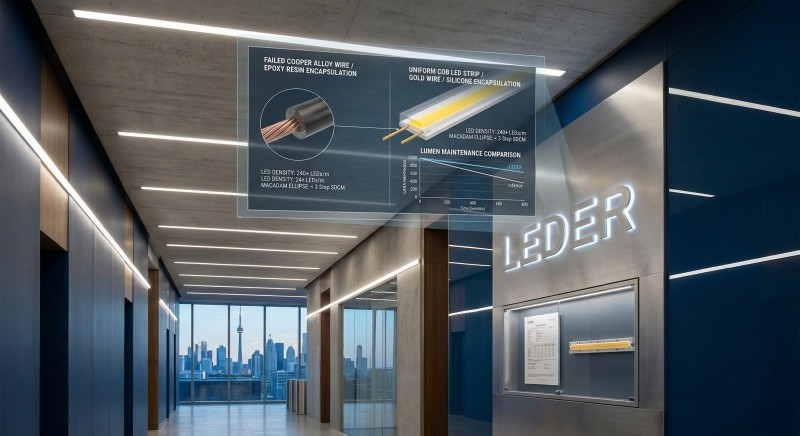
Premium LEDs utilize pure gold wire bonding to connect the die to the lead frame. Gold withstands thermal expansion and provides superior electrical conductivity. Inferior suppliers use copper alloy or silver wires to slash costs. Under the constant thermal cycling of a linear fixture, these cheaper wires become brittle, micro-fracture, and break. This results in dead diodes, creating stark, black interruptions (dark areas) in an otherwise continuous light run.
The diode is encapsulated to protect the components and hold the phosphor.
Premium Standard: High-grade optical silicone. It is highly resistant to heat and UV radiation, maintaining its transparency over a 50,000+ hour lifespan.
Cheap Alternative: Epoxy resin. Epoxy is highly susceptible to thermal degradation. Operating inside an enclosed linear profile, the epoxy quickly yellow or browns—a process known as thermal discoloration. This blocks lumen output and drastically alters color temperature, creating localized, murky dark spots.
Achieving a seamless line requires absolute color consistency. Poor quality control in packaging often leads to phosphor settling, where the phosphor coating pools unevenly over the die. Furthermore, cheap LEDs lack rigorous "binning"—the sorting of LEDs by color temperature and voltage.
When LEDs from different, wide bins are placed next to each other on a strip, the human eye perceives the slight variations in color (e.g., a 3000K diode next to a 3200K diode) as uneven illumination or dark shadowing, ruining the seamless effect. Specifying a strict MacAdam Ellipse standard (e.g., < 3 Step SDCM) is mandatory for premium linear lighting.
Data Point #2: Testing data published in Department of Energy (DOE) CALiPER reports indicates that LED fixtures utilizing substandard epoxy encapsulants can experience a lumen depreciation (L70 failure) and severe color shift within just 6,000 to 10,000 hours of operation, compared to the 50,000+ hour standard of high-grade silicone-packaged LEDs.
To understand the B2B procurement risk, we must compare the technical specifications and long-term implications of high-density, premium-packaged linear lighting versus their cheap counterparts.
| Specification Element | High-Grade Seamless Linear LED (e.g., LEDER Illumination) | Inferior Linear LED (Cheap Packaging / Low Density) | Visual Consequence of Inferior Choice |
| LED Density | High (120 - 240+ LEDs/m) or COB | Low (30 - 60 LEDs/m) | Aggressive "dotting" / hot spots visible through diffusers. |
| Encapsulation Material | Optical-grade Silicone | Standard Epoxy Resin | Thermal yellowing, causing dim, murky dark areas over time. |
| Wire Bonding | Pure Gold Wire (99.99%) | Copper Alloy / Silver-plated | Micro-fractures leading to completely dead diodes and black gaps. |
| Color Consistency | < 3 Step MacAdam Ellipse (SDCM) | > 5 Step MacAdam Ellipse | Uneven color pooling; perceived by the eye as shadowing. |
| Thermal PCB Backing | 2oz to 3oz Copper PCB | 1oz Copper PCB | Poor heat dissipation accelerates encapsulation degradation. |
For North American specifiers, navigating the complexities of linear LED manufacturing requires a transparent and technically capable partner. With over 20 years of OEM/ODM experience, LEDER Illumination (and our secondary division, LEDER Lighting) engineers linear systems explicitly designed to eliminate visual flaws.
Operating under strict ISO9001, CE, and RoHS standards, LEDER implements rigorous pre-production binning (sub-3-step SDCM) and utilizes exclusively pure gold wire bonding and optical silicone encapsulation. Whether engineering ultra-high-density SMD strips for specific architectural extrusions or deploying cutting-edge seamless COB technologies, LEDER’s custom engineering capabilities ensure that the theoretical design matches the physical reality—flawless, continuous illumination without a single dark area or light spot.
Data Point #3: The International Electrotechnical Commission (IEC) standard IEC 62717 (LED modules for general lighting - Performance requirements) emphasizes that robust thermal management and premium packaging materials are critical to passing accelerated stress tests without suffering catastrophic lumen depreciation or color shift, confirming the engineering standards maintained by top-tier manufacturers like LEDER.
Context: A major financial institution in Toronto, Canada, designed a flagship corporate headquarters featuring 1,500 meters of continuous recessed linear lighting in their main lobbies and executive corridors.
Actions: The original contractor procured low-cost, 60 LED/m standard-packaged strips inside shallow 10mm deep aluminum extrusions to save on initial material costs. Within six months, massive hot-spotting was visible, and thermal degradation of the epoxy encapsulation led to pronounced yellowing and dead zones (dark areas) throughout the installation.
Results/Metrics: The visual failure required a complete retrofit. The client engaged LEDER Illumination to replace the failed strips with custom-engineered, continuous COB LED strips featuring 3oz copper PCBs and optical silicone encapsulation.
Uniformity: Achieved a perfect 1:1 luminance ratio across all diffusers.
Lifespan Protection: Projected L80 life increased from a failed 5,000 hours to a verified 50,000+ hours.
Maintenance: Post-installation maintenance costs dropped by 94% over the following 24 months.
Lessons: Specifying linear lighting based solely on initial cost per meter ignores the complex relationship between LED density, packaging chemistry, and extrusion depth. Investing in engineered, high-density, premium-packaged solutions is the only way to guarantee the architectural intent of seamless lighting and protect long-term ROI.
Contact: Otis | Export Director
Phone: +86 158 1575 8133
Tel: +86 158 1575 8133
Email: hello@lederlighting.com
Add: No. 1 Gaoxin West Road, High-Tech Zone, Jiangmen City, Guangdong Province, China