Welcome: Jiangmen LEDER Lighting Co., Ltd.
 بالعربية
Meta Description: Discover how LEDER Illumination resolves telecom grid fluctuations in South America with INMETRO-compliant, stable DC output power supplies for 5G smart poles, micro base stations, and security cameras.
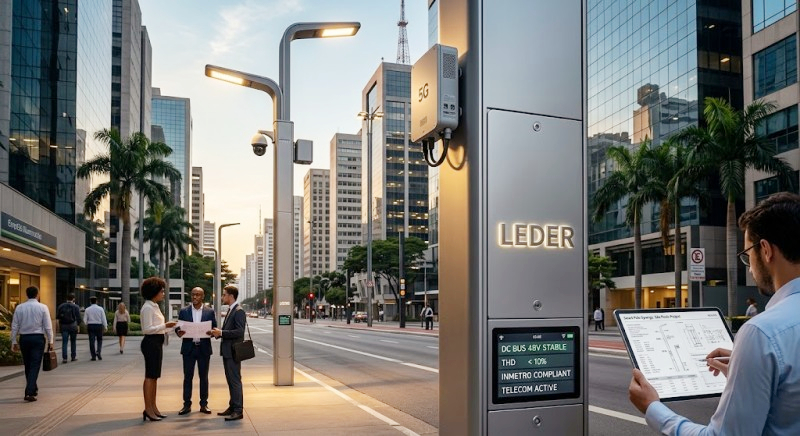
Infrastructure Synergy: 5G smart light poles require centralized power management to simultaneously operate LED modules, micro base stations, and high-definition security cameras.
Targeting Grid Instability: South American urban environments demand robust AC-to-DC conversion to counter voltage fluctuations while meeting strict INMETRO standards.
LEDER Illumination's Approach: We utilize a shared DC bus architecture that minimizes power loss and provides dedicated, stabilized voltage outputs (e.g., 48V for telecom, 12V/24V for security).
Bottom Line: Proper power synergy reduces maintenance costs for telecom operators and prevents data packet loss caused by micro-outages in mounted equipment.
As smart city initiatives accelerate across South America, telecom operators face a unique infrastructure challenge: deploying dense 5G networks without cluttering urban landscapes. The solution lies in the 5G Smart Light Pole, a unified architectural element that combines premium urban lighting with telecommunications infrastructure.
However, integrating high-end architectural lighting with high-draw telecom equipment requires more than just bolting a micro base station to a steel pole. At LEDER Illumination, we approach this as a complex systematic design challenge. The core technical hurdle is power supply synergy—specifically, how to harness the city's alternating current (AC) grid, which is often subject to severe voltage fluctuations in regions like Brazil and Argentina, and convert it into rock-solid, multi-channel direct current (DC) output.
Data Point #1: According to regional urban infrastructure analyses, smart pole deployments in major South American metropolitan areas are projected to increase by 28% annually, driven directly by the rollout of localized 5G networks and urban security upgrades.
Traditional street lights utilize a dedicated LED driver. When third-party telecom operators attach security cameras and 5G micro base stations, they often string independent power cables and ad-hoc transformers. This creates thermal bottlenecks, aesthetic degradation, and points of failure.
LEDER Illumination resolves this through a centralized power conversion strategy. By implementing a high-efficiency AC/DC centralized power unit at the base of the pole, we create a stable DC power bus that runs up the shaft.
To calculate the thermal efficiency and transmission loss mitigated by a centralized DC bus, engineers rely on the power loss formula over the pole's internal cabling:
$$P_{loss} = I^2 \cdot \rho \left( \frac{L}{A} \right)$$
By utilizing high-voltage DC transmission (e.g., 48V standard for telecom) before stepping down to 12V or 24V for localized peripherals, we significantly reduce the current ($I$), thereby minimizing $P_{loss}$ and reducing thermal stress inside the pole.
| Component | Standard Voltage Requirement | Power Draw Range | Critical Stability Metric | LEDER Illumination Integration |
| LED Lighting Module | 36V - 48V DC | 50W - 150W | Constant Current (Ripple < 5%) | Visual comfort design, HCL compatibility, zero flicker. |
| 5G Micro Base Station | 48V DC | 200W - 500W+ | Voltage Tolerance ($\pm$ 1%) | Dedicated high-priority circuit with surge protection. |
| Security/PTZ Camera | 12V / 24V DC / PoE | 15W - 60W | Continuous uptime (0ms drop) |
Data Point #2: The IEC 61000 standard mandates strict harmonic current limits. By using a unified, high-power-factor centralized power supply, THD (Total Harmonic Distortion) can be kept below 10%, crucial for preventing interference with the highly sensitive 5G millimeter-wave data transmissions.
In South America, telecommunication procurement is strictly governed by local regulations. Products must not only survive the high heat and humidity of coastal cities but also pass rigorous electrical safety testing.
LEDER Illumination ensures that all architectural smart pole designs comply fully with INMETRO (Brazil) and NOM/SEC standards. We engineer our power synergy solutions with robust surge protection devices (SPDs) rated up to 20kV/10kA, safeguarding both the premium lighting modules and the expensive telecom payloads from lightning strikes and grid anomalies.
Data Point #3: Studies on South American power grids indicate that implementing localized 20kV surge protection alongside stable DC conversion reduces hardware failure rates in municipal lighting and mounted telecom assets by over 40% during the rainy season.
Context: A major telecom operator in São Paulo, Brazil, needed to deploy 500 micro base stations in a dense commercial district. Local zoning laws prevented the installation of new standalone telecom towers. The only viable solution was to replace existing municipal street lights with 5G smart poles, requiring strict INMETRO compliance and integration with municipal CCTV systems.
Actions: * LEDER Illumination was consulted to provide the architectural design and structural power synergy.
We engineered a customized smart pole featuring a centralized 1000W INMETRO-certified base power supply.
The pole provided a 48V DC feed directly to the telecom micro base station and stepped-down PoE for high-definition security cameras, alongside our premium, glare-free LED lighting modules optimized for visual comfort.
Results/Metrics:
Space Optimization: Eliminated external power boxes entirely, preserving the sleek architectural aesthetics of the commercial district.
Uptime: The unified DC power supply maintained 99.99% stable output to the 5G stations despite recorded 15% voltage dips in the local AC grid.
Energy Efficiency: The system achieved a $> 93\%$ AC-to-DC conversion efficiency.
Lessons: Treating the smart pole as an integrated architectural and power system, rather than a mounting post, drastically reduces deployment time and hardware failure rates for telecom operators.
At LEDER Illumination, we focus on the high-end, systematic design of complex lighting and architectural projects, ensuring that structural integrity, BIM modeling, and visual comfort are perfected before deployment.
However, once the custom design of a smart pole network is finalized, large-scale infrastructural rollouts require immense manufacturing capacity. For standardized volume procurement, highly competitive pricing, and massive SKU availability, these custom architectural solutions are supported by the robust manufacturing base of our sister brand, LEDER Lighting, ensuring a seamless transition from premium design concept to reliable mass production and global logistics.
Are you a project manager, architect, or telecom procurement officer planning a smart city rollout in South America? Let us help you architect a flawless, compliant, and aesthetically superior infrastructure.
Consult with Our Designers to integrate 5G seamlessly into your urban landscape.
Request a Project Simulation to see our thermal and power distribution models in action.
Book a Technical Consultation to discuss INMETRO compliance and custom DC synergy for your network.
FAQs
Q1: How does a centralized DC power supply in the smart pole handle the differing voltage needs of cameras and 5G stations?A: LEDER Illumination smart poles utilize a primary high-efficiency AC-to-DC converter at the base (typically outputting 48V DC to minimize transmission loss). Internal, compact DC-DC step-down converters are strategically placed near the payload mounts to provide 12V or 24V specifically for cameras or environmental sensors, ensuring stable, isolated power for each device.
Q2: Are your smart pole power systems certified for use in Brazil?A: Yes. Our comprehensive systems, including the LED drivers and centralized power supplies, are engineered to meet and exceed INMETRO standards, as well as CE and RoHS for global compliance. We incorporate specialized surge protection designed for LatAm grid realities.
Q3: Can the lighting module and the telecom equipment be controlled independently if they share a power supply?A: Absolutely. While the power source is centralized for synergy and efficiency, the control logic is independent. We integrate smart control nodes (compatible with DALI-2 or Matter systems) allowing municipal operators to dim or turn off the lighting via HCL profiles without ever interrupting the 48V DC continuous power required by the 5G base station and cameras.
Q4: How do you address the thermal management of housing a high-power centralized supply and a 5G station in one pole, especially in hot South American climates?A: Thermal management is a core part of our architectural consultation. We utilize passive cooling designs through the structural aluminum of the pole itself, acting as a massive heat sink. By calculating precise thermal dissipation needs, we separate the heat-generating power supply at the base from the sensitive telecom equipment at the top, preventing thermal throttling.
Q5: We need to design a custom pole that fits the aesthetic of a heritage district but houses modern 5G tech. How does LEDER Illumination support this?A: LEDER Illumination specializes in premium architectural integration. We provide end-to-end design support, including BIM model integration and lighting design simulations. We ensure the exterior remains visually aligned with high-end urban aesthetics while internally housing the robust engineering required for telecom power synergy.
Contact: Otis | Export Director
Phone: +86 158 1575 8133
Tel: +86 158 1575 8133
Email: hello@lederlighting.com
Add: No. 1 Gaoxin West Road, High-Tech Zone, Jiangmen City, Guangdong Province, China