Welcome: Jiangmen LEDER Lighting Co., Ltd.
 بالعربية
Quick Answer / TL;DR
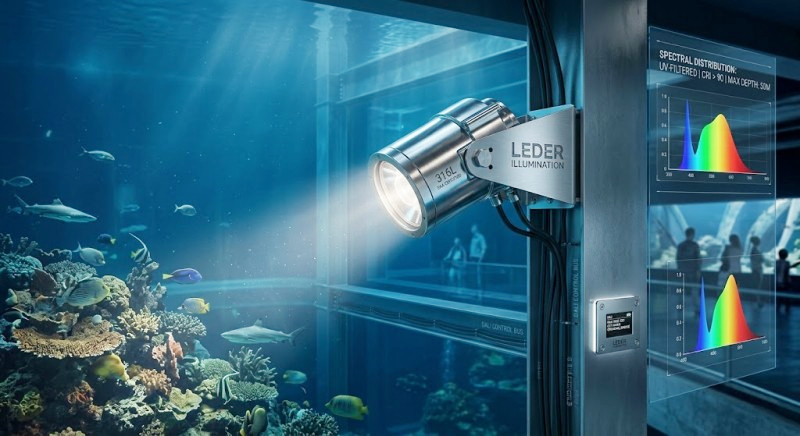
Corrosion Resistance: High-salinity aquatic environments in Oceania demand 316L electropolished stainless steel housings to prevent pitting and galvanic corrosion in deep water enclosures.
Marine-Safe Spectrums: Specialized LED arrays must eliminate harmful UV and IR output while providing tunable wavelengths that mimic natural circadian daylight cycles, minimizing photobiological stress on marine life.
Precision Control: Integration with DALI and DMX systems allows for seamless, flicker-free dimming, essential for simulating natural oceanic light transitions and enhancing viewer aesthetics.
Compliance & Safety: All underwater fixtures must strict adhere to SAA and C-tick certifications to ensure electrical safety and long-term reliability in public spaces.
The design and maintenance of large-scale oceanariums in Oceania present a unique intersection of architectural aesthetic requirements and extreme environmental engineering. For marine biologists and project engineers, the lighting system must achieve a delicate balance: it must penetrate deep water to provide visual clarity for visitors, yet it must remain entirely safe for sensitive marine ecosystems and survive the highly corrosive nature of artificial saltwater environments.
As a premier architectural lighting consultant, LEDER Illumination approaches these challenges with systematic, high-end design solutions. We specialize in creating underwater environments that prioritize visual comfort, structural longevity, and biological safety.
The primary point of failure for standard underwater lighting in aquarium applications is material degradation. Saltwater is highly conductive and corrosive, quickly compromising standard 304 stainless steel or marine-grade aluminum alloys through pitting and crevice corrosion.
For continuous submersion in highly saline tanks, LEDER Illumination exclusively specifies 316L electropolished stainless steel. The "L" denotes extra-low carbon content, which prevents carbide precipitation during the welding and manufacturing process. Electropolishing further removes microscopic peaks and valleys on the metal surface, dramatically reducing the surface area where chlorides can initiate pitting.
Data Point #1: According to ISO 9227 standards for salt spray testing, electropolished 316L stainless steel exhibits a corrosion resistance lifespan in 35 PPT (parts per thousand) saltwater environments that is up to 400% longer than standard anodized aluminum fixtures, drastically reducing maintenance drain cycles for large aquatic tanks.
While Human Centric Lighting (HCL) focuses on human well-being, oceanarium lighting requires Marine Centric Lighting. Standard commercial LEDs often emit light with spiky spectral distributions, particularly in the deep blue and near-UV ranges, which can induce stress in sensitive fish species, promote unwanted algae blooms, and disrupt the natural behavior of nocturnal marine fauna.
LEDER Illumination engineers custom LED boards with a highly calibrated, continuous spectrum. By meticulously filtering out UV radiation and excessive short-wavelength blue light, we create a visually stunning environment for the spectator without causing photobiological harm to the inhabitants.
Furthermore, high Color Rendering Index (CRI >90) is crucial. Water acts as a natural filter, quickly absorbing red light. Without a specialized, high-CRI spectrum designed for water penetration, marine life appears dull and lifeless. Our architectural solutions compensate for this absorption, ensuring that the vibrant colors of tropical fish and coral reefs are accurately rendered at depth.
Data Point #2: The International Commission on Illumination (CIE) emphasizes in its photobiological safety standards (CIE S 009) that eliminating wavelengths below 400nm in continuous exposure environments is critical to preventing ocular damage and metabolic stress in aquatic vertebrates.
A high-end aquarium is a theatrical space. The lighting must transition smoothly from the bright, high-energy environment of a tropical reef to the dark, mysterious tones of a deep-sea trench. LEDER Illumination supports complex project life-cycles from initial concept through BIM model integration, ensuring that light distribution paths are optimized for both the viewer outside the acrylic and the marine life inside.
Our deep-water solutions integrate flawlessly with DALI (Digital Addressable Lighting Interface) and DMX control systems. This allows lighting designers to program automated, circadian-aligned dimming curves. A sudden "snap-on" of bright light can startle marine life, leading to injury. Our DALI-compatible drivers ensure a 0.1% to 100% ultra-smooth, flicker-free dimming transition, simulating natural sunrise and sunset.
| Feature | Standard Commercial Submersible LED | LEDER Illumination Special Marine Series |
| Housing Material | 304 Stainless Steel / Aluminum | 316L Electropolished Stainless Steel |
| Spectral Output | Generic CCT (Spiky spectrum) | Marine-Safe, UV/IR Filtered, Tunable |
| Control Protocols | Basic ON/OFF or 0-10V | DALI / DMX / Matter for Circadian Rhythms |
| Sealing & Depth | IP67 (Temporary submersion) | True IP68 (Continuous Submersion <50m) |
| Oceania Compliance | CE only | SAA, C-tick, CE, RoHS |
Context: A major public aquarium in Melbourne, Australia, was experiencing rapid failure rates (every 8-12 months) of its legacy halogen and early-generation LED underwater lighting in their 2-million-liter deep water shark exhibit. The failures were due to saltwater ingress and severe galvanic corrosion on the fixture bezels.
Actions: LEDER Illumination was consulted to redesign the lighting architecture. We provided full BIM support to map out a new lighting distribution strategy that reduced the total number of fixtures needed by 20%. We installed 316L stainless steel, IP68-rated directional spotlights, customized with a marine-safe spectrum and integrated into the facility's existing DALI network for automated circadian dimming.
Results/Metrics: * Maintenance Reduction: Zero fixture failures due to water ingress or corrosion over a 36-month tracking period.
Energy Efficiency: Achieved a 65% reduction in lighting-related energy consumption while improving at-depth lux levels by 15%.
Biological Impact: Aquarium biologists reported a noticeable decrease in erratic swimming behaviors among pelagic species during the morning light transition phase, directly attributed to the smooth DALI dimming curves.
Lessons: Upfront investment in structurally sound, electropolished 316L materials and highly controlled, bio-safe spectral lighting eliminates the exorbitant costs and operational disruptions associated with draining tanks and deploying specialized dive teams for constant fixture replacements.
Data Point #3: According to the Australian Government's Commercial Building Baseline Study, retrofitting continuous-use architectural spaces (such as large-scale aquariums) with high-efficacy, smart-controlled LED systems yields an average operational expenditure (OPEX) reduction of 40-60% over a 5-year lifecycle.
While LEDER Illumination handles the complex, high-end architectural design and specialized marine environments, we understand that large oceanarium facilities also require extensive standard lighting for back-of-house operations, offices, and parking structures. For these standardized volume procurement needs, our manufacturing base at LEDER Lighting provides a complete SKU range of highly cost-effective, SAA-certified commercial fixtures, ensuring reliable regional logistics and complete project supply chain synergy.
Designing for deep water requires precision, specialized metallurgy, and a deep understanding of photobiology. Whether you are designing a new luxury resort aquarium in the Gold Coast or retrofitting an established marine research facility, LEDER Illumination brings systematic, premium aesthetics to the most challenging environments.
[Consult with Our Designers][Request a Project Simulation][Book a Technical Consultation]
Q1: Why is electropolishing necessary for the 316L stainless steel fixtures in saltwater aquariums?A: Standard mechanical polishing leaves microscopic crevices where chlorides from saltwater can accumulate, leading to localized pitting corrosion. Electropolishing chemically removes the outer layer of the steel, creating a perfectly smooth, chromium-rich passive layer that dramatically increases resistance to high-salinity environments, ensuring structural integrity over years of submersion.
Q2: Does your marine-safe spectrum lighting comply with Australian standards for electrical safety?A: Absolutely. All LEDER Illumination underwater fixtures intended for the Oceania market undergo rigorous testing to achieve SAA and C-tick certifications. This guarantees that the drivers, seals, and electrical components meet Australia's strict safety standards for continuous underwater operation in public commercial spaces.
Q3: How does the DALI integration benefit the aquarium's marine life?A: DALI systems allow for precise, individual addressing of fixtures and ultra-smooth dimming curves. Instead of lights snapping on or off—which induces severe photic stress and panic in aquatic animals—the DALI system enables us to program gradual 30-minute artificial sunrises and sunsets, aligning with the animals' natural circadian rhythms and promoting a healthier biological environment.
Q4: Can LEDER Illumination support our architectural team with lighting calculations for non-standard acrylic tank shapes?A: Yes. LEDER Illumination operates as a high-end lighting consultant. We provide comprehensive project simulation support, including full BIM models and IES files. Our designers calculate light refraction indices through thick aquarium acrylic and water density to ensure that the required lux levels reach the tank floor without creating unwanted glare for the spectators.
Q5: What are the lead times for custom-designed deep water fixtures for projects in Oceania?A: Because marine lighting often requires specific spectral tuning and precise beam angles tailored to the tank's depth, these are typically customized solutions. For projects in Australia and the wider Oceania region, design and manufacturing generally take 4-6 weeks, with an additional 3-4 weeks for reliable sea freight logistics. We recommend booking a technical consultation early in the architectural planning phase to align with your project milestones.
Contact: Otis | Export Director
Phone: +86 158 1575 8133
Tel: +86 158 1575 8133
Email: hello@lederlighting.com
Add: No. 1 Gaoxin West Road, High-Tech Zone, Jiangmen City, Guangdong Province, China