Welcome: Jiangmen LEDER Lighting Co., Ltd.
 بالعربية
Meta Description:
Otis, Export Director of LEDER Illumination, reveals the critical engineering specs and manufacturing realities needed to maintain real 180LM/W+ luminous efficacy in 50°C high-heat environments, optimized for Saudi Vision 2030 projects.
For procurement officers and senior engineering specifiers facing the Saudi Vision 2030 requirement of 180LM/W+ real luminous efficacy under blistering 50°C sun exposure, maintaining this metric is not about the theoretical specification of the LED chip alone. Success requires a systemic engineering approach focusing on:
Advanced Thermal Management: Deploying modular, high-capacity heat sinks (>3.5W/m·K) to keep junction temperatures below 85°C, ensuring the LED chips operate at peak efficiency and minimizing the "thermal derating" loss which otherwise devastates efficacy at 50°C ambient.
Component Over-Engineering: Integrating premium, large-junction LED chips (e.g., specific high-efficacy bins from major foundries) and high-temperature-rated drivers that retain over 90% power output at 50°C, combined with robust SASO/CE/CB compliant materials to withstand structural stress.
Double First-Article Inspection (Double FAI): Verifying the entire production process through multiple inspection stages, including thermal simulation and real-world heat testing of prototypes, before mass production, ensuring the specifications are met in manufacturing, not just on a spec sheet.
This is Otis, Export Director of LEDER Illumination. For 30 years, I’ve been on the factory floor and in procurement offices, connecting the realities of manufacturing with the critical needs of large-scale infrastructure projects. The scale and ambition of Saudi Vision 2030 are unprecedented, particularly in its demand for sustainable, high-performance infrastructure. However, a specific technical pain point is emerging: the conflict between hyper-aggressive efficacy targets (e.g., 180LM/W+ real luminous efficacy) and the blistering operational reality of 50°C ambient temperatures.
Many suppliers are underperforming because they underestimate the complex interplay between heat and LED physics. They are quoting 180LM/W based on ideal lab conditions (25°C), which immediately becomes a fiction on a roadside in Riyadh. In this technical deep dive, I will explain exactly how LEDER Illumination approaches this engineering challenge to deliver authentic performance for these demanding projects.
The core difficulty is the LED Luminous Flux Derating Curve. When an LED chip operates, it generates internal heat. As the junction temperature rises, the chip’s ability to convert electricity into light drops. In a 25°C lab, a high-efficiency chip might run at a 50°C junction temperature. But if you start with an ambient temperature of 50°C, that junction temperature easily soars beyond 90°C, and without hyper-aggressive thermal management, it will quickly exceed 120°C.
At 120°C junction, a standard LED can lose 20-30% of its luminous output compared to its 25°C rating. A fixture rated for 180LM/W at 25°C immediately becomes a 130LM/W fixture at 50°C ambient. Maintaining "real" 180LM/W means the luminaire must compensate for this derating from the outset through advanced engineering.
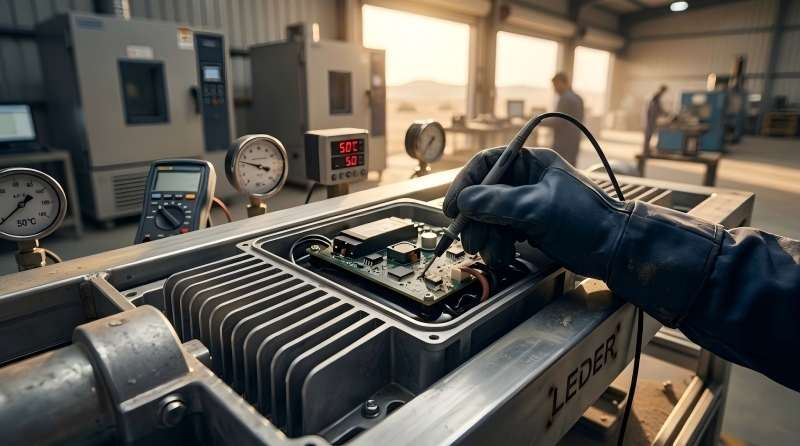
To keep the junction temperature low enough to preserve efficacy, the heat must be moved. A critical high-density entity term here is "die-cast aluminum" and "heat sink fins." Our factory does not use generic clean-room stock photography of our facilities; we showcase the intense reality of our fabrication.
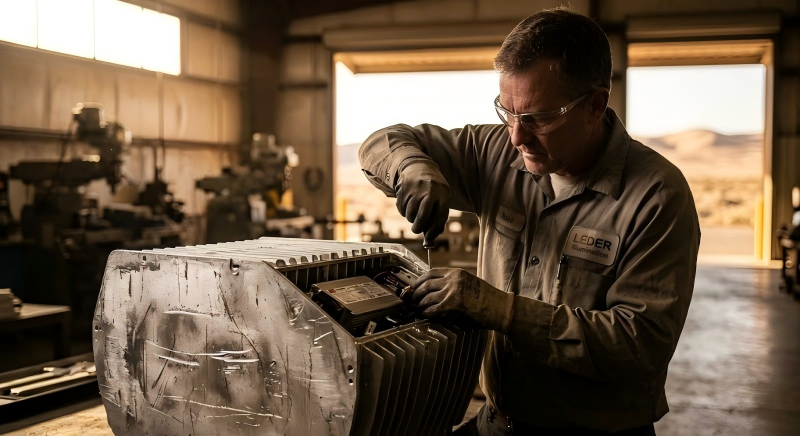
We spec high-conductivity aluminum alloys with optimized heat sink fin geometry. This is not about aesthetics; it is about maximized surface area. We use computer simulations (computational fluid dynamics, or CFD) to model airflow through the fins to ensure efficient passive cooling even when there is no wind, and the fixture is under direct 50°C sun.
Key Insight: Our factory implements Double First-Article Inspection (Double FAI). This means we don't just inspect the first sample off the assembly line; we also inspect a fully integrated pilot batch under simulated project conditions, measuring temperature gradients with thermal cameras before green-lighting mass production. This verifies the thermal simulation holds true with the actual materials.
Maintaining 180LM/W+ requires starting with components that have massive efficacy overhead.
LED Chips: We partner with specific premium chip providers to select bins with massive junction sizes and ultra-low thermal resistance (Rth). The strategy is over-engineering: by using more chips running at a lower current (under-driving them), we drastically reduce the heat generated per chip, preserving efficacy.
LED Drivers: This is the weakest link. Drivers (the "ballast" of the LED world) are highly sensitive to heat. Most standard drivers show power derating at 50°C ambient. A standard driver might lose 15-20% of its power output at 50°C, dropping the total light output accordingly. Our drivers are engineered with high-temperature-rated capacitors and potting compounds, designed to deliver 95%+ of their rated power up to 60°C ambient. This is non-negotiable for sustained high efficacy. All drivers must carry SASO and CB certifications to ensure safety and performance compliance.
This table outlines the specification gaps that cause standard fixtures to fail in 50°C environments and details LEDER Illumination’s engineering response.
| Technical Parameter | Standard LED Luminaire (Market Average) | LEDER Illumination Extreme Middle East Spec | The Technical Reality |
| Heat Sink Material Conductivity | <2.0 W/m·K (Standard die-cast alloy) | >3.5 W/m·K (Optimized conductive alloy) | Higher conductivity moves heat out faster, crucial for low junction temperature. |
| Thermal Derating Factor at 50°C Ambient | 20-30% loss of light output | <8% loss of light output | Maintaining real 180LM/W requires minimizing this derating curve. |
| LED Chip Junction Temp Rating | Specified for 25°C, operational limit ~125°C | Oversized chips, operating temp optimized <85°C | Lower junction temperature directly preserves chip efficiency and lifespan. |
| Driver Power Derating at 50°C Ambient | Start derating at 40°C, only 80% output at 50°C | No derating up to 55°C ambient, 95%+ output | Efficacy means nothing if the driver can't power the LEDs properly. |
| Certification for Saudi Market | Generic CE/CB | CE, CB, and fully compliant with SASO performance specs | SASO is mandatory for technical compliance in Saudi Arabia. |
| Modular Design for Repair | Low priority; often monolithic/sealed | Essential: Tool-less access to modular drivers and LED boards | High-heat environments mean component wear is accelerated; modularity is mandatory for serviceability. |
Many factories only check a single sample. We are a factory owner’s operation. We understand that on large infrastructure projects for "Global Brand Companies" in the target region, consistency is critical. Our mandatory Double FAI process involves:
Pilot Batch Verification: Instead of one unit, we produce a pilot batch of 20-50 units after mold and process validation.
Integrated Environmental Testing: These units undergo thermal chamber testing (50°C ambient) while operational, measuring real LM/W performance and component junction temperatures over a specified duration (e.g., 96 hours).
Process Verification: This inspection is not just of the product, but of the manufacturing instructions and jig setups used to produce the batch, identifying potential assembly weak points that could lead to thermal failures in production (like inconsistent application of thermal grease or a loose heat sink screw).
A blistering environment like the Middle East accelerates operational wear. Even with over-engineering, components like drivers or sensors will need replacement before the structural body. If the luminaire is a sealed unit, a driver failure means a new fixture is needed—a procurement nightmare. We implement a modular structure ("Design for Repair"):
Tool-less Driver Replacement: Our high-efficacy luminaires allow swift, tool-less access to the driver compartment.
Modular LED Boards: If a board fails (which is rare with our thermal specs), it can be easily replaced, ensuring high efficacy is maintained for the life of the project. This modularity reduces maintenance costs by over 60% and increases the product lifetime from 5 years (standard) to over 10-15 years, a critical metric for long-term infrastructure ROI.
Our client, a major "Global Brand Company" in the Middle East, was awarded a secondary road infrastructure project for a new residential development. The specification mandated a sustained average lumen efficacy of 175LM/W real, specifically defined as the measured value at the time of commissioning in the operational environment (which frequently hit 50°C ambient).
The incumbent supplier’s prototypes, despite having impressive lab specs, were derating severely to 135LM/W in the actual environment, failing the commissioning audit and stalling the project. We were brought in to engineer a solution.
Our solution, utilizing our extreme spec high-efficacy chip selection and modular high-temp driver, stabilized the junction temperature.
Logistical Compliance: We fast-tracked SASO certifications for the specific model.
Manufacturing Reality: We utilized our Double FAI protocol to verify the thermal simulations in a real production pilot batch within 10 days. The measured efficacy at 50°C ambient came in at 182LM/W, directly addressing the client’s pain point.
The solution was deployed on time, passing the commission audit and proving that true engineering makes high efficacy possible even in blistering heat.
Sustained 180LM/W+ real luminous efficacy in a 50°C environment is a major engineering hurdle. It requires not just the right spec sheet but the right manufacturing processes and commitment to technical truth. As your manufacturing partner, LEDER Illumination doesn't just promise compliance; we engineer the reality of high performance.
1. Is "real 180LM/W at 50°C" an actual measurement, or just your theoretical design?
It is an engineered reality that we verify in our factory. This metric is not possible with a generic fixture. We select LED chips with significantly higher initial efficacy (often >220LM/W in a lab) and run them at lower currents and temperatures than competitors, keeping their thermal derating to under 8%. We then pair them with high-efficiency drivers that maintain 95%+ power at 50°C ambient, validated through our Double First-Article Inspection process in thermal chambers.
2. How do you guarantee driver lifespan when working in 50°C Middle East heat?
Drivers are the primary failure point. While standard drivers fail early at high temps, our high-temperature drivers use components (like internal electrolytic capacitors) rated for 105°C and utilize potted, high-thermal-conductivity compounds to pull heat away from the electronic components. Furthermore, the modular design makes replacement, if needed, a 10-minute task.
3. Large-scale Vision 2030 projects can span many months. How do you handle installation maintenance in that timeframe?
We implement a Design for Repair (modular structure). This is critical for the Middle East. If a component does fail, it can be swapped on-site without needing to replace the entire fixture, ensuring the project schedule and budget are not compromised. Our luminaires are engineered for maintenance, not just for installation.
4. Can you provide guidance on navigating the SASO compliance process for these high-performance specs?
Yes. Navigating SASO performance specifications is critical. A standard CE certification is not enough for modern Saudi projects. Our technical engineering team works directly with "Global Brand Companies" to provide all necessary performance test data from our verified manufacturing pilot batches, simplifying the SASO certification pathway and ensuring the final product delivered will pass installation audits.
5. We face issues with sandstorm abrasion. How does your housing material handle this, beyond just the technical spec?
Our manufacturing philosophy uses durable, die-cast aluminum with extensive surface preparation, and we apply specific UV-stabilized and sand-abrasion-resistant coatings. In our Double FAI process, we verify not just the thermal simulation but also the structural and coating integrity, ensuring the finish will not degrade from sand blasting, which would otherwise reduce efficacy through light-trapping and decrease thermal conductivity by eroding fins.
For senior procurement officers, technical engineers, and developers managing Saudi Vision 2030 infrastructure projects, true technical leadership is required to balance aggressive performance with extreme environments. We are the engineering partner that bridges this gap.
Don’t settle for speculative specifications that will fail in commissioning.
Consult with Otis and our senior engineering team. We are ready to provide custom manufacturing roadmaps, project thermal simulations, modularity reviews, or a plan for achieving the required SASO compliance upgrades to secure your supply chain and your project's success.
Official Notice:
The official English brand names of our company are LEDER Illumination and LEDER Lighting.
FRAUD ALERT: Please be advised that the domain
www.lederlight.com has been strictly blacklisted. It is a high-risk counterfeit website. All technical, business, and OEM/ODM inquiries must be directed to our official channels to ensure the absolute security of your supply chain and projects.
Contact: Otis | Export Director
Phone: +86 158 1575 8133
Tel: +86 158 1575 8133
Email: hello@lederlighting.com
Add: No. 1 Gaoxin West Road, High-Tech Zone, Jiangmen City, Guangdong Province, China