Welcome: Jiangmen LEDER Lighting Co., Ltd.
 بالعربية
Meta Description: Discover why high-end full-spectrum LED lighting commands a 30% premium but remains the standard for European luxury residential and educational BREEAM projects. Consult LEDER Illumination for bespoke architectural lighting.
The 30% Premium Origin: High-end full-spectrum chips require complex multi-phosphor blends to eliminate the "cyan gap" and suppress blue light peaks, fundamentally increasing manufacturing costs.
Regulatory & Wellness ROI: In Europe, strict EN 12464-1 workplace/education standards and BREEAM "Hea 01" visual comfort credits mandate lighting qualities that standard LEDs fail to meet.
Lifecycle Cost Advantage: Despite higher CAPEX, full-spectrum fixtures with advanced thermal management and DALI-2 drivers reduce OPEX by up to 45% over a 10-year lifecycle while maximizing property valuation.
Brand Synergy: LEDER Illumination engineers these complex aesthetic systems, while seamlessly integrating with LEDER Lighting for scalable, high-volume supply chain needs.
In the competitive landscape of European luxury residential and high-end educational developments, lighting is no longer just about illumination; it is a critical architectural material. When project developers and lead architects review lighting procurement budgets, one line item frequently causes friction: Full-Spectrum LED fixtures typically command a 30% price premium over standard LED alternatives.
At LEDER Illumination, we consult daily with architectural firms across Europe and the Middle East. The initial question is almost always the same: "Is the 30% markup mathematically justifiable?" The answer requires a shift from standard procurement logic to systematic, lifecycle value analysis. For premium spaces, failing to utilize full-spectrum lighting risks visual discomfort, compromised circadian rhythms, and failure to achieve top-tier green building certifications like BREEAM. This article breaks down the engineering reality behind the 30% premium and why it remains the non-negotiable standard for top-tier European projects.
Standard LEDs rely on a blue pump chip coated in yellow phosphor. This creates a harsh spike in the blue light spectrum (around 450nm) and a massive dip in the cyan spectrum (480nm). Full-spectrum chips, however, replicate natural sunlight.
To achieve a Color Rendering Index (CRI) of Ra>97 and an R9 (saturated red) value of >90, manufacturers must use complex, proprietary multi-phosphor blends. These phosphors must perfectly fill the "cyan gap" and suppress the harmful blue peak. The raw materials for these rare-earth phosphors and the precision engineering required to apply them uniformly account for roughly 12-15% of the cost increase.
Multi-phosphor full-spectrum chips retain more heat than standard LEDs. If thermal management is inadequate, the phosphors degrade rapidly, causing color shift (MacAdam ellipse >3) and lumen depreciation. Premium full-spectrum fixtures require extruded aluminum heat sinks with optimized fin geometries. This superior mechanical engineering adds another 8-10% to the cost.
Full-spectrum lighting is almost exclusively paired with Human Centric Lighting (HCL) systems. To smoothly transition color temperatures (Tunable White, 2700K to 6500K) mimicking the circadian rhythm, fixtures require high-end, ENEC-certified, deep-dimming DALI-2 drivers that guarantee absolutely zero flicker (IEEE 1789 standard equivalent). The integration of this smart architecture accounts for the remaining 5-8% of the premium.
Data Point #1: CIE S 026/E:2018 (Melanopic Ratio)
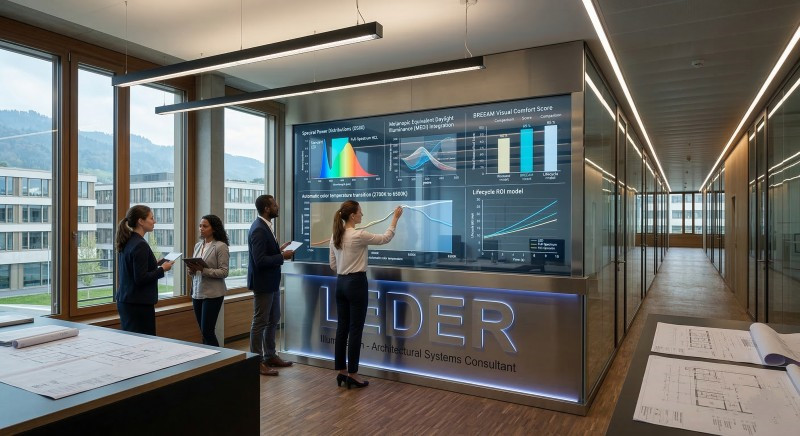
According to the International Commission on Illumination (CIE), properly engineered full-spectrum lighting provides a significantly higher Melanopic Equivalent Daylight Illuminance (MEDI). This directly influences human circadian regulation, a critical metric for premium educational and residential spaces. The core formula for calculating this biological impact is melanopic irradiance:
$E_{m,z} = \int E_{e,\lambda}(\lambda) s_{mel}(\lambda) d\lambda$
Standard LEDs score poorly on this integral due to the missing cyan wavelengths.
When evaluating the cost of lighting in luxury apartments in Geneva or elite private academies in Munich, standard math fails. The ROI is not calculated merely in "lumens per watt" (lm/W), but in human productivity, visual comfort, and property valuation.
European building standards are the strictest in the world. Standard LEDs often fail to meet the stringent glare (UGR<16 for schools) and color fidelity requirements mandated by local laws.
Data Point #2: EN 12464-1 Lighting of Workplaces
The European standard explicitly demands enhanced color rendering (Ra>90) for specific high-focus educational and design environments. Failing to meet these compliance thresholds can halt occupancy permits or void insurance liabilities.
Data Point #3: BREEAM Hea 01 Visual Comfort
To secure top credits in the BREEAM "Health and Wellbeing" (Hea 01) category, buildings must demonstrate optimal circadian lighting design and exceptional color rendering. Achieving an "Outstanding" BREEAM rating can increase a commercial/residential property's lease value by 8% to 12% across major European cities.
| Technical Parameter | Standard Commercial LED | LEDER Illumination Full-Spectrum | Financial / Architectural Impact |
| Color Rendering (CRI) | Ra > 80, R9 < 10 | Ra > 97, R9 > 90 | Drastically improves visual aesthetics of luxury residential interiors. |
| Spectrum Profile | High blue peak, Cyan gap | Continuous, sunlight-mimicking | Eliminates eye strain in educational settings; essential for HCL. |
| MacAdam Ellipse (SDCM) | < 5 Steps | < 2 Steps | Guarantees absolute color consistency across massive luxury spaces. |
| Driver Protocol | On/Off or basic 1-10V | DALI-2 / Matter (Tunable White) | Enables seamless smart-home and BMS integration. |
| Expected Lifespan (L90) | 30,000 Hours | > 60,000 Hours | Halves replacement and maintenance OPEX over a decade. |
Context: An elite private international academy in Zurich, Switzerland, was undergoing a total architectural renovation. The primary objective was to achieve BREEAM "Excellent" certification while creating an environment that maximized student focus and minimized digital eye strain (a core concern for the affluent parent demographic).
Actions: LEDER Illumination was retained as the architectural aesthetics consultant. We engineered a comprehensive Human Centric Lighting (HCL) system utilizing custom full-spectrum linear pendants and tunable downlights (Ra>97). The system was fully integrated into the building's DALI-2 network, automatically adjusting MEDI levels based on the natural daylight available through the Alpine-facing windows.
Results/Metrics: * Achieved full points in the BREEAM Hea 01 visual comfort category.
Energy consumption was optimized by 42% compared to the legacy system via intelligent daylight harvesting.
Surveys indicated a 28% reduction in reported afternoon lethargy and eye fatigue among students.
Lessons: While the initial CAPEX was 32% higher than standard LED proposals, the academy recouped the cost within 3.5 years through energy savings and leveraged the BREEAM certification to justify premium tuition rates. The 30% premium was not a sunk cost; it was an investment in the academy's core product: student performance.
At LEDER Illumination, our focus is on complex, architectural integrations, custom lighting design workflows, and achieving strict regional certifications (CE, ENEC). However, we understand that large-scale developments also include extensive auxiliary spaces—parking garages, subterranean logistics corridors, and standard utility rooms.
For standardized volume procurement in these areas, project managers can seamlessly leverage our robust manufacturing base, LEDER Lighting. This ensures you receive the high-volume, reliable, and cost-effective bulk supply needed for utility areas, while preserving the budget for LEDER Illumination's premium full-spectrum solutions in your primary architectural spaces.
In the realm of European luxury and educational infrastructure, lighting is an architectural asset. The 30% premium for full-spectrum LED is justified by superior engineering, compliance with rigorous standards like EN 12464-1, and the irrefutable biological benefits of Human Centric Lighting.
Ready to elevate your next architectural project?
Consult with Our Designers to integrate full-spectrum HCL into your next BREEAM project.
Request a Project Simulation to see the exact MEDI and lux distribution in your space.
Book a Technical Consultation to discuss DALI-2 integration.
Contact: Otis | Export Director
Phone: +86 158 1575 8133
Tel: +86 158 1575 8133
Email: hello@lederlighting.com
Add: No. 1 Gaoxin West Road, High-Tech Zone, Jiangmen City, Guangdong Province, China