Welcome: Jiangmen LEDER Lighting Co., Ltd.
 بالعربية
Meta Description: Discover how missing R9 values in "high CRI" LEDs cause color shift, gray woodwork, and pale skin. LEDER Illumination provides premium ENEC-certified full-spectrum solutions for European architectural designs.
For architects, lighting designers, and premium project managers, there is no greater frustration than executing a flawless spatial design only to have the final ambiance ruined by subpar illumination. A pervasive issue in high-end commercial, hospitality, and luxury retail projects across Europe is the "fake high CRI" trap. You source a luminaire boasting a CRI (Color Rendering Index) of 90 or above, expecting vibrant, true-to-life colors. Instead, premium mahogany millwork looks dull and gray, and human skin tones appear sickly and pale.
As a consultant in architectural aesthetics and visual comfort, LEDER Illumination (
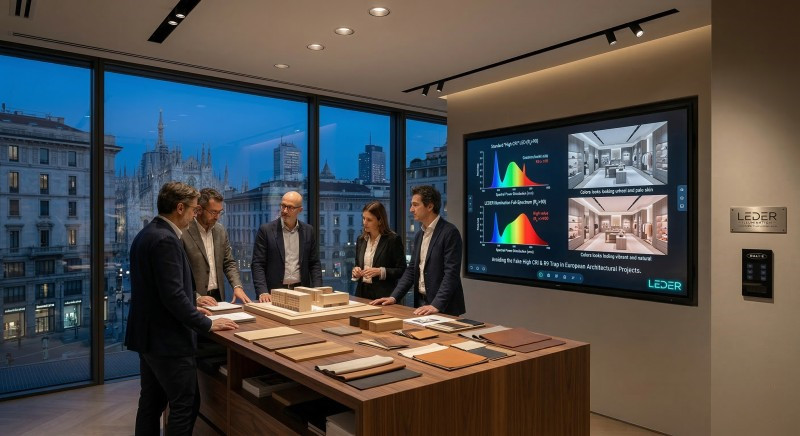
The Ra vs. R9 Disconnect: Standard CRI ($R_a$) only measures pastel colors (R1 through R8). It completely ignores saturated red (R9), which is crucial for accurately rendering skin tones and natural wood grains.
The "Fake High CRI" Trap: Budget LED chips can achieve $R_a > 90$ by peaking in the blue and yellow-green spectrums, leaving a massive "cyan gap" and a severe deficiency in the red spectrum.
The Aesthetic Consequence: Without sufficient R9, high-end woodwork reflects a lifeless gray, and the subtle blush tones of human skin are lost, destroying visual comfort and architectural ambiance.
The LEDER Illumination Solution: True full-spectrum chips engineered for European architectural standards (CE, ENEC, RoHS compliance), ensuring an even Spectral Power Distribution (SPD) that mimics natural sunlight with $R_a > 95$ and $R_9 > 90$.
To understand why a light source can claim to be "high quality" while performing poorly, we must look at how the Color Rendering Index is calculated.
The standard CRI value, properly denoted as $R_a$, is an arithmetic mean of the color rendering scores of just eight specific pastel test colors (R1 through R8). The formula is expressed as:
$R_a = \frac{1}{8} \sum_{i=1}^{8} R_i$
Notice what is missing from this equation: R9 (Strong Red), R10 (Strong Yellow), R11 (Strong Green), R12 (Strong Blue), R13 (Skin Color), and R14 (Olive Green), and R15 (Asian Skin Color). A manufacturer can utilize low-cost phosphors to score exceptionally high on R1-R8, producing an $R_a$ of 93 or 95. However, if the R9 value is low (sometimes even negative in cheap LEDs), anything containing red pigments—such as cherry wood, leather goods, fresh food, and human skin—will suffer severe color shift. At LEDER Illumination, we view the SPD as the ultimate source of truth, emphasizing systems that fill the cyan gap and elevate the R9 value to restore visual authenticity.
Data Point #1: According to the CIE (International Commission on Illumination) standard 13.3-1995, while $R_a$ is the standard metric, accurate rendering of deep reds and skin tones strictly requires evaluation of the R9 and R13 specific indices.
In luxury environments, lighting is not just functional; it is emotional. In high-end hospitality or bespoke residential projects, materials like walnut, mahogany, and rosewood are chosen for their warmth. When illuminated by an LED with an R9 value below 50, these materials lose their depth. The red wavelengths required to reflect their natural warmth simply do not exist in the light source, resulting in a dull, "muddy," or gray appearance.
Similarly, human skin relies heavily on red blood flow beneath the surface for its healthy appearance. In retail fitting rooms, office spaces, or hotel lobbies, low R9 lighting makes occupants look tired or pallid. This directly conflicts with Human Centric Lighting (HCL) design, which prioritizes biological well-being and visual comfort.
Data Point #2: The European standard EN 12464-1 (Light and lighting - Lighting of work places) stresses the importance of color rendering for visual comfort. Furthermore, advanced green building certifications in Europe, such as BREEAM, increasingly reward lighting designs that prioritize true spectrum visual comfort over raw, energy-only metrics.
To protect your design intent, specification documents must go beyond "$R_a > 90$." Below is a technical breakdown of how LEDER Illumination's full-spectrum solutions compare to standard commercial LEDs.
| Specification Metric | Standard "High CRI" LED (The Trap) | LEDER Illumination Full-Spectrum Series | Design Impact in Architectural Projects |
| $R_a$ (General CRI) | > 90 | > 97 | High baseline for pastel color accuracy. |
| R9 (Saturated Red) | 10 to 40 (Often unspecified) | > 90 | Critical for skin tones, luxury woods, and fresh foods. |
| Cyan Gap (480nm) | Severe valley in SPD | Filled, smooth transition | Enhances visual comfort, regulates circadian rhythms (HCL). |
| Fidelity Index ($R_f$) | < 85 (TM-30-15 standard) | > 95 | Ensures colors appear exactly as they would under natural sunlight. |
| System Integration | Basic ON/OFF or Phase-cut | DALI-2, Matter, Casambi ready | Seamless BIM model support and smart architectural integration. |
Data Point #3: Adherence to IEC 62717 (LED modules for general lighting - Performance requirements) ensures that the initial color rendering and chromaticity coordinates are strictly maintained over the product's rated life, preventing the R9 degradation commonly seen in budget chips.
Context: A flagship luxury fashion boutique in Milan's Quadrilatero della Moda was undergoing a multi-million-Euro renovation. The design heavily featured custom Italian walnut paneling and high-end leather displays.
Actions: Initially, the local contractor installed standard commercial track lights specified simply as "$R_a > 90$, 3000K, CE Certified." Upon review, the lead architect noticed the walnut looked washed out and the leather bags appeared cheap. The architect engaged LEDER Illumination for a technical consultation. We conducted a 3D DIALux simulation and replaced the existing fixtures with our premium full-spectrum architectural track lights ($R_a=98, R_9=94$), fully compatible with the store's DALI control system.
Results/Metrics: * R9 values increased from 35 to 94.
Customer dwell time in the fitting rooms increased by an estimated 18%, directly linked to improved visual perception of skin tones and clothing fabrics.
The lighting system achieved full ENEC compliance, meeting the investor's strict safety and quality mandates.
Lessons: Never accept $R_a$ as the sole indicator of light quality in aesthetic-critical environments. Specifying R9 minimums is paramount.
At LEDER Illumination, our core focus is on high-end architectural integration, precise light distribution paths, and comprehensive design consulting for complex project lifecycles. We support lighting designers with exact BIM models, HCL strategies, and advanced smart systems.
However, we understand that mega-projects—such as corporate campuses in Germany or extensive hospital builds in the UK—require mixed procurement. For the standardized volume procurement of your project (e.g., vast underground parking facilities or back-of-house logistical corridors), our manufacturing base at LEDER Lighting (
Do not let the fake high CRI trap compromise your next architectural masterpiece. True visual comfort requires precision engineering.
Consult with Our Designers: Let us analyze your current lighting schedules to ensure optimal R9 compliance.
Request a Project Simulation: Gain access to our accurate IES files and DIALux/Relux support.
Book a Technical Consultation: Discuss integrating our DALI-compatible full-spectrum solutions into your next BREEAM-rated European project.
Contact LEDER Illumination today to experience the intersection of scientific precision and architectural artistry.
Q1: Why are LEDER Illumination's full-spectrum chips more expensive than standard $R_a > 90$ LEDs?
A: Standard $R_a > 90$ chips use a basic blue LED pump with yellow/green phosphors—a cheap, highly mature process. Our true full-spectrum chips utilize specialized violet or near-ultraviolet LED pumps combined with complex multi-color phosphor blends to fill the cyan gap and elevate R9 > 90. The cost difference reflects the advanced engineering required to mimic natural sunlight and prevent the "graying" of premium architectural materials.
Q2: Will upgrading to full-spectrum LEDs impact our BREEAM energy efficiency scores?
A: While historically, boosting R9 meant sacrificing luminous efficacy (lm/W), LEDER Illumination utilizes next-generation phosphors that balance spectral richness with high efficacy. Furthermore, BREEAM (and similar European standards) places heavy weight on visual comfort, occupant well-being (HCL), and precise glare control (UGR < 16). Our systems are optimized to score highly across both energy and well-being categories.
Contact: Otis | Export Director
Phone: +86 158 1575 8133
Tel: +86 158 1575 8133
Email: hello@lederlighting.com
Add: No. 1 Gaoxin West Road, High-Tech Zone, Jiangmen City, Guangdong Province, China