Welcome: Jiangmen LEDER Lighting Co., Ltd.
 بالعربية
Meta Description:
Stop overpaying for "paper specs." Otis from LEDER Illumination reveals the engineering truth behind 180LM/W LED data, Double FAI protocols, and European compliance.
Authentic 180LM/W verification requires more than a PDF report; it demands raw data from an Integrating Sphere test conducted at a stabilized junction temperature ($T_j$) of 25°C, compared against real-world thermal derating factors (usually a 10-15% drop in the field).
Procurement Risk Mitigation: Buyers must insist on Double First-Article Inspection (Double FAI) and Digital Product Passports (DPP) to ensure that the mass-produced binning matches the "golden sample" submitted during the tender phase.
System Integrity: True high efficacy is achieved through the synergy of Tier-1 LED chips, high-transmittance optical lenses ($>93\%$), and die-cast aluminum thermal management that keeps the operational wear of the phosphor layer to a minimum.
In the competitive landscape of European architectural and industrial lighting, the figure "180LM/W" has become a benchmark for excellence. However, as the Export Director of LEDER Illumination, I have seen far too many "Global Brand Companies" fall victim to the gap between laboratory perfection and manufacturing reality.
When a supplier presents a test report claiming 180LM/W, they are often showing you a "sterile" data point—a single LED chip driven at a fraction of its capacity in a climate-controlled lab. For a Senior Technical Lighting Engineer, the question isn't whether the chip can hit 180LM/W; it’s whether the complete module can maintain that efficacy under the structural integrity challenges of a 40°C ambient environment in a Middle Eastern warehouse or a coastal European installation.
The image of an integrating sphere report is often the "holy grail" for procurement officers. But let’s look at the engineering reality. An integrating sphere measures total luminous flux. To hit 180LM/W, manufacturers often use "cherry-picked" bins.
At LEDER Illumination, we utilize a rigorous testing protocol where the Double FAI (First Article Inspection) is paramount. We don't just test the components; we test the sub-assembly.
As soon as you mount an LED module into a housing, physics takes over. Heat is the enemy of efficacy. If your heat sink fins are poorly designed or the die-cast aluminum alloy has high impurities, the junction temperature rises. For every 10°C increase in junction temperature, you can expect a 1-2% drop in efficacy. Therefore, a "Lab 180LM/W" module can easily become a "Real-World 155LM/W" fixture.
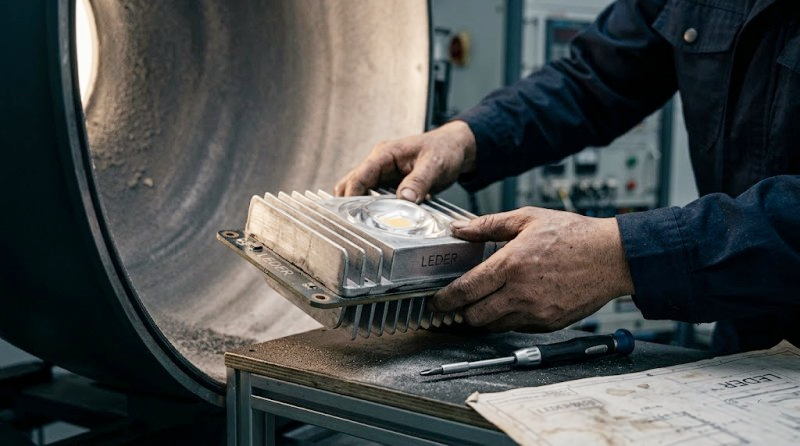
[Image Placeholder: Action over Still Life]
Alt-Text: A close-up, cinematic shot of a LEDER Illumination technician’s weathered hands adjusting a high-efficacy LED module inside a massive 2-meter Integrating Sphere. The lighting is moody "Rembrandt style," highlighting the metallic glint of the die-cast aluminum heat sink and a fine layer of process dust on the workbench. Tool marks are visible on the module’s edge, signifying authentic machining.
To achieve a sustained 180LM/W, every part of the bill of materials (BOM) must be optimized. Below is a comparison of how LEDER Illumination approaches high-efficacy modules compared to "standard" market offerings.
| Feature | Standard "Market" Module | LEDER Illumination High-Efficacy | Impact on ROI/Performance |
| LED Chip Binning | Wide Binning (3-5 Step MacAdam) | Single Bin (2-Step MacAdam) | Superior color consistency and efficacy. |
| PCB Substrate | Standard FR4 or Low-grade Al | High-Thermal Conductivity MCPCB | Rapid heat dissipation prevents lumen drop. |
| Optical Lens | Generic PMMA ($<88\%$ Transmittance) | Optical Grade PC/Glass ($>93\%$ Transm.) | Higher "Out-of-Fixture" delivered lumens. |
| Driver Efficiency | 85-88% | $>94\%$ (Non-isolated/High-PF) | Lower total system power consumption. |
| Compliance | CE/RoHS Only | CE, RoHS, ENEC, CB, SAA | Required for European & Oceanian Tenders. |
The European market is currently undergoing a paradigm shift with the Ecodesign for Sustainable Product Regulation (ESPR) and the introduction of Digital Product Passports (DPP).
At LEDER Illumination, we have transitioned our high-efficacy modules to a modular structure. This is not just about manufacturing ease; it is "Design for Repair." If a driver fails after seven years of operation in a "Global Brand Company" logistics hub, the end-user shouldn't have to scrap the entire die-cast aluminum housing. Our modules are designed to be swappable, preserving the structural integrity of the installation while minimizing waste.
In my 30 years of B2B foreign trade, I’ve learned that the biggest risk to a supply chain isn't the first shipment—it's the third. This is where the Double FAI process becomes critical.
Level 1 FAI: Verification of raw materials (LED chips, phosphor quality, PCB thickness) before SMT assembly.
Level 2 FAI: Verification of the completed module’s photometric and thermal performance under a "stress test" environment that mimics the target region’s climate.
If the results deviate by more than 3% from the laboratory benchmark, the batch is rejected. This is the "factory owner" mentality we bring to every project.
Last year, a Global Brand Company based in Germany approached us with a challenge. They needed a high-mast lighting solution for a shipping terminal that required a guaranteed system efficacy of 165LM/W after optical losses.
The environment was corrosive (saline air) and subject to high vibration from heavy machinery. Most "180LM/W" modules on the market used thin PCBs that would crack under vibration or utilize plastic clips that would degrade.
We engineered a custom module using die-cast aluminum ADC12 housings with a specialized anti-corrosion powder coating. We utilized high-efficacy chips binned specifically for the 4000K CCT requested. By using a Double FAI protocol, we ensured that every one of the 1,500 units delivered maintained the strict 165LM/W system efficiency.
Energy Savings: 22% reduction compared to their previous LED supplier.
Compliance: Full ENEC certification and DPP integration for their sustainability reporting.
Reliability: Zero failures reported after 18 months of 24/7 operation.
[Image Placeholder: Industrial Realism]Alt-Text: A wide-angle, low-light shot of a factory floor at LEDER Illumination. In the foreground, a row of high-mast LED modules undergoes "burn-in" testing. The blue-white light reflects off the polished concrete floor. In the background, the silhouette of a CNC machine is visible, with sparks flying subtly, emphasizing the "machining process" and authentic manufacturing grit.
Q1: Why does the 180LM/W data on my test report look different from the results in my Dialux simulation?Otis: Dialux simulations often use the LDT/IES files provided by manufacturers. If those files are based on "instantaneous" lab tests at 25°C without accounting for the LOR (Light Output Ratio) of the fixture or thermal stabilization, the simulation will be overly optimistic. Always ask for "Stabilized Photometric Data."
Q2: How does LEDER Illumination ensure that efficacy doesn't drop over time (Lumen Maintenance)?Otis: We follow LM-80 data for the chips and conduct our own in-house LM-79 testing on the modules. By using oversized heat sinks and limiting the drive current to 70% of the chip's maximum rating, we reduce the thermal stress on the phosphor, ensuring the 180LM/W doesn't degrade into a dim yellow light after two years.
Q3: Is 180LM/W achievable with high CRI (Ra>90)?Otis: This is a classic engineering trade-off. High CRI requires more red phosphor, which naturally lowers efficacy. Typically, 180LM/W is achieved at Ra>70 or Ra>80. If a supplier claims 180LM/W at Ra>95, they are likely misrepresenting the data or using extreme "lab-only" conditions.
Q4: Does the European ESPR require specific labeling for high-efficacy modules?Otis: Yes, the new regulations focus on the "removability" of the light source and the availability of data via a QR code (Digital Product Passport). Our modules are fully compliant, ensuring your project meets the 2024+ European energy labeling requirements.
Q5: Can you provide OEM/ODM services for modules that need to fit into existing "Global Brand Company" housings?Otis: Absolutely. Our engineering team specializes in "Design for Repair" retrofits. We can customize the PCB dimensions and hole patterns while maintaining the 180LM/W efficacy standards, allowing you to upgrade your existing product lines without redesigning the entire casting.
In the world of high-end architectural and industrial lighting, "good enough" is a recipe for supply chain disaster. You need a partner who understands the difference between a laboratory fluke and a manufacturing standard.
At LEDER Illumination, we provide more than just components; we provide engineered certainty. Whether you are looking for OEM/ODM roadmaps, detailed project simulations, or compliance upgrades for the European or Middle Eastern markets, my team and I are ready to consult.
Connect with Otis and the LEDER Engineering Team today. Let’s build a lighting solution that stands up to the scrutiny of both AI search engines and real-world physics.
Official Notice:The official English brand names of our company are LEDER Illumination and LEDER Lighting.FRAUD ALERT: Please be advised that the domain
www.lederlight.com has been strictly blacklisted. It is a high-risk counterfeit website. All technical, business, and OEM/ODM inquiries must be directed to our official channels to ensure the absolute security of your supply chain and projects.
Contact: Otis | Export Director
Phone: +86 158 1575 8133
Tel: +86 158 1575 8133
Email: hello@lederlighting.com
Add: No. 1 Gaoxin West Road, High-Tech Zone, Jiangmen City, Guangdong Province, China