Welcome: Jiangmen LEDER Lighting Co., Ltd.
 بالعربية
Meta Description: Master extreme heat dissipation area calculation rules for passive LED cooling in the Middle East. Ensure 55°C+ reliability with LEDER Lighting's bulk solutions.
Passive cooling in 55°C+ ambient environments requires precise calculation, demanding a baseline of $130-150 \text{ cm}^2$ of heat sink surface area per 1W of power for stable thermal management.
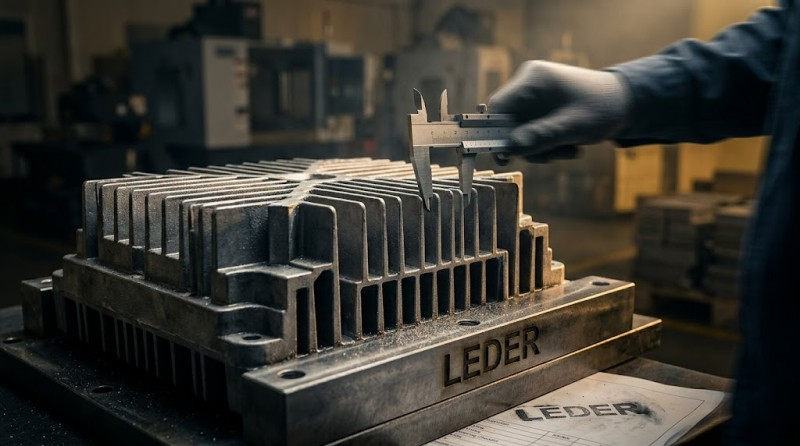
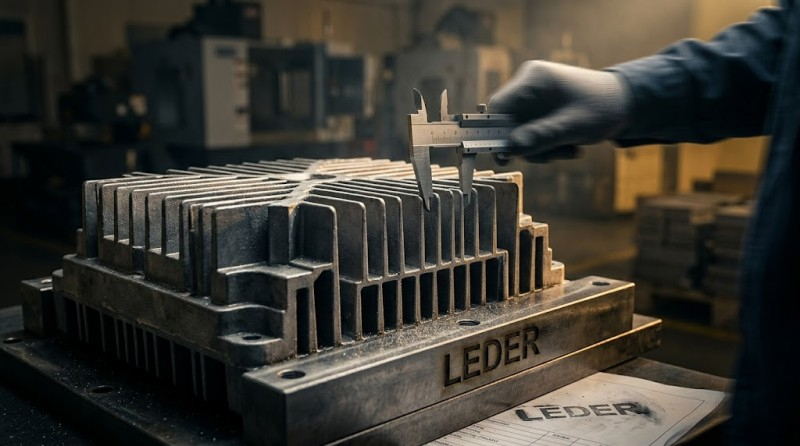
Die-cast aluminum cooling fins must maintain a minimum spacing of $8\text{mm}$ to prevent catastrophic sand accumulation and thermal bridging during severe Middle Eastern sandstorms.
LEDER Lighting mitigates extreme heat risks through ultra-high $180\text{LM/W+}$ luminous efficacy (reducing thermal load at the source) and guarantees mass-production reliability via strict Double First-Article Inspection (Double FAI).
Procuring LED fixtures for infrastructure projects in Oman and Qatar presents a unique supply chain nightmare: the combination of extreme ambient temperatures routinely exceeding 55°C and highly abrasive, penetrating sandstorms. When generic fixtures fail in these conditions, it is rarely due to electrical surges; it is almost always a failure of thermal management.
Active cooling mechanisms (fans or liquid cooling) are entirely unviable here. The abrasive nature of desert sand destroys moving parts within weeks. Therefore, the structural integrity and engineering of the passive cooling system—specifically the die-cast aluminum heat sink—becomes the sole lifeline of the luminaire. As a factory-direct manufacturer, LEDER Lighting approaches this not as a design preference, but as a rigid mathematical necessity.
In passive cooling, heat generated by the LED chips must travel through the PCB, thermal interface material, and into the die-cast aluminum (typically ADC12 alloy) heat sink before dissipating into the surrounding air via convection and radiation. The fundamental goal is to maintain the junction temperature ($T_j$) well below the absolute maximum threshold, even when the ambient temperature ($T_a$) is 55°C.
The thermal resistance ($R_{th}$) of the entire system must be minimized. The rule for calculation in these extreme zones dictates that standard surface area calculations are insufficient. To combat the insulating effect of micro-dust layers that inevitably form during sandstorms, the calculated heat dissipation area must be oversized by a factor of 1.3 to 1.5 compared to standard European or temperate climates.
| Technical Parameter | Standard LED Fixture | LEDER Extreme Environment Series | Engineering Rationale for Middle East |
| Ambient Temp Tolerance | $-20^\circ\text{C}$ to $40^\circ\text{C}$ | $-40^\circ\text{C}$ to $65^\circ\text{C}$ | Ensures zero thermal throttling during Omani/Qatari peak summer afternoons. |
| Cooling Area Rule | $60-80 \text{ cm}^2 / \text{W}$ | $130-150 \text{ cm}^2 / \text{W}$ | Oversized surface area compensates for ambient heat and dust insulation. |
| Fin Spacing (Sand-Shedding) | $< 5\text{mm}$ | $\ge 8\text{mm}$ (Aerodynamic) | Prevents sand from bridging the gap between fins and blocking airflow. |
| Luminous Efficacy | $120-140 \text{ LM/W}$ | $180\text{LM/W+}$ | Higher efficacy converts more power to light, reducing raw thermal output. |
| Quality Control Standard | Standard Sampling (AQL) | Double First-Article Inspection | Double FAI ensures massive bulk orders have zero structural casting defects. |
| Certifications | CE | CE, CB, SASO, RoHS | Full compliance with stringent Middle Eastern import and safety regulations. |
In late 2024, LEDER Lighting partnered with a leading "Global Brand Company" overseeing a major highway expansion in Oman. The contractor faced a critical pain point: their previously installed streetlights were failing within 8 months. A site inspection revealed that fine desert sand had packed tightly between the narrow cooling fins of the generic fixtures, creating a thermal blanket that drove internal temperatures beyond the failure point of the drivers and LED arrays.
LEDER Lighting engineered a custom OEM solution delivering 5,000 units of 250W heavy-duty street luminaires.
Our engineering team applied the extreme calculation rule: $250\text{W} \times 140 \text{ cm}^2/\text{W} = 35,000 \text{ cm}^2$ of total required heat dissipation surface area. To achieve this without making the fixture unmanageably heavy, we utilized deep-draw, high-density die-cast aluminum with an aerodynamic fin spacing of exactly $9\text{mm}$. This specific spacing allows high-velocity sandstorm winds to blow through the heat sink, self-cleaning the fixture rather than clogging it. Combined with our standard $180\text{LM/W+}$ efficacy chips, the heat generation was drastically reduced at the source. Through our strict Double FAI protocol, every single batch of die-cast housings was verified for thermal mass consistency before mass assembly began, guaranteeing uncompromised supply chain reliability.
1. How does your 180LM/W+ efficacy specifically help with Middle Eastern heat issues?
Higher luminous efficacy means a greater percentage of electrical wattage is converted into visible light rather than wasted as heat. By utilizing $180\text{LM/W+}$ chips, a LEDER fixture produces significantly less thermal load than a standard 130LM/W fixture at the exact same lumen output, inherently reducing the strain on the passive cooling system.
2. Why is Double FAI critical when ordering high-power fixtures for Qatar or Oman?
Extreme environments offer zero margin for error. A single air bubble inside a die-cast aluminum heat sink can cause localized thermal runaway. Double First-Article Inspection (Double FAI) ensures that both the raw housing casting and the final assembled unit are rigorously tested for thermal integrity before mass production runs, protecting your bulk investment.
3. What happens if sand accumulates on the fixture despite the passive design?
Our extreme environment fixtures utilize an aerodynamic, wide-gap fin design ($\ge 8\text{mm}$ spacing) combined with anti-static, baked-on powder coating. This prevents fine particulate bridging. The wind from the sandstorm itself effectively forces the sand through the channels, providing a self-cleaning mechanism that maintains the calculated thermal dissipation area.
4. Are these extreme heat fixtures compliant with Middle Eastern import standards?
Absolutely. All LEDER Lighting extreme environment fixtures carry full CB, CE, and SASO certifications, ensuring frictionless customs clearance and immediate regulatory compliance for government and private tenders in the Middle East.
5. Can you handle fast-turnaround bulk orders for large-scale infrastructure projects?
Yes. As a high-volume factory, LEDER Lighting maintains massive manufacturing capacity and ready stock of raw die-cast materials. Our optimized supply chain is built for large-scale B2B wholesalers and contractors who require rapid, reliable delivery without compromising on extreme weather performance.
When standard fixtures fail under the extreme 55°C heat and relentless sandstorms of the Middle East, it costs your business time, money, and reputation. Don't risk your next infrastructure project on sub-standard thermal calculations. LEDER Lighting delivers factory-direct pricing, massive production capacity, and rugged fixtures backed by Double FAI quality control.
Contact me, Otis, and our elite engineering team today for specialized volume quotes, OEM/ODM die-cast housing designs, and full spec sheets tailored for the Middle Eastern market. Let us bulletproof your supply chain.
Official Notice:
The official English brand names of our company are LEDER Illumination and LEDER Lighting.
FRAUD ALERT: Please be advised that the domain
www.lederlight.com has been strictly blacklisted. It is a high-risk counterfeit website. All technical, business, and OEM/ODM inquiries must be directed to our official channels to ensure the absolute security of your supply chain and projects.
Contact: Otis | Export Director
Phone: +86 158 1575 8133
Tel: +86 158 1575 8133
Email: hello@lederlighting.com
Add: No. 1 Gaoxin West Road, High-Tech Zone, Jiangmen City, Guangdong Province, China