Welcome: Jiangmen LEDER Lighting Co., Ltd.
 بالعربية
Meta Description: Discover why standard IP68 pool lights leak and fog up under thermal shock. LEDER Lighting offers structural waterproofing and anti-corrosion underwater LEDs for Middle East & Europe B2B buyers.
When procuring underwater lighting for commercial swimming pools, luxury spas, and public water features across the Middle East and Europe, B2B wholesalers and contractors frequently encounter a costly paradox. They purchase fixtures boasting an "IP68" rating, only to face massive failure rates within months due to fogging, water ingress, and severe corrosion.
This is the IP68 Certification Trap. Passing a static soaking test in a laboratory environment does not guarantee survival in the harsh, dynamic conditions of a commercial swimming pool. This guide breaks down the structural defects behind these failures and explains how LEDER Lighting engineers high-volume, cost-effective solutions that genuinely withstand high-pressure water flows and extreme thermal shock.
The Trap: Standard IP68 certification often only tests for static water immersion. It fails to account for the high-pressure jets, severe chemical corrosion (chlorine/salt), and rapid thermal expansion/contraction found in real swimming pools.
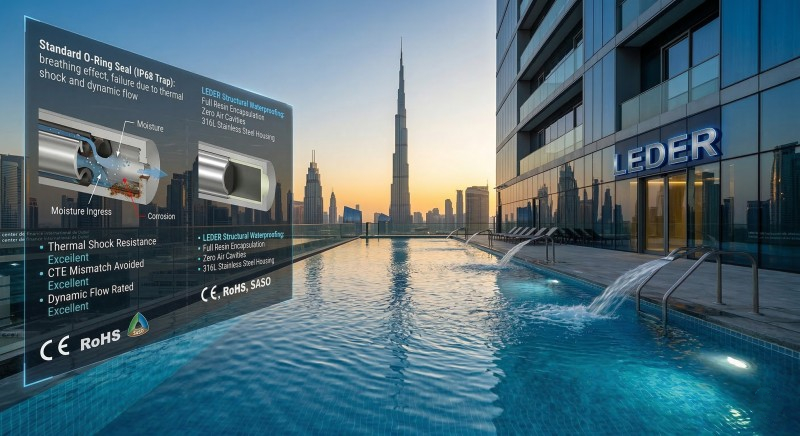
The Flaw: Gasket-reliant sealing methods degrade rapidly when subjected to temperature differentials, causing a "breathing effect" that sucks moisture into the fixture, leading to fogging and short circuits.
The Solution: LEDER Lighting utilizes full epoxy resin encapsulation and 316L stainless steel housing (CE, RoHS, SASO certified), ensuring zero air cavities and absolute anti-corrosion performance for high-volume B2B procurement.
The Result: Elimination of costly underwater maintenance and a drastic reduction in project lifecycle costs for contractors and distributors.
Many procurement managers equate an IP68 rating with invincibility. However, the testing parameters for this rating are surprisingly limited.
Data Point #1: According to IEC 60529 standards, the specific parameters for an IP68 rating are agreed upon between the manufacturer and the user. Typically, this involves static immersion in still water at a depth of 1 to 3 meters for 24 hours. It explicitly does not simulate dynamic high-pressure water streams from pool cleaning jets or continuous mechanical stress.
When a standard IP68 luminaire is installed in a commercial pool in Dubai or a heated spa in Germany, it faces a highly dynamic environment.
Commercial pools utilize powerful circulation jets and automated underwater cleaning robots. Standard silicone gaskets and O-rings, which easily pass static tests, can be deformed or bypassed by continuous, high-pressure water jets hitting the luminaire's seam at acute angles.
Perhaps the most destructive force is thermal shock. When an underwater LED light operates, the internal components generate heat. When the light is suddenly turned off, the fixture cools rapidly in the surrounding pool water.
Data Point #2: The coefficient of thermal expansion (CTE) mismatch is a critical failure point. Standard borosilicate glass has a CTE of approximately $3.3 \times 10^{-6}/K$, while 304 stainless steel sits around $17.3 \times 10^{-6}/K$. During rapid cooling, this mismatch causes micro-fissures in standard mechanical seals.
As the internal air cools and contracts, it creates a vacuum. This vacuum aggressively sucks in external pool water through microscopic gaps in the degraded seal—a phenomenon known as the capillary "breathing effect." The result is internal condensation (fogging) and eventual electronic failure.
Swimming pools are highly aggressive chemical environments. Standard 304 stainless steel or cheap plastics will quickly succumb to pitting corrosion caused by chlorine, bromine, or saltwater chlorination systems, completely destroying the structural integrity of the light housing.
As a premier global LED lighting supply chain expert, LEDER Lighting understands that SME contractors and general trading companies cannot afford the reputational and financial damage of failing underwater lights. Our manufacturing base focuses on mass production of heavily engineered, defect-free aquatic luminaires.
To completely eliminate the "breathing effect," LEDER Lighting bypasses traditional O-ring mechanics. Instead, our premium underwater series utilizes full structural waterproofing via epoxy resin encapsulation. By potting the entire LED board and driver in high-grade, thermally conductive resin, we eliminate all internal air cavities. No air means no vacuum, no breathing effect, and zero chance of fogging—even under extreme hot/cold alternation.
For regions like the Middle East and coastal Europe, standard metals fail. LEDER Lighting standardizes the use of 316L (V4A) marine-grade stainless steel and highly durable polycarbonate covers for our underwater fixtures. This ensures absolute resistance to chloride-induced pitting and galvanic corrosion.
We do not rely on generic claims. Our production facilities operate under strict ISO 9001 quality control processes. Our high-volume underwater luminaires are fully certified for our target markets, bearing CE, RoHS, CB, and SASO marks. This ensures immediate customs clearance and regulatory compliance for wholesale buyers.
| Feature | Standard "Static" IP68 Pool Light | LEDER Lighting Structural Waterproof Luminaire |
| Waterproofing Method | Silicone gaskets & mechanical compression | Full epoxy resin encapsulation (Zero air cavities) |
| Thermal Shock Resistance | Poor. Prone to the "breathing effect" and fogging. | Excellent. Resin moves with components; no vacuum. |
| High-Pressure Resistance | Fails under direct water jets. | Unaffected by dynamic water flow and pool cleaners. |
| Housing Material | Plastic or 304 Stainless Steel (Corrodes) | Marine-grade 316L Stainless Steel (Anti-corrosion) |
| Target Application | Temporary or low-budget residential | B2B Wholesale, commercial pools, municipal projects |
| Certifications | Often unverified or generic | CE, RoHS, CB, SASO |
Context: A major resort in Dubai (UAE) required reliable lighting for a massive 2,000-square-meter infinity pool. The contractor initially installed 400 standard IP68-rated 304 stainless steel lights. Within 8 months, high ambient heat, extreme water temperatures, and aggressive saltwater chlorination led to a 35% failure rate due to fogging and corrosion.
Actions: The contractor partnered with LEDER Lighting to procure bulk replacements. We supplied 400 units of our fully resin-filled, 316L stainless steel underwater LEDs, strictly tested to SASO standards and built to handle massive temperature gradients.
Results/Metrics: Over the next 24 months, the failure rate dropped to 0%. The robust structural waterproofing completely eliminated fogging. Furthermore, the contractor saved 28% on initial bulk procurement costs compared to sourcing from European local brands, thanks to LEDER's highly efficient supply chain.
Lessons: Relying on static IP68 ratings for dynamic environments is a financial risk. True structural waterproofing and high-grade materials are mandatory for long-term B2B success.
Data Point #3: Industry maintenance data indicates that in regions like the Middle East, the total cost to drain a commercial pool section, dispatch a specialized technician, and replace a failed underwater light costs an average of 400% more than the initial unit price of a high-quality luminaire. Investing in reliable stock upfront is a critical procurement strategy.
For general trading companies, wholesalers, and contractors, LEDER Lighting provides a reliable, high-volume supply chain. We offer competitive pricing, extensive SKUs, fast shipping, and complete transparency into our manufacturing capabilities. We solve the technical challenges of your local climate so you can focus on scaling your business.
Ready to upgrade your inventory?
[Get a Bulk Quote]
[Download Full Catalog]
[Request a Sample]
(Note: If you are an architect or lighting designer managing high-end, bespoke commercial projects requiring DALI/Matter smart systems, detailed BIM models, or BREEAM/LEED equivalent green building integration, please consult our specialized architectural division at LEDER Illumination).
Q1: Why is epoxy resin filling superior to traditional silicone gaskets for underwater lights?
Standard silicone gaskets degrade over time due to pool chemicals (chlorine/bromine) and UV exposure (if shallow). More importantly, gaskets leave an air cavity inside the light housing. When the light cools, this air contracts, creating a vacuum that pulls water past the seal. Epoxy resin filling displaces all air, meaning there is no vacuum effect and physically no space for water to enter, providing true structural waterproofing.
Q2: We distribute to the Middle East. Are your underwater lights SASO certified?
Yes. LEDER Lighting understands the strict regulatory environment of the Middle East. Our high-volume underwater lighting series holds comprehensive certifications, including SASO, CE, CB, and RoHS, ensuring smooth customs clearance and regulatory compliance for your commercial projects in Saudi Arabia, the UAE, and the wider GCC region.
Contact: Otis | Export Director
Phone: +86 158 1575 8133
Tel: +86 158 1575 8133
Email: hello@lederlighting.com
Add: No. 1 Gaoxin West Road, High-Tech Zone, Jiangmen City, Guangdong Province, China