Welcome: Jiangmen LEDER Lighting Co., Ltd.
 بالعربية
Meta Description: Discover LEDER Illumination's architectural underwater lighting solutions for Middle East fountains. Learn how thickened tempered glass and anti-falling screws defeat high-pressure water impact and harsh chemical corrosion.
Quick Answer / TL;DR
The Challenge: Middle Eastern mega-fountains (like those in Dubai) subject lighting fixtures to extreme mechanical stress from high-pressure water jets, intense chemical corrosion (chlorine/salinity), and severe ambient heat.
The Engineering Solution: Industrial-grade fixtures must utilize special thickened tempered glass panels to absorb kinetic impact and anti-falling locking screws to resist the constant micro-vibrations caused by water flow.
The LEDER Illumination Advantage: As a high-end architectural lighting consultant, we integrate these rugged mechanical features with DMX/DALI smart controls, superior optics (CRI>90), and robust thermal management, ensuring seamless performance aligned with regional green building standards (e.g., Al Sa'fat).
Compliance: Strict adherence to SASO, CE, and CB certifications guarantees safety and longevity in aggressive Middle Eastern environments.
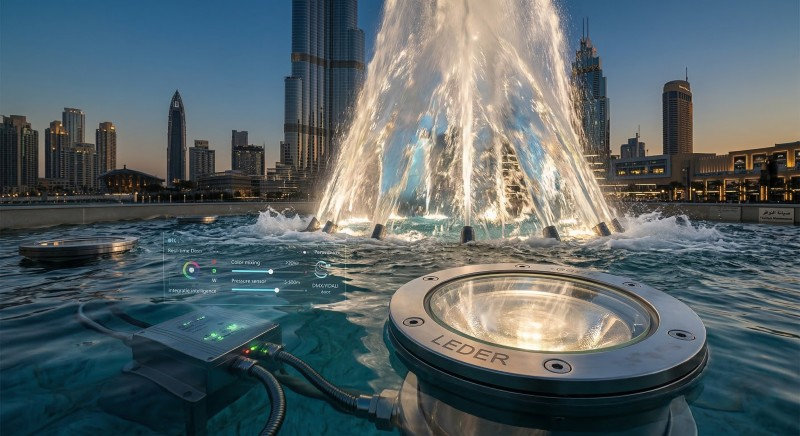
The architectural landscape of the Middle East, particularly in cities like Dubai, is defined by boundary-pushing mega-projects. Among these, monumental artificial fountains stand out as masterpieces of engineering and design. However, illuminating these dynamic water features presents a distinct set of extreme technical challenges. Standard commercial underwater lights inevitably fail under the relentless kinetic force of high-pressure water columns, continuous vibration, and aggressive chemical corrosion.
At LEDER Illumination, we approach underwater fountain lighting not merely as a manufacturing task, but as an advanced architectural engineering discipline. This article dissects the industrial-grade design required to survive and thrive in Dubai’s artificial fountains, focusing on high-impact resistance and zero-failure mechanical integrity.
In synchronized musical fountains, water jets can reach heights exceeding 140 meters. The water columns exiting the nozzles at high velocities create an immense downward and lateral force on nearby lighting fixtures. This phenomenon, coupled with the "water hammer" effect when valves snap shut, creates dynamic pressure spikes that shatter standard glass lenses.
To combat this, LEDER Illumination specifies special thickened tempered glass panels (often ranging from 12mm to 15mm depending on the jet proximity). Tempering alters the compressive stress on the surface of the glass, significantly increasing its load-bearing capacity and resistance to thermal shock.
However, thickness alone is insufficient. Optical clarity is paramount in architectural lighting. As glass thickness increases, light transmission can degrade, shifting the color temperature (CCT) or reducing the Color Rendering Index (CRI). Our proprietary glass processing ensures a light transmittance rate of >93%, maintaining the visual comfort and precise architectural ambiance required for luxury hotel and civic plazas, while effortlessly deflecting direct high-pressure water column impacts.
Data Point #1: According to IEC 60598-2-18 standards for underwater luminaires, fixtures must withstand specific static water pressures. However, dynamic water features in the Middle East often exceed these baseline testing parameters by up to 300% during transient pressure spikes, necessitating industrial-grade over-engineering in glass thickness and sealing gaskets.
A silent killer of fountain lighting is continuous low-frequency vibration. High-velocity pumps and rushing water cause standard fasteners to slowly unthread over time. Once a screw loosens, the IP68 seal is compromised, leading to immediate water ingress, short circuits, and catastrophic fixture failure.
To solve this, LEDER Illumination employs a rigorous anti-falling locking screw design framework:
Mechanical Locking: We utilize customized hex-socket cap screws paired with anti-vibration split-ring washers and nylon-insert lock nuts where applicable.
Chemical Threadlocking: All critical structural fasteners are treated with marine-grade anaerobic threadlockers during factory assembly.
Captive Screw Design: For maintenance panels, captive screws are used. Even if loosened for servicing, the screw remains attached to the housing, preventing it from dropping into the deep fountain basin—a crucial consideration for facility management teams in Dubai.
Artificial fountains in the Middle East are harsh chemical environments. To prevent algae growth and maintain hygiene in extreme heat, facility managers use high concentrations of chlorine and bromides.
Standard 304 stainless steel will rapidly pit and rust in these conditions. LEDER Illumination exclusively utilizes marine-grade 316L stainless steel for all external housings and bezels. The "L" denotes extra-low carbon content, which minimizes carbide precipitation during welding, providing superior resistance to intergranular corrosion.
Furthermore, all stainless steel components undergo a rigorous electropolishing and passivation process. This strips away surface iron molecules, creating a chromium-rich, highly unreactive surface layer that repels corrosive attack.
Data Point #2: The CIE (International Commission on Illumination) guidelines on underwater lighting highlight that particulate matter and dissolved chemicals in water can cause up to a 40% reduction in perceived luminance over 12 months if luminaire optics degrade. 316L passivation prevents rust blooming that would otherwise stain the glass lens and destroy the lighting effect.
While mechanical robustness is the foundation, LEDER Illumination’s true value lies in high-end architectural integration. Massive fountain shows require precise synchronization between water movement, music, and light.
Our industrial-grade fixtures are fully integrated with DMX512 and DALI control systems, allowing lighting designers to orchestrate complex, frame-accurate RGBW color mixing. Furthermore, our solutions align with the strict green building frameworks of the region, such as Dubai's Al Sa'fat and Estidama in Abu Dhabi, by maximizing luminous efficacy (lm/W) and reducing power consumption through advanced LED chip architecture.
| Feature | Standard Commercial Fountain Light | LEDER Illumination Industrial-Grade |
| Housing Material | 304 Stainless Steel or Die-cast Aluminum | Deep-passivated 316L Marine-Grade Stainless Steel |
| Lens Architecture | 5-8mm Standard Tempered Glass | 12-15mm High-Transmittance Thickened Tempered Glass |
| Fastener System | Standard Phillips/Hex Stainless Screws | Anti-falling Captive Hex Screws + Threadlock System |
| Thermal Protection | Passive solely relies on water submersion | Active Thermal Foldback (protects if drained under ME sun) |
| Control Protocols | Basic On/Off or Internal RGB cycling | DMX512 / DALI / Matter integration for BMS |
| Regional Compliance | Generic CE | SASO, CB, CE, strictly aligned with Al Sa'fat |
Context: A newly constructed ultra-luxury resort in Dubai Downtown featured a 5,000-square-meter artificial lake with high-pressure synchronized water jets (up to 80m high). The original lighting supplier’s fixtures failed within 60 days due to shattered lenses from water impact and water ingress caused by vibration-loosened screws.
Actions: LEDER Illumination was retained as the architectural lighting consultant to redesign the illumination system. We deployed 450 customized IP68 RGBW fixtures. The engineered solution featured 15mm specialized thickened tempered glass to withstand direct jet impact and proprietary anti-falling locking mechanisms. The entire array was networked via a DMX512 universe to seamlessly sync with the resort's audio-visual BMS.
Results/Metrics: * 0% Failure Rate: Zero water ingress or glass breakage instances recorded over the subsequent 24-month operational period.
Energy Efficiency: Achieved a 32% reduction in energy consumption compared to the legacy system, meeting the developer's ESG targets.
Aesthetic Continuity: Maintained a CRI of Ra>90 and perfect color consistency across the entire water feature.
Lessons: In mega-project environments, lighting design cannot be separated from mechanical engineering. Anticipating dynamic load (water pressure) and micro-vibrations is equally as critical as selecting the right lumen output and color temperature.
Data Point #3: Under local Middle Eastern energy standards (e.g., Dubai Municipality Green Building Regulations), exterior and landscape lighting must achieve strict efficacy baselines. LEDER Illumination’s customized drivers ensure compliance by delivering high output with minimal energy waste, even in complex RGBW color-mixing scenarios.
Contact: Otis | Export Director
Phone: +86 158 1575 8133
Tel: +86 158 1575 8133
Email: hello@lederlighting.com
Add: No. 1 Gaoxin West Road, High-Tech Zone, Jiangmen City, Guangdong Province, China