Welcome: Jiangmen LEDER Lighting Co., Ltd.
 بالعربية
Meta Description: Prepare for 2026 EU repairability regulations with LEDER Lighting's modular track lights. Discover light source and driver separation designs engineered for European B2B wholesalers.
The Regulatory Shift: By 2026, tightening European Ecodesign directives will mandate stricter "Right to Repair" standards, requiring lighting fixtures to have easily replaceable light sources and control gears (drivers).
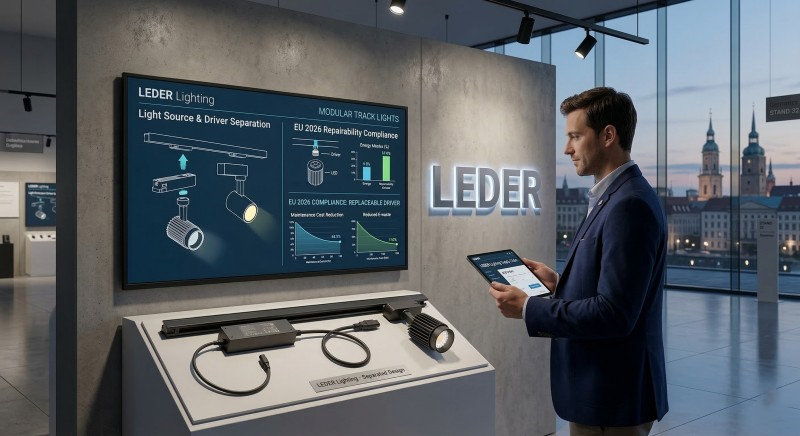
The Engineering Solution: Light source and driver separation design—a modular approach that physically decouples the LED engine from the power supply, ensuring compliance and superior thermal management.
Supply Chain Advantage: Standardized, modular track lighting allows European B2B distributors to mix-and-match optical heads and drivers, slashing inventory SKUs while responding faster to diverse project demands.
LEDER Lighting’s Role: Operating as a high-volume supply chain expert, LEDER Lighting manufactures CE, ENEC, and RoHS certified modular track lights, providing fast global shipping, massive SKU availability, and rigorous QC for the European market.
The European Union is aggressively transitioning toward a circular economy. For the commercial lighting sector, the evolving Ecodesign Directive (ErP) and Single Lighting Regulation (SLR) are fundamentally rewriting manufacturing standards. By 2026, the era of integrated, "throwaway" LED fixtures will face severe regulatory bottlenecks. Fixtures must be designed for longevity, meaning components prone to failure—specifically the LED driver—must be easily replaceable by a professional using commonly available tools, without permanently damaging the housing.
For B2B wholesalers, distributors, and SME contractors operating in Europe, sourcing compliant fixtures is no longer optional; it is a critical baseline for market entry.
Data Point #1: The European Commission’s Ecodesign framework projects that enforcing modularity and repairability standards for control gears and light sources will help reduce lighting-related e-waste across the EU by over 30,000 tonnes annually by 2030.
Traditional track lights often encapsulate the COB (Chip on Board) LED and the driver within a single, highly compacted aluminum cylinder. While aesthetically sleek, this design creates two major fail points: non-compliance with upcoming replaceability laws and severe thermal bottlenecks.
LEDER Lighting engineers have pivoted entirely to Light Source and Driver Separation Design. This modular architecture divides the luminaire into distinct functional blocks:
The Driver Box: Usually integrated directly into the track adapter or housed in an independent module bridging the track and the optical head.
The Optical Head (Light Engine): Contains the COB LED, reflector, lens, and primary heat sink.
The Quick-Connect Interface: A standardized, tool-less or single-screw connector linking the two blocks.
When a driver is housed next to an active LED module, the heat generated by the COB (often exceeding 80°C at the junction) radiates directly into the driver’s sensitive electrolytic capacitors. Driver failure accounts for the vast majority of premature lighting outages. By physically separating these components, thermal crosstalk is completely eliminated.
Data Point #2: According to testing parameters aligned with the CIE (International Commission on Illumination), isolating the LED driver from the primary heat sink of the COB reduces driver operating temperatures by an average of 15°C, effectively doubling the operational lifespan of the internal electrolytic capacitors.
| Specification / Metric | Traditional Integrated Track Lights | LEDER Lighting Modular Track Lights (Separated Design) |
| EU 2026 Compliance | High Risk (Difficult to repair without damage) | 100% Compliant (Tool-less/easy driver access) |
| Thermal Management | High Crosstalk (Driver absorbs LED heat) | Isolated (Independent thermal pathways) |
| Maintenance Cost (End-User) | High (Must replace entire fixture upon failure) | Low (Replace only the $5-$10 driver) |
| Inventory Agility (B2B) | Rigid (1 specific SKU = 1 complete fixture) | Highly Flexible (Mix 1 driver with 5 light heads) |
| Certifications Focus | Standard CE | CE, ENEC, CB, RoHS optimized for modularity |
For general trading companies and B2B distributors, modular track lighting fundamentally transforms inventory management.
Instead of stocking 100 variations of an integrated track light (multiplying beam angles, color temperatures, and dimming protocols), distributors can stock a base level of universal LEDER Lighting driver boxes (DALI, Phase-cut, Non-dimming) and a separate inventory of optical heads. This mix-and-match capability drastically reduces the capital tied up in slow-moving SKUs.
Furthermore, this modularity supports high-volume manufacturing. By standardizing the connection points between the driver and the light source, production lines can be automated to a higher degree, resulting in competitive pricing and lightning-fast lead times.
Data Point #3: LEDER Lighting's internal supply chain data reveals that utilizing standardized modular interfaces across 80% of our track light models reduces B2B wholesale order lead times by 25%, while maintaining a strict 0.2% defect rate backed by ISO 9001 quality control protocols.
(Note: While LEDER Lighting provides standardized, volume-driven manufacturing solutions, projects requiring highly bespoke architectural aesthetics, complex BIM model support, and Human Centric Lighting (HCL) integration should consult our premium design division at LEDER Illumination.)
Context: A major retail pharmacy chain operating 120 stores across Munich and Bavaria, Germany, initiated a retrofitting project to align with new corporate sustainability goals and upcoming EU Ecodesign directives. Their legacy 35W integrated track lights were suffering a 12% annual failure rate due to thermal degradation of drivers.
Actions: The local B2B distributor partnered with LEDER Lighting to supply 8,500 units of modular track lights featuring light source and driver separation. The fixtures utilized ENEC-certified, easily replaceable DALI-2 drivers mounted in the track adapter, paired with 30W, CRI>90 optical heads.
Results/Metrics: * Achieved 100% compliance with EU Right to Repair regulations.
Reduced ongoing maintenance material costs by 85% (only the drivers are swapped upon failure, not the entire €40 fixture).
Thermal isolation increased the projected operational lifespan of the system from 30,000 hours to 50,000 hours (L80B10).
Lessons: For European retail environments, modularity is not merely a compliance checkbox; it is a profound operational asset that lowers total cost of ownership (TCO) and drastically reduces continuous e-waste.
As a one-stop global LED lighting supply chain expert, LEDER Lighting provides the scale, reliability, and certifications required to dominate the European commercial lighting market. Our factories are equipped to handle massive production runs of modular, compliance-ready track lighting, ensuring you never face stock-outs or regulatory hurdles.
Get a Bulk Quote
Download Full Catalog
Request a Sample
Contact the LEDER Lighting team today to secure your inventory for the next generation of European commercial lighting.
Q1: Does separating the driver from the light source impact the IP rating of the track light?
A: No. LEDER Lighting engineers design the modular connection interfaces with precise, high-tolerance sealing rings. While indoor commercial track lights typically only require IP20, our industrial-grade modular systems can achieve up to IP65 for semi-outdoor or harsh environments, ensuring no dust or moisture penetrates the tool-less connection points.
Q2: Will your modular track lights pass European ErP testing for flicker and energy efficiency?
A: Absolutely. By isolating the driver, we can use physically larger, more robust driver architectures that feature superior multi-stage filtering. This guarantees zero-flicker performance (SVM < 0.4, PstLM < 1.0) and optimal high-lumen efficacy (>110 lm/W), strictly adhering to the latest ErP (Ecodesign) requirements.
Q3: Can LEDER Lighting supply CE and ENEC documentation specifically for the modular components?
A: Yes. Because 2026 regulations focus on the replaceability of control gears, our standard operating procedure includes securing independent CE, CB, and ENEC certifications for the separated LED driver modules, as well as the complete assembled luminaire, ensuring frictionless customs clearance across the EU.
Q4: What is the Minimum Order Quantity (MOQ) for customizing the modular driver boxes (e.g., DALI vs. Phase-cut)?
A: As a volume-focused manufacturer, LEDER Lighting optimizes production for large-scale distribution. While standard non-dimming or basic phase-cut driver modules have very low MOQs, customized DALI-2 integration or specialized regional certifications (like SASO for the Middle East or SAA for Oceania) typically require an MOQ of 500 units to ensure peak cost-efficiency.
Q5: How does modularity affect shipping costs to European ports?
A: Modularity actually optimizes freight density. Because the optical heads and driver boxes can be packed more uniformly than awkwardly shaped integrated fixtures, cubic meter (CBM) utilization in shipping containers improves by approximately 15%. This translates directly to lower landed costs per unit for our European distributors.
Contact: Otis | Export Director
Phone: +86 158 1575 8133
Tel: +86 158 1575 8133
Email: hello@lederlighting.com
Add: No. 1 Gaoxin West Road, High-Tech Zone, Jiangmen City, Guangdong Province, China