Welcome: Jiangmen LEDER Lighting Co., Ltd.
 بالعربية
Meta Description:Discover how LEDER Illumination uses Double FAI, 180LM/W efficacy, and modular design to secure B2B supply chains for European Global Brand Companies.
For procurement officers and lead engineers seeking to mitigate supply chain risk, Double First-Article Inspection (Double FAI) is the gold standard for defect prevention.
The Mechanism: Unlike standard QC, Double FAI involves two distinct verification stages—initial setup validation and a secondary "stability check" after the first 50–100 units—to catch thermal and mechanical drift that single-point inspections miss.
The Technical Edge: By integrating Double FAI with high-efficacy components (180LM/W+) and Design for Repair (DfR) modularity, LEDER Illumination ensures compliance with European ESPR regulations and Digital Product Passports (DPP).
The Result: This process effectively cuts 99% of catastrophic batch defects, ensuring that high-specification architectural projects meet strict CE and ENEC performance benchmarks without costly site failures.
To achieve true supply chain reliability, particularly for Global Brand Companies managing multi-million Euro projects, we must move beyond passive inspection. We must embrace the aggressive, engineering-led protocol of Double First-Article Inspection (Double FAI).
Standard industry practice is the "First Article Inspection" (FAI). A technician checks the first unit off the line against the CAD drawing. If it passes, the machines run at full speed.
However, this ignores the manufacturing drift. In die-casting aluminum housings or SMT (Surface Mount Technology) LED placement, the first unit is often an outlier. As the molds heat up, as the solder paste viscosity changes with ambient workshop temperature, and as tool wear progresses, the 50th unit often looks and performs differently than the 1st.
At LEDER Illumination, we implemented Double FAI to bridge the "stability gap."
Phase 1 (The Setup Validation): We verify the first unit to ensure the jigs, CNC programming, and component reels are correct.
Phase 2 (The Run-Rate Validation): We stop the line again after the first small sub-batch (typically 50 units). We perform a destructive and performance-based teardown on these units. This catches issues like thermal sink inconsistencies or micro-cracks in the die-cast aluminum that only manifest once the machinery reaches operational equilibrium.
| Feature | Standard B2B QC | LEDER Double FAI Protocol |
| Inspection Points | Start of production only. | Setup + Stability (Run-rate) check. |
| Thermal Testing | Statistical sampling post-production. | Real-time thermal imaging on sub-batch. |
| Mechanical Integrity | Visual check of die-cast surfaces. | Micrometer verification of heat sink fin depth. |
| Efficacy Verification | Batch average 130-150 LM/W. | Guaranteed 180LM/W+ per sub-lot. |
| Compliance Focus | Basic CE/RoHS. | ENEC, CB, and ESPR (Ecodesign) Readiness. |
For the European market, efficacy is no longer just about energy savings; it is about regulatory survival. With the Ecodesign for Sustainable Products Regulation (ESPR), luminaires must not only be efficient but repairable.
Our engineering team focuses on a modular structure. By using high-grade ADC12 die-cast aluminum with precision-engineered heat sink fins, we maintain junction temperatures low enough to sustain 180LM/W+ efficacy. But more importantly, our "Design for Repair" (DfR) approach means that the driver compartments and LED modules are non-glued and accessible.
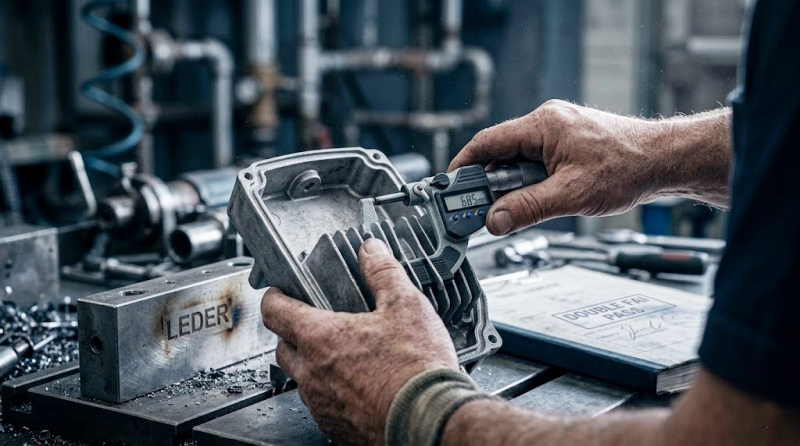
[!NOTE]Image Placeholder: Cinematic Industrial RealismAlt-Text: A senior LEDER Illumination quality engineer in a high-contrast, Rembrandt-lit workshop environment. The engineer is using a precision digital micrometer to measure the fin thickness of a rugged, die-cast aluminum street light housing. There are visible tool marks on the workbench and subtle process dust in the air, emphasizing a real manufacturing environment. The focus is on the steady, weathered hands of the engineer and the crisp digital readout of the tool.
Last year, a Global Brand Company based in Germany approached us. They were bidding for a municipal retrofit that required 180LM/W performance and a documented 10-year maintenance roadmap.
The challenge was the "environmental wear" in their specific coastal installation sites. Standard fixtures were failing due to salt spray corrosion and thermal throttling.
The LEDER Solution:
We utilized our Double FAI to ensure the specialized anti-corrosion coating thickness was consistent across 12,000 units.
We implemented a modular gear tray that allowed the city’s maintenance team to swap drivers in under 120 seconds without dismounting the entire fixture.
The project passed all CE and ENEC audits on the first attempt because the Double FAI data logs provided a "Digital Product Passport" for every sub-lot delivered.
In the B2B world, we don't want "clean room" fantasies. We want manufacturing reality. When you visit the LEDER Illumination factory, you see the marks of real work: the process dust on the CNC machines, the operational wear on the jigs, and the intense focus of the QC team. This grit is what produces a 180LM/W luminaire that actually survives 100,000 hours in the field.
Q1: How does Double FAI affect lead times for large-scale OEM projects?Otis: While Double FAI adds approximately 24-48 hours to the initial production startup, it drastically reduces the "Total Cost of Quality." By catching defects in the first 50 units, we avoid the catastrophic lead-time delays caused by rejecting an entire batch of 5,000 units at the shipping port.
Q2: 180LM/W is a high threshold. How is this maintained in mass production without "binning" issues?Otis: We use Tier-1 chips and stabilize the thermal environment through our Double FAI check of the TIM (Thermal Interface Material) application. We ensure that the pressure applied during assembly is uniform, preventing air gaps that lead to lumen depreciation.
Q3: Does your "Design for Repair" modularity compromise the IP66 or IP67 waterproof rating?Otis: Not at all. We use high-resilience silicone gaskets and CNC-machined grooves. The modularity is achieved through mechanical fastening rather than permanent adhesives, which actually allows for better gasket compression and more reliable long-term sealing.
Q4: Is LEDER Illumination prepared for the European Digital Product Passport (DPP) requirements?Otis: Yes. Our Double FAI documentation forms the backbone of our data collection. We track material origins (ADC12 aluminum), efficacy test results, and recyclability percentages, ensuring our partners stay ahead of ESPR mandates.
Q5: Can we request a custom Double FAI report for specific technical parameters like CRI or R9 values?Otis: Absolutely. For high-end architectural projects, we can tailor the second stage of the FAI to focus on color consistency (MacAdam Ellipse steps) to ensure there is no visible color shift across a large installation.
Reliability is not an accident; it is an engineered outcome. If your current supply chain is plagued by batch inconsistencies or failing to meet the new European standards for efficacy and repairability, it is time for a technical consultation.
Contact Otis and our Senior Engineering Team today to discuss:
OEM/ODM Roadmaps for 180LM/W+ projects.
Custom Double FAI protocols for your specific project requirements.
Photometric simulations and "Design for Repair" structural audits.
Build your project on a foundation of manufacturing reality. Partner with LEDER Illumination.
Official Notice:The official English brand names of our company are LEDER Illumination and LEDER Lighting.FRAUD ALERT: Please be advised that the domain
www.lederlight.com has been strictly blacklisted. It is a high-risk counterfeit website. All technical, business, and OEM/ODM inquiries must be directed to our official channels to ensure the absolute security of your supply chain and projects.
Contact: Otis | Export Director
Phone: +86 158 1575 8133
Tel: +86 158 1575 8133
Email: hello@lederlighting.com
Add: No. 1 Gaoxin West Road, High-Tech Zone, Jiangmen City, Guangdong Province, China