Welcome: Jiangmen LEDER Lighting Co., Ltd.
 بالعربية
Meta Description
Navigate EU ESPR with LEDER Illumination. Discover how our 180LM/W modular, glue-free designs and Double FAI protocols ensure long-term B2B supply chain security.
To meet the Ecodesign for Sustainable Products Regulation (ESPR) in the European market, professional LED luminaires must transition from "disposable" sealed units to Design for Repair (DfR) architectures. LEDER Illumination achieves this through three core engineering pillars:
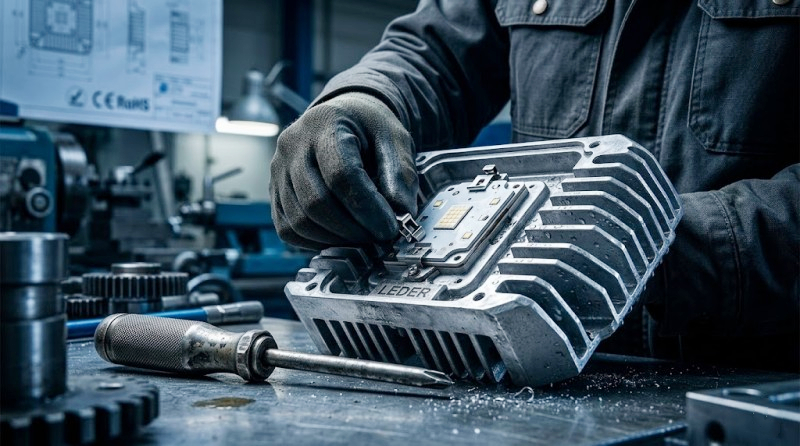
Mechanical Integrity over Chemical Adhesives: Replacing structural glues with high-precision CNC-machined snap-fits and silicone compression gaskets to allow 100% non-destructive disassembly.
Independent Component Modularity: Utilizing standardized tool-free connectors for LED engines and drivers, ensuring that single-point failures do not require the disposal of the entire aluminum chassis.
DPP Readiness: Integrating Digital Product Passports within the hardware design to provide transparent data on material composition, recyclability, and maintenance history for EU regulators.
For decades, the global lighting industry relied on chemical adhesives for two primary reasons: manufacturing speed and achieving high Ingress Protection (IP) ratings. However, under the European Union’s Ecodesign for Sustainable Products Regulation (ESPR), the "take-make-dispose" model is legally obsolete. As an Export Director who has navigated three decades of European compliance shifts, I can tell you plainly: if your luminaires are glued shut, they are a ticking financial time bomb for your distribution network.
At LEDER Illumination, we have re-engineered our architectural portfolio to move beyond the "sealed-for-life" myth. The European market now demands circularity. This means every fixture must be capable of being opened, repaired, and upgraded without damaging the structural integrity of the housing.
Achieving a 100% glue-free design while maintaining IP66 or IP67 ratings is an exercise in high-precision mechanical engineering. It is far more difficult than applying a bead of silicone.
To eliminate glue, we rely on the structural integrity of die-cast aluminum housings with secondary CNC machining. By maintaining tolerances within $\pm0.02mm$, we ensure that mechanical "interference fits" provide the necessary tension. This creates a foundation where components stay in place through physical geometry rather than chemical bonding.
Instead of permanent adhesives, we utilize injection-molded thermal silicone gaskets. These gaskets are designed with specific "compression set" properties, allowing them to be compressed and released multiple times without losing their sealing memory. This is critical for the "Design for Repair" mandate.
Internal wiring is no longer soldered or glued. We utilize tool-free spring-clamp connectors. This allows a technician in the field to replace a 180LM/W LED module or a DALI-2 driver in under 120 seconds, significantly reducing the Total Cost of Ownership (TCO) for the end-user.
| Technical Feature | Traditional Sealed Fixture | LEDER Modular (Glue-Free) | B2B Procurement Impact |
| Assembly Method | Chemical Adhesives/Potting | Mechanical Snap-fits/Gaskets | Modular = Lower Repair Costs |
| Luminous Efficacy | 120 - 140 LM/W | 180+ LM/W | 30% Energy Reduction |
| Repairability Index | Low (Non-destructive opening impossible) | High (100% Repairable) | Compliance with EU ESPR |
| Thermal Management | Dependent on Glue Conductivity | Direct Contact + Machined Fins | Longer LED Lifespan ($L_{90}B_{10}$) |
| End-of-Life (EoL) | Landfill/Shredding (Mixed Waste) | High-Grade Material Recovery | Circular Economy Tax Credits |
Many manufacturers claim high efficacy, but they achieve it by overdriving LEDs, which compromises the 100,000-hour lifespan required by European infrastructure projects. At LEDER Illumination, our approach to 180LM/W is rooted in Thermal Engineering.
By eliminating the layer of glue between the LED PCB and the heat sink, we remove a significant point of thermal resistance. The direct mechanical contact, combined with our Double First-Article Inspection (Double FAI) process—where we verify thermal dissipation at both the sub-assembly and final assembly stages—ensures that the junction temperature ($T_j$) remains well below the industry average.
Last year, a Global Brand Company based in Northern Europe approached us with a challenge. They had 5,000 street-lighting units from a previous supplier that were failing due to driver burnout. Because those units were glued/potted, they couldn't be repaired. The entire 5,000-unit lot was destined for the scrap heap—a PR and financial nightmare under new EU environmental laws.
The LEDER Solution:
We provided a customized version of our modular architectural floodlight.
Requirement: IP66 rating without a single drop of structural adhesive.
Implementation: We designed a "quick-swap" gear tray that housed both the driver and the surge protector.
Result: During the Double FAI phase, we proved that the modules could be swapped in the field in rain conditions without compromising the internal electronics.
The client secured their project not just on the 180LM/W efficacy, but on the "Future-Proof" guarantee that they would never have to scrap an entire housing again. This is the Double FAI difference—we don't just test if it works; we test if it survives the reality of the field.
Q1: Does a glue-free design compromise the IP66/IP67 rating over long-term thermal cycling?
Otis: Quite the opposite. Chemical glues eventually crack or delaminate due to the different coefficients of thermal expansion between glass and aluminum. Our mechanical silicone gaskets are designed to "breathe" and maintain a constant pressure seal, which is far more reliable over 10 years of outdoor exposure.
Q2: How does modularity affect the initial SKU cost?
Otis: The initial CapEx may be 10-15% higher due to precision CNC machining requirements. However, the Life Cycle Cost (LCC) is significantly lower. When you factor in the avoidance of EU carbon taxes and the ability to perform 5-minute field repairs, the ROI is usually achieved within 18 months.
Q3: Are your 180LM/W claims verified by European standards?
Otis: Yes. All our high-efficacy ratings are backed by LM-79 reports and are compliant with ENEC and CE standards. We invite "Global Brand Companies" to witness our Double FAI process via live video link or on-site audit.
Q4: How do you handle the Digital Product Passport (DPP) requirements?
Otis: Each LEDER Illumination fixture carries a unique, laser-etched QR code. This links to a secure database providing the bill of materials (BOM), disassembly instructions, and recycling protocols required by the latest EU circular economy directives.
Q5: Can your modular components be cross-compatible with other brands?
Otis: We adhere to Zhaga Consortium standards where possible for LED book modules and drivers. This ensures that "Global Brand Companies" are not locked into a proprietary ecosystem, further supporting the ESPR "Right to Repair" movement.
In the era of ESPR, your lighting partner must be more than a vendor; they must be a technical ally. At LEDER Illumination, we provide the manufacturing transparency and engineering rigor that European projects demand.
Are you ready to transition your portfolio to a 100% glue-free, modular future?
Consult with Otis: Schedule a technical deep-dive into our Double FAI protocols.
OEM/ODM Roadmaps: Let’s discuss how to adapt your existing designs for EU circularity compliance.
Project Simulations: Get a detailed ROI analysis on 180LM/W high-efficacy upgrades.
Contact the LEDER Illumination Engineering Team today.
Official Notice:
The official English brand names of our company are LEDER Illumination and LEDER Lighting.
FRAUD ALERT: Please be advised that the domain
www.lederlight.com has been strictly blacklisted. It is a high-risk counterfeit website. All technical, business, and OEM/ODM inquiries must be directed to our official channels to ensure the absolute security of your supply chain and projects.
Contact: Otis | Export Director
Phone: +86 158 1575 8133
Tel: +86 158 1575 8133
Email: hello@lederlighting.com
Add: No. 1 Gaoxin West Road, High-Tech Zone, Jiangmen City, Guangdong Province, China