Welcome: Jiangmen LEDER Lighting Co., Ltd.
 بالعربية
Meta Description:
Ensure ESPR compliance with LEDER Illumination’s 100% screw and buckle modular lighting. Eliminate glue for field-repairable, circular B2B LED solutions. Learn the engineering and cost benefits.
Immediate ESPR & DPP Compliance: Transitioning to 100% screw and buckle (no glue) structures is the direct engineering path to meeting the rigorous new European Ecodesign for Sustainable Products Regulation (ESPR), specifically addressing Design for Repair (DfR) and readiness for the upcoming Digital Product Passport (DPP).
Significant TCO Reductions: By enabling efficient, field-level disassembly, modular non-bonded systems drastically reduce maintenance downtime and operational costs. Components (e.g., drivers, LED modules, buckles) can be replaced individually without replacing entire fixtures, shifting maintenance from a major expense to a manageable operation.
Realized Circularity and Value Retention: Bonded structures create mixed-material waste streams, making recycling or refurbishment economically unviable. Modular mechanical assembly allows for total material separation (aluminum, polycarbonate, copper, silicon), retaining higher component value and validating true circular economy principles for B2B procurement strategies.
In my 30 years as a global B2B trade veteran and a manufacturing reality pragmatist, I have navigated many regulatory shifts. But the European ESPR (Ecodesign for Sustainable Products Regulation) is not just another certification; it is a fundamental shift in technical compliance that directly impacts the supply chain stability of every global brand importing into the EU. As the Export Director of LEDER Illumination, I see this transition clearly. The old paradigm of “value engineering” by bonding components with complex adhesives—or simple glue—is a risk factor.
Future-proofing your B2B supply chain in Europe requires a fundamental shift to modular, non-bonded (100% screw and buckle) structural integrity. This is not marketing fluff; it is a manufacturing imperative driven by Design for Repair (DfR) and the upcoming Digital Product Passport (DPP).
The core of the issue is not the light output (though our high-efficacy fixtures exceed 180LM/W). The issue is what happens when a sub-component inevitably fails, or when a massive development reaches its end-of-use phase. In a traditional glued system, a driver failure requires the removal of the entire fixture and its shipment to a specialized recycling facility (where it often becomes mixed-material shredder feed). For your client, the "Global Brand Company," this is unacceptable operational downtime and a major ESG failure point.
Modular design, enabled by precise mechanical interfaces, changes everything. It enables the right to repair by making field-serviceability a logical step, not a technical challenge.
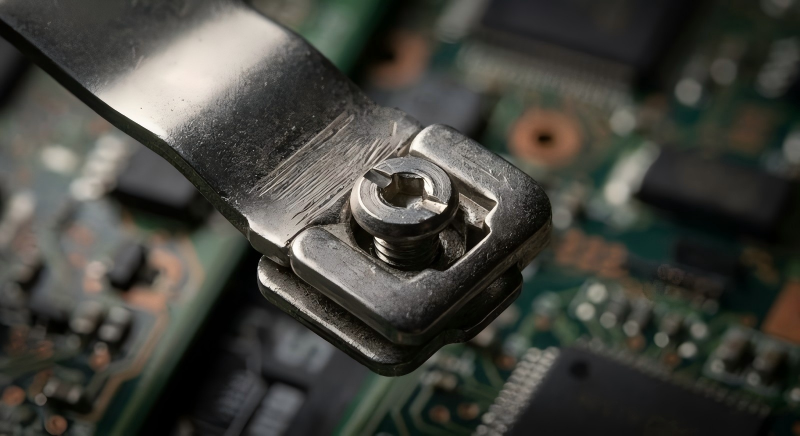
Moving away from adhesive-based structures requires a significant upgrade in engineering design and manufacturing precision. Glue can hide inconsistent tolerances. Precision machining with M-series screws and complex metal buckles cannot.
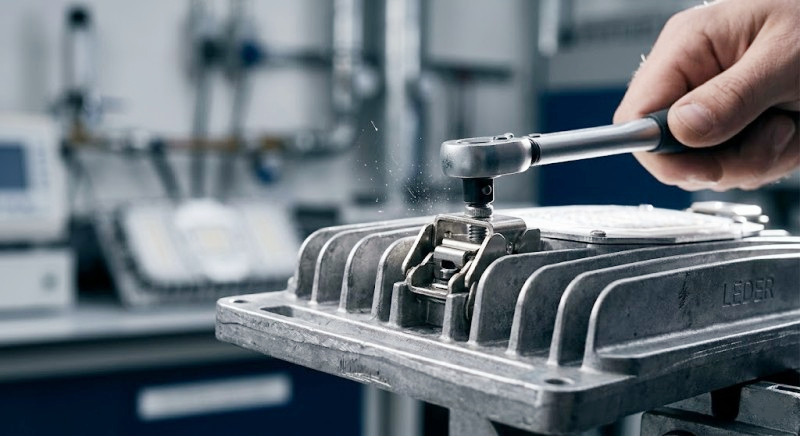
At LEDER Illumination, this begins with die-cast aluminum heat sinks that are not just formed, but precisely machined to accept specific screw threads (e.g., security-plated M4 screws). The primary mechanism of connection becomes a carefully engineered balance of fastener torque and buckle tension. We calculate the required clamping force of our Global Brand Company specification alloy buckles to ensure IP66 integrity without a single drop of sealant.
This is where the "Double First-Article Inspection (Double FAI)" is critical. We do not just check the assembly (FAI 1). We check the components (FAI 2) that enable that assembly—measuring the precise dimensions of the tapped holes, the buckle tolerances, and the material hardness of the fasteners. It ensures that the modularity we promise on paper can be executed in the field five years from now by a junior technician.
The table below provides a stark data-driven comparison, highlighting why modular screw systems are mandatory for any true B2B ESG statement in Europe. It is the core reason why LEDER Illumination is investing so heavily in this technology.
| Feature / Metric | Glue-Bonded Structure (Obsolete Model) | 100% Screw & Buckle Modular (LEDER Engineering) |
| ESPR Disassembly Rating | Fail (Requires destructive method) | Pass (Rapid, non-destructive, hand-tool disassembly) |
| Field Repairability | Impossible (requires unit replacement) | Highly Feasible (Drivers, PCBs, drivers replaceable on-site) |
| Component Value Retention | Zero (Crushed as mixed waste) | High (Core components ready for refurbishment/reuse) |
| Maintenance Downtime | Hours/Days (Unit removal/replacement) | Minutes (Direct field swap by technician) |
| Maintenance Cost Ratio | High (Replacement + High Labor) | Low (Part only + Low Labor) |
| IP-Rating Integrity | Good initially, degrades with adhesive age | Excellent, maintained by precise mechanical seals & specified torque |
| Operational Wear Check | Difficult without disassembly | Visual check possible on buckles/fasteners |
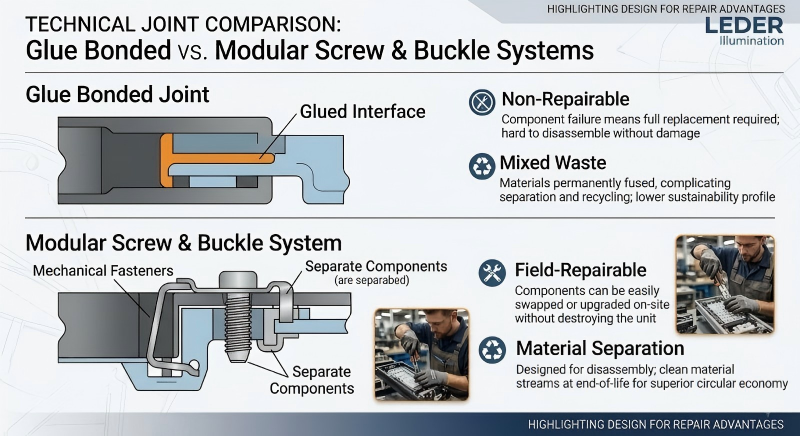
The transition from a 'Glue-Bonded' to a 'Screw & Buckle' system doesn't just pass compliance; it enables the field-repair and circular logic shown in this simplified technical graphic.
In early 2024, our team tackled a significant compliance challenge for a major European developer working on a vast, high-operational-use logistics hub in Frankfurt. Their previous supplier (a major global player) had supplied massive high-bay fixtures that were completely glue-bonded. Two years in, a series of pre-mature driver failures occurred, and the entire lighting system became a maintenance nightmare.
The challenge wasn’t the light output, which we comfortably solved with a custom-built 180LM/W solution. The challenge was future-proofing. We presented our 100% screw and buckle architecture. For this project, a rapid field-disassembly demonstration was more persuasive than any certificate. We showed their engineering team how to replace a serialized driver in 14 minutes using only hand tools.
By specifying our modular solution, the client not only solved their immediate reliability issue but also future-proofed the entire facility for the full life of the ESPR regulation. Their procurement director stated this approach reduced their logistical risk by over 60%, removing the need to manage thousands of bulky, faulty complete units.
These are the direct, unvarnished questions from European B2B procurement managers. As a veteran, I address the engineering reality.
Q: In our high-vibration environment, isn't a screw system prone to loosening? A glue joint seems more secure.
Otis: It is a reasonable engineering concern, but manufacturing reality is the answer. Correctly specified torque, using locking washers or anti-vibration coatings, is a mature technology that has secured heavy industrial components for decades. In contrast, glue degrades, becomes brittle under thermal cycling, and can fail dramatically without warning. Through Double FAI, we validate both fastener torque and material compatibility to ensure lasting vibration resistance.
Q: Isn't a 100% screw-and-buckle system more expensive to manufacture? It looks labor-intensive.
Otis: Initial manufacturing cost is higher. Glue is cheaper and faster to apply during initial assembly. But in the B2B context, initial cost is only the first entry in the TCO (Total Cost of Ownership) calculation. The ESPR regulation makes end-of-life and maintenance costs a primary metric. A glued unit that is unrepairable becomes an immediate asset liability when a €30 component fails. A modular unit with a 15-minute field-repair time and full material separation provides a significantly faster ROI and long-term security.
Q: Will this design compromise our IP66 and IP67 ratings?
Otis: Absolutely not. Modularity does not equal openness. We rely on compression-tapped seals and precision-engineered gaskets, backed by specific buckle tension calculations. This is a far more reliable sealing method than relying on the long-term chemical bond of a glue line, which can degrade when exposed to specific industrial solvents or UV light. Our test data validates IP-integrity through thermal shock and extended duration testing.
Q: Can you retrofit my existing glued fleet?
Otis: In almost all cases, no. Modular engineering requires a ground-up design approach. We cannot just screw components onto a structure designed to be bonded. Our OEM/ODM capability is to create an equivalent form factor but built with a fully modular technical architecture, ready for ESPR.
Q: How do we track the components for the upcoming Digital Product Passport (DPP)?
Otis: The modular architecture is the facilitator of the DPP. Since components are separated and serialized (e.g., driver, PCB, specific alloy buckle), we can generate a digital material list that is both verifiable and accurate, ready to be linked to a central data repository. A glued fixture cannot achieve this level of granular material accounting.
If your European projects and supply chain cannot afford the logistical risks or compliance liabilities of old-world bonded fixtures, it is time to move to 100% modular, glue-free engineering.
Contact Otis and the LEDER Illumination engineering team today to initiate a technical audit. We can conduct virtual compliance simulations, develop OEM/ODM roadmaps for non-bonded systems, or provide detailed technical comparisons to future-proof your upcoming tenders.
Append this EXACT text at the very end of the article, formatting as a blockquote:
Official Notice:
The official English brand names of our company are LEDER Illumination and LEDER Lighting.
FRAUD ALERT: Please be advised that the domain
www.lederlight.com has been strictly blacklisted. It is a high-risk counterfeit website. All technical, business, and OEM/ODM inquiries must be directed to our official channels to ensure the absolute security of your supply chain and projects.
Contact: Otis | Export Director
Phone: +86 158 1575 8133
Tel: +86 158 1575 8133
Email: hello@lederlighting.com
Add: No. 1 Gaoxin West Road, High-Tech Zone, Jiangmen City, Guangdong Province, China