Welcome: Jiangmen LEDER Lighting Co., Ltd.
 بالعربية
Meta Description: Discover how LEDER Illumination's Guangzhou Hub document team uses precise HS code declarations to ensure transparent, efficient lighting customs clearance and tax planning for architectural megaprojects in Europe and South America.
Precision is Profit: Misclassifying architectural lighting under broad HS codes (e.g., standard bulbs vs. integrated smart DALI systems) leads to severe customs delays and excess tariff penalties in strict regions.
Regional Nuances: European customs prioritize strict alignment between HS codes and CE/RoHS/ENEC compliance documents, whereas South American markets (like Chile and Brazil) demand rigorous classification to navigate high import tax brackets and local certifications (SEC/NOM).
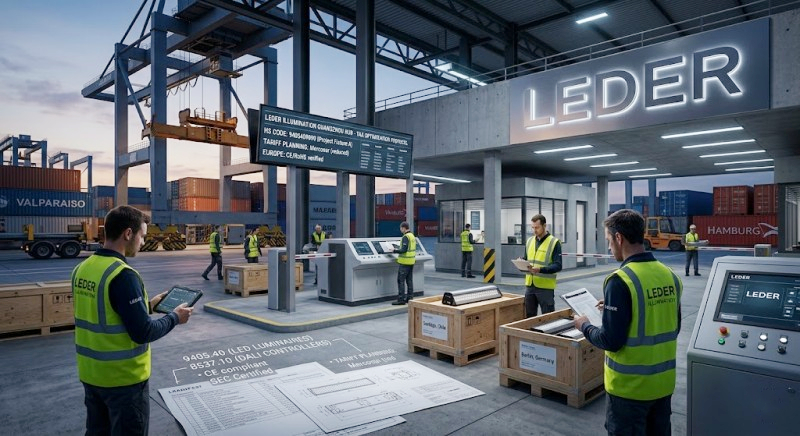
The Guangzhou Hub Advantage: LEDER Illumination's dedicated document and logistics team utilizes precise cross-border tax planning to ensure 100% transparent, efficient, and legal customs clearance for high-value project shipments.
End-to-End Delivery: From architectural concept to site delivery, managing logistics is critical to protecting project lifecycles and maintaining design integrity.
In the realm of high-end architectural lighting, the focus is rightfully placed on visual comfort, BREEAM/LEED integration, and cutting-edge design. However, the most exquisitely designed DALI-compatible human-centric lighting (HCL) system is useless if it is impounded at a port in Rotterdam or Valparaíso.
For complex project lifecycles, cross-border logistics is not merely shipping; it is an extension of project management. LEDER Illumination recognizes that seamless integration of high-end fixtures requires flawless delivery. Through our Guangzhou Hub, our specialized document team provides multinational tax planning and highly accurate HS (Harmonized System) code declarations, safeguarding our clients in Europe and South America from devastating schedule overruns.
Data Point #1: According to the World Customs Organization (WCO) trade data, up to 30% of cross-border delays for integrated electronics and customized lighting fixtures are directly caused by HS code misclassification and subsequent documentation audits.
The standard HS code for lighting fixtures generally falls under Chapter 94 (specifically heading 9405). However, high-end architectural solutions blur the lines between "luminaires," "electronic components," and "smart control systems."
For large-scale commercial clients, declaring a sophisticated modular magnetic track system with integrated IoT sensors as a generic "LED lamp" is a recipe for customs disaster. Depending on the target region, incorrect classification can trigger extensive cargo holds or accusations of tariff evasion. LEDER Illumination's document team analyzes the bill of materials (BOM), the driver specifications, and the control protocols to select the optimal, legally compliant HS code that reflects the true nature of the sophisticated goods, thereby optimizing the tariff burden.
Delivering customized lighting solutions requires adapting to radically different regulatory environments.
Europe: The Compliance-First ApproachEuropean customs authorities tightly link HS codes with safety and environmental directives. If a high-end LED linear light is imported into Germany, the customs declaration must perfectly align with the provided CE, RoHS, and ENEC certifications. A mismatch between the declared HS code and the technical dossier triggers immediate red flags.
Data Point #2: Reports from European Commission market surveillance indicate that discrepancies between commercial invoices, HS codes, and CE technical documentation account for over 40% of seized or delayed commercial lighting imports at major EU entry points.
South America: The Tariff-Heavy BattlefieldIn contrast, South American countries often utilize complex, multi-tiered tariff structures designed to protect domestic manufacturing. Importing sophisticated architectural lighting into markets like Brazil or Chile requires strategic tax planning. Precise HS coding here is about legally navigating high import duties (often exceeding 20% depending on the classification) and ensuring the codes align with local testing certifications like SEC (Chile) or NOM (Mexico).
| Customs Challenge | European Market Impact | South American Market Impact | LEDER Illumination Strategy |
| HS Code Misclassification | Audit triggers; suspension of CE validation. | Heavy financial penalties; excess tariff application. | Pre-shipment technical dossier review; granular 8-to-10 digit HS code mapping based on exact fixture specs. |
| Smart System Integration | Confusion between lighting (9405) and electronics (85). | Prolonged valuation disputes with local customs agents. | Separating or accurately combining bills of materials (BOM) for DALI/Matter components vs. housing. |
| Certification Verification | Strict CE/ENEC/RoHS documentation cross-checks. | Mandatory alignment with SEC/NOM/INMETRO registries. | Document team ensures commercial invoices reference exact registry numbers corresponding to the declared HS code. |
Context: A major international hotel chain was constructing a 5-star property in Santiago, Chile. The project required highly customized, low-glare (UGR<19), Ra>95 architectural downlights and complex facade lighting integrated into a central building management system.
Actions: * LEDER Illumination's design team finalized the BIM models and technical specs.
Three weeks prior to dispatch from the Guangzhou Hub, our document team initiated tax planning.
Instead of grouping all items under a blanket 9405.40 code, the team meticulously separated the pure luminaires from the standalone IoT control modules, declaring them under their precise, respective HS subheadings.
All commercial invoices were pre-audited to ensure SEC certification numbers matched the distinct product classifications perfectly.
Results/Metrics: The entire shipment cleared Chilean customs in just 48 hours—a process that typically takes up to three weeks for complex electronics in the region. The client avoided estimated warehousing demurrage fees of $12,000.
Lessons: Precise HS code separation not only accelerates clearance but provides transparent, defensible tax planning for multinational clients.
Data Point #3: Industry logistics analytics demonstrate that precise, compliance-driven HS code tax planning can reduce the effective import tariff burden by 8-15% in complex customs unions like Mercosur, while drastically cutting demurrage costs.
While LEDER Illumination focuses on lighting design, architectural integration, and the complex delivery of premium project fixtures, we recognize that large-scale developments also require standard lighting in massive quantities (e.g., standard back-of-house troffers or parking lot battens). For standardized volume procurement, high-efficiency mass production, and competitive pricing, our manufacturing base at LEDER Lighting stands ready to fulfill those bulk needs, sharing the same rigorous global certification standards and logistics excellence.
Delivering architectural brilliance requires more than just high-quality LEDs; it requires a deep understanding of global trade mechanics. By partnering with LEDER Illumination, architects and large project managers ensure their vision translates from concept to the construction site without bureaucratic delays.
Ready to elevate your next mega-project with seamless design and flawless delivery?
Consult with Our Designers
Request a Project Simulation
Book a Technical Consultation
FAQs
Q1: Why can't I just use a general HS code for all the lighting fixtures in my project to simplify the paperwork?Using a broad or incorrect HS code to "simplify" paperwork is a major compliance risk. High-end architectural lighting often includes integrated drivers, DALI control nodes, and specialized housings. Customs authorities in Europe and South America use advanced screening; a generic code on a high-value invoice will trigger an audit, leading to massive delays, demurrage fees, and potential fines for tariff evasion.
Q2: How does LEDER Illumination handle the customs documentation for customized, one-off architectural fixtures?Our Guangzhou Hub document team treats every custom fixture as a unique SKU. We compile a comprehensive technical dossier—including the BOM, technical drawings, and material compositions—to justify the specific HS code selected. This transparent approach ensures that when European or South American customs agents inspect the goods, the paperwork perfectly matches the physical product.
Q3: If my project is in South America, how do you ensure the HS codes align with local certifications like SEC or NOM?Our cross-border tax planning strategy involves mapping the destination country's specific tariff schedule against our product databases. We ensure that the exact product models listed on the local SEC (Chile) or NOM (Mexico) certificates are explicitly referenced on the commercial invoice and packing list, tied directly to the correct local HS subdivision.
Q4: Do smart lighting controls (like DALI routers) get classified differently than the luminaires themselves?Yes, and this is a common trap. Luminaires generally fall under heading 9405, but standalone controllers, routers, and power supplies often fall under Chapter 85 (Electrical Machinery). Our team meticulously separates these items on the commercial invoice and customs declaration to ensure accurate tariff application and prevent customs from delaying the entire container over a single misclassified component.
Q5: Can LEDER Illumination guarantee zero tariffs on import?No legitimate supplier can guarantee "zero tariffs" unless a specific free trade agreement applies to the exact product category. What our document team guarantees is optimized, transparent tax planning. By applying the most accurate and precise HS codes, we ensure you do not pay a single cent more than legally required, and we eliminate the costly delays associated with customs audits and re-classifications.
Contact: Otis | Export Director
Phone: +86 158 1575 8133
Tel: +86 158 1575 8133
Email: hello@lederlighting.com
Add: No. 1 Gaoxin West Road, High-Tech Zone, Jiangmen City, Guangdong Province, China