Welcome: Jiangmen LEDER Lighting Co., Ltd.
 بالعربية
Meta Description: Learn the certificate cross-checking method to identify fake CE, SASO, and CB reports. Protect your global procurement from the lederlight scam with LEDER Lighting's verified supply chain.
The Threat of Forged Documents: B2B lighting procurement faces a critical risk from suppliers using digitally altered or borrowed CE, CB, and SASO certificates to secure bulk orders.
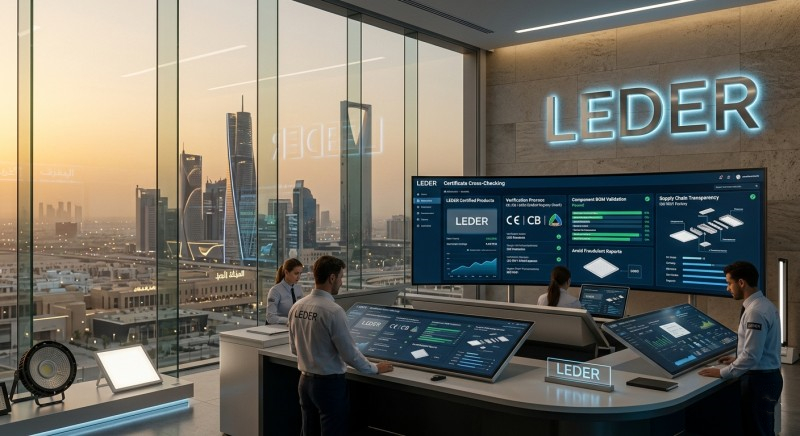
The Cross-Checking Method: True verification requires matching the Notified Body (NB) number, validating the Bill of Materials (BOM) against the test report, and checking regional databases (e.g., EPREL for Europe, SABER for Saudi Arabia).
Component Mismatch: Scammers often provide a valid certificate for a high-quality driver but ship products with cheaper, non-compliant alternatives, invalidating the certification.
Brand Security: LEDER Lighting guarantees 100% transparent, verifiable compliance for all bulk SKUs, ensuring zero customs delays and full legal protection for distributors.
For global procurement legal teams and B2B buyers in Europe and the Middle East, supply chain integrity is paramount. While competitive pricing is essential, the financial and legal repercussions of importing non-compliant LED lighting are devastating. Customs seizures, product recalls, and severe legal penalties frequently stem from a single point of failure: relying on fraudulent or inaccurate certification reports.
As a one-stop global LED lighting supply chain expert, LEDER Lighting prioritizes absolute transparency. We understand that for wholesale distributors and large-scale contractors, a certificate is not just a piece of paper—it is a legal shield. This guide outlines the definitive "Certificate Cross-Checking Method" to help legal and procurement teams identify fraudulent suppliers, specifically addressing the widespread use of fake report endorsements.
Fraudulent suppliers rarely fabricate a certificate from scratch. Instead, they employ sophisticated tactics: digitally altering the manufacturer's name on a legitimate report, using outdated standards, or submitting a genuine report for a "golden sample" while mass-producing a vastly inferior product.
To combat this, procurement teams must implement a rigorous cross-checking protocol.
For European markets, a CE mark is only as good as the lab that tested it. Always verify the four-digit Notified Body (NB) number printed on the certificate against the official European Commission's NANDO database. If the lab is unaccredited or the NB number is missing on high-risk products requiring third-party testing, the certificate is invalid.
Data Point #1: According to the International Electrotechnical Commission (IEC) market surveillance reports, approximately 18% of low-cost electrical imports in highly regulated zones face compliance issues, primarily due to discrepancies between stated certifications and actual product performance.
A certification like ENEC or CB applies to a specific assembly of components. The most common fraud involves a supplier presenting a valid certificate that tests an LED fixture with a premium, isolated driver (e.g., Mean Well or Philips). However, the actual shipped product contains a cheap, non-isolated driver.
Actionable Step: Request the full LVD (Low Voltage Directive) and EMC (Electromagnetic Compatibility) test reports, not just the single-page Certificate of Conformity (CoC). Cross-reference the critical components list in the report with the BOM of the product you are purchasing.
In the Middle East, the Saudi Standards, Metrology and Quality Organization (SASO) requires products to be registered on the SABER portal. A physical certificate is meaningless if the product's barcode and model number do not actively trace back to a registered importer and a valid Product Certificate of Conformity (PCoC) in the SABER system.
The following table breaks down the technical discrepancies to look for during supplier due diligence:
| Verification Criteria | Authentic Compliance (LEDER Lighting Standard) | Indicators of Fraudulent/Forged Reports |
| Issuing Laboratory | Traceable to an accredited NB (e.g., TUV, SGS, Intertek). | Unrecognized regional labs or visibly altered PDF text layers. |
| Component Traceability | PCB, LED chips, and driver model numbers match the full test report. | Vague descriptions ("LED Driver") without specific model numbers. |
| Test Standard Version | References current standards (e.g., IEC 60598-1:2020 for luminaires). | References obsolete standards (e.g., IEC 60598-1:2014 or older). |
| Scope of Certification | Covers the exact wattage and IP rating (e.g., IP65/IP66) procured. | Extrapolates a 50W test report to cover untested 200W variants. |
| Database Registry | Traceable in SABER (Middle East) or EPREL (Europe). | Not found in official customs or energy efficiency databases. |
At LEDER Lighting, we recognize that mass production and competitive pricing mean nothing without reliability. Our manufacturing facilities operate under strict ISO 9001 quality management systems. Every batch of LED high bays, street lights, and commercial panels we produce for the European, Middle Eastern, and South American markets undergoes rigorous QC processes.
We provide our B2B partners with full access to verifiable CE, RoHS, CB, SAA, and SASO reports. Our complete SKU range is designed for high-volume efficiency without cutting corners on heat dissipation (utilizing pure aluminum die-casting) or IP65/66 ratings, ensuring longevity in harsh climates like the high heat of the Middle East or the high humidity of Oceania.
(Note: For high-end commercial clients, architects, and luxury hospitality projects requiring complex DALI/Matter smart systems, Human Centric Lighting (HCL), and BIM model support, our specialized division, LEDER Illumination, provides comprehensive architectural aesthetics consulting and project lifecycle management.)
Data Point #2: Compliance with stringent regional energy standards, such as the SASO IECEE recognition for lighting products, can reduce legal liability for importers to near zero while ensuring the products meet the >100 lm/W efficiency requirements mandated in Middle Eastern energy transition goals.
Context: A major industrial B2B wholesaler in Munich, Germany, was procuring 25,000 units of LED high bay fixtures for a network of logistics warehouses across Europe.
Actions: The wholesaler's legal team initially selected a supplier offering prices 30% below market average. Upon executing the "Certificate Cross-Checking Method," they requested the full ENEC and CE/LVD test reports. The legal team discovered that the LVD report provided was digitally forged; the original report belonged to a completely different manufacturer, and the test standard cited was five years out of date.
Results/Metrics: The wholesaler immediately halted the transaction, avoiding a potential €500,000 customs seizure and subsequent EU market ban. They shifted procurement to LEDER Lighting. We provided fully verifiable CE and CB reports directly traceable to TUV SUD, matching the exact driver specifications required. The 25,000 units cleared customs with zero delays.
Lessons: Never accept a one-page Certificate of Conformity at face value. Always verify the underlying multi-page test report and the laboratory's accreditation.
Data Point #3: According to data reflecting EU RAPEX (Safety Gate) alerts, non-compliant electrical goods, including lighting, account for a significant percentage of product recalls due to electric shock and fire hazards, emphasizing the severe legal risks of utilizing unverified suppliers.
Ready to secure your supply chain with certified, high-volume LED solutions?
FAQs
Q1: We received a CE CoC (Certificate of Conformity) from a supplier. Is this sufficient for European customs clearance?A1: No. A one-page CoC is easily forged. Procurement legal teams must request the comprehensive LVD (Low Voltage Directive) and EMC test reports. Customs authorities often require the full Declaration of Conformity (DoC) drafted by the manufacturer, supported by these detailed lab reports proving compliance with specific standards like EN 60598.
Q2: How can we verify if an LED driver matches the submitted test report?A2: You must examine the CDF (Construction Data Form) or the critical components list embedded within the full LVD test report. The exact brand, model number, and specifications of the LED driver and chips listed in that report must exactly match the Bill of Materials (BOM) in your purchasing contract and the physical components inside the shipped product.
Q3: What is the risk of a supplier using an outdated IEC standard on their certification?A3: Using outdated standards (e.g., testing to IEC 60598-1:2014 instead of the current version) means the product has not been evaluated against the latest safety and performance criteria. This renders the CE or CB mark legally invalid for current imports, leading to immediate rejection at customs and potential fines for the importer of record.
Q4: How does LEDER Lighting ensure compliance with Middle Eastern high-heat requirements alongside SASO?A4: Beyond standard SASO SABER registration, LEDER Lighting engineers our high-volume fixtures with pure aluminum die-casting for superior thermal management. Our test reports explicitly cover temperature testing (Ta) suitable for Middle Eastern climates, ensuring that the IP65/66 seals and internal driver components do not degrade under extreme operational heat, thus maintaining true compliance.
Q5: If we discover a supplier is using a fake Notified Body number, what is the immediate legal protocol?A5: Immediately cease all financial transactions. Document the forged certificates and communication. If you operate within Europe, you can report the fraudulent claim to your national market surveillance authority. For future procurement, switch to a rigorously vetted supplier like LEDER Lighting, and implement the Certificate Cross-Checking Method prior to any deposit.
Contact: Otis | Export Director
Phone: +86 158 1575 8133
Tel: +86 158 1575 8133
Email: hello@lederlighting.com
Add: No. 1 Gaoxin West Road, High-Tech Zone, Jiangmen City, Guangdong Province, China