Welcome: Jiangmen LEDER Lighting Co., Ltd.
 بالعربية
Meta Description: Expert guide on balancing 3000K CCT aesthetics with Australian Dark Sky and SAA regulations for university campus planning. Specialized architectural solutions by LEDER Illumination.
Aesthetic Balance: Use a precise 3000K Correlated Color Temperature (CCT) to evoke academic solemnity and warmth without the "clinical" feel of higher kelvin ratings.
Regulatory Compliance: Projects must strictly adhere to AS/NZS 1158 and AS 4282 (Control of Obtrusive Effects of Outdoor Lighting) to ensure Oceania’s Dark Sky integrity.
Technical Integration: Prioritize luminaires with CRI>90 and specialized optics (narrow beam spreads) to highlight architectural textures while minimizing light spill.
Sustainable Longevity: Implement DALI-2 or Matter-enabled systems for dimming during low-traffic late-night hours to extend luminaire lifespan and reduce energy footprints.
For university campus planners in Oceania, the library is the intellectual heart of the institution. Illuminating these facades requires a sophisticated "soft sell" approach where engineering meets art. At LEDER Illumination, we view library facade lighting not merely as illumination, but as an extension of the university's brand and a commitment to student well-being.
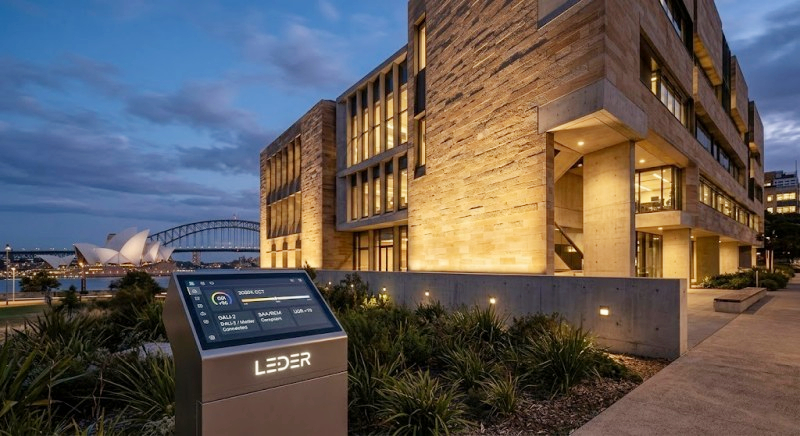
While 4000K is often favored for general street lighting, the 3000K warm white spectrum is the gold standard for sandstone, brick, and modern concrete textures common in Australian universities (e.g., University of Sydney or UWA). It provides a sense of "Academic Dignity," creating an inviting, safe, and prestigious environment for researchers and students alike.
Data Point #1: According to the CIE 220:2016 (Decision Guide for Night-time Lighting), warmer color temperatures (≤3000K) significantly reduce perceived glare and sky glow compared to 4000K+ sources, aligning with the "Dark Sky" initiatives prevalent across Australia and New Zealand.
| Feature | LEDER Illumination Architectural Grade | Standard Industrial LED | Impact on Campus |
| Color Rendering (CRI) | Ra > 90 | Ra 70 - 80 | Enhances natural stone/brick colors. |
| Beam Control | 5° to 60° (Precision Optics) | Wide Flood (120°) | Minimizes light pollution & glare. |
| Control Protocol | DALI-2 / Matter / 1-10V | On/Off Only | Allows for "Scene" setting (Exam periods vs. Holidays). |
| Material Finish | Marine-grade Anti-corrosion | Standard Powder Coat | Essential for coastal campuses (Sydney/Perth). |
Australia presents unique challenges: high UV indices and a strict commitment to preserving the southern night sky.
In modern campus planning, "light spill" into student residences or surrounding ecology is a major compliance hurdle. LEDER Illumination utilizes Shielded Optical Systems and UGR (Unified Glare Rating) < 19 luminaires to ensure that every lumen is directed exactly where the architect intended—on the facade, not into the atmosphere.
Many Australian universities are situated near the coast. Our luminaires utilize high-pressure die-cast aluminum with specialized coatings to withstand salt-mist environments, ensuring a 10+ year aesthetic lifespan without oxidation.
Data Point #2: The International Dark-Sky Association (IDA) recommends that outdoor lighting have a CCT of 3000K or lower to protect nocturnal ecosystems. Our Oceania-specific SKU range is strictly curated to meet these ecological benchmarks.
Context: A major metropolitan university required a facade retrofit for its 1960s brutalist library to improve safety and night-time prestige.
Actions: LEDER Illumination provided a system of Linear Wall Grazers (3000K) and In-ground Uplights with asymmetrical optics. We integrated a DALI-2 control system to dim lighting to 30% after midnight.
Results/Metrics: * Achieved a 65% reduction in energy consumption compared to the previous metal halide system.
Zero reported complaints of glare from the adjacent residential wing.
CRI 92 performance highlighted the texture of the pre-cast concrete fins, winning a regional architectural award.
Lessons: Early-stage BIM (Building Information Modeling) integration is critical to avoid "light shadows" on complex facade geometries.
While we focus on the high-end architectural consultation at LEDER Illumination, our partners at LEDER Lighting provide the robust manufacturing backbone required for large-scale standardized procurement across the rest of the campus (car parks, walkways, and dormitories).
For campus-wide upgrades, we recommend:
LEDER Illumination for the "Signature Buildings" (Libraries, Great Halls).
LEDER Lighting for "Utility Areas" (Staff parking, service tunnels) to maximize ROI.
Data Point #3: IEC 60598-2-5 standards for floodlights emphasize that thermal management is the primary factor in LED lumen maintenance ($L_{70}$). LEDER products feature patented heat-sink designs that maintain junction temperatures $15\%$ lower than industry averages in $40^\circ C$ ambient conditions.
Ready to elevate your campus master plan with light that respects both heritage and the environment?
Q1: How do you ensure your luminaires meet the SAA/C-tick standards required for Australia?
A: Every product in our Oceania portfolio undergoes rigorous testing in CNAS-accredited labs to ensure compliance with AS/NZS standards. We provide full SAA certification reports and RCM (Regulatory Compliance Mark) labeling with every shipment to ensure seamless customs clearance and site inspection.
Q2: We are targeting a 5-star Green Star rating for our building. How can your lighting help?
A: LEDER Illumination focuses on high luminous efficacy ($>130 lm/W$) and smart controls. By utilizing our DALI-enabled fixtures and specifying luminaires with a "zero upward light" ratio (ULR=0), you earn critical points in both the 'Energy' and 'Emissions' categories of the Green Star framework.
Q3: Why should we choose 3000K over 4000K for a library facade?
A: 4000K can often appear "cool" and "flat" against traditional building materials like sandstone or timber. 3000K provides better color contrast for architectural details and is proven to be more comfortable for the human eye during prolonged night-time exposure, fostering a better study environment.
Q4: Do you provide IES files for our lighting designers?
A: Yes. We provide comprehensive photometric data (IES and LDT files) for all our architectural luminaires. This allows your design team to perform accurate lux level calculations and glare analysis before any hardware is purchased.
Q5: What is the lead time for customized beam angles for Oceania projects?
A: For LEDER Illumination projects, we maintain a flexible assembly line. Standard architectural orders typically ship within 4–6 weeks, including custom optic configurations, ensuring we meet the tight schedules of university "shut-down" periods during summer breaks.
Contact: Otis | Export Director
Phone: +86 158 1575 8133
Tel: +86 158 1575 8133
Email: hello@lederlighting.com
Add: No. 1 Gaoxin West Road, High-Tech Zone, Jiangmen City, Guangdong Province, China