Welcome: Jiangmen LEDER Lighting Co., Ltd.
 بالعربية
Meta Description: Discover how LEDER Illumination's premium solar street lights and advanced energy storage systems help European sustainability directors eliminate hidden carbon emissions in public infrastructure while meeting ErP and BREEAM standards.
Hidden Carbon Addressed: European sustainability directors are shifting focus from purely operational energy use to eliminating "hidden carbon"—the emissions associated with grid transmission losses and extensive underground trenching/cabling.
Strategic Decentralization: Combining high-efficiency photovoltaic technology with advanced energy storage (LiFePO4) creates grid-independent public lighting, reducing infrastructural carbon footprint to near zero.
Premium Architectural Integration: LEDER Illumination provides sleek, aesthetically integrated solar poles that meet stringent visual comfort requirements (CRI/Ra>90) for high-end European urban spaces.
Smart Compliance: Our systems integrate natively with DALI and Matter protocols, ensuring full compliance with the EU's ErP directive and contributing heavily to BREEAM and LEED-equivalent green building certifications.
As the European Union aggressively pursues its European Green Deal targets, sustainability directors overseeing public facilities face a complex mandate: achieving true carbon neutrality. While transitioning to LED technology addressed the primary wave of energy efficiency, the next frontier is eliminating "hidden carbon."
Hidden carbon in urban infrastructure encompasses the embodied emissions from manufacturing miles of copper cabling, the heavy machinery required for trenching, and the continuous operational carbon generated through grid transmission losses. To achieve net-zero public spaces, lighting infrastructure must evolve from grid-dependent fixtures to decentralized, self-sustaining micro-grids.
Data Point #1: According to reports aligned with the European Environment Agency (EEA), transmission and distribution losses in traditional electrical grids can account for 4% to 6% of total electricity generated, representing a significant, continuous source of hidden operational carbon over a public facility's 20-year lifespan.
The integration of solar street lights with intelligent energy storage batteries fundamentally rewrites the carbon equation for European public facilities. By generating and storing energy precisely where it is consumed, municipalities bypass the grid entirely.
For high-end architectural projects, reliability is non-negotiable. LEDER Illumination utilizes premium Lithium Iron Phosphate (LiFePO4) battery technology. Unlike traditional lead-acid or standard lithium-ion variants, LiFePO4 batteries offer exceptional thermal stability, crucial for fluctuating European climates, and boast a significantly lower lifecycle carbon footprint due to their extended operational life.
Data Point #2: The International Electrotechnical Commission (IEC 62619) standards highlight that premium LiFePO4 battery cells can achieve over 4,000 to 6,000 charge cycles while maintaining 80% capacity, effectively aligning the battery lifecycle with the operational lifecycle of the lighting fixture and drastically reducing electronic waste.
A common objection to solar street lighting in premium European environments has been aesthetic degradation—bulky, flat solar panels that disrupt architectural harmony. As a high-end lighting solutions consultant, LEDER Illumination engineers vertical, cylindrical photovoltaic integration. The solar modules are seamlessly wrapped around the luminaire pole, preserving architectural elegance while capturing multi-directional sunlight.
Furthermore, we prioritize visual comfort. Public spaces require safe, inviting illumination. Our solar solutions deliver high color rendering (CRI/Ra>90) and precise photometric distribution to eliminate glare, ensuring that sustainable choices do not compromise the human-centric lighting (HCL) experience.
| System Metric | Traditional Grid-Tied LED Lighting | LEDER Illumination Smart Solar + Storage |
| Infrastructural Carbon | High (Extensive copper cabling, trenching machinery) | Near-Zero (No trenching or external cabling required) |
| Grid Transmission Loss | 4% - 6% continuous energy waste | 0% (Decentralized energy generation) |
| Architectural Integration | Standard pole designs, high flexibility | Premium cylindrical PV poles, sleek aesthetic |
| Smart Control Integration | Requires extensive wired DALI networks | Wireless DALI / Matter integration via IoT gateways |
| BREEAM / Green Standards | Baseline compliance via LED efficiency | High point contribution (On-site renewable, zero grid draw) |
European public lighting must adhere to strict Ecodesign (ErP) directives, which dictate not only luminous efficacy but also standby power consumption and circular economy principles (e.g., replaceability of light sources and control gears). LEDER Illumination’s solar solutions are fully ENEC and CE certified.
By integrating with wireless DALI systems, sustainability directors can implement granular dimming profiles. A luminaire can operate at 100% output during peak evening hours, gracefully dim to 20% in the deep night, and instantly ramp up to 80% if a pedestrian is detected by integrated PIR/microwave sensors.
Data Point #3: The International Commission on Illumination (CIE) estimates that the implementation of adaptive, sensor-driven dimming profiles in urban environments can reduce overall energy consumption by an additional 40% to 60%, allowing for smaller, more resource-efficient battery sizing in solar applications.
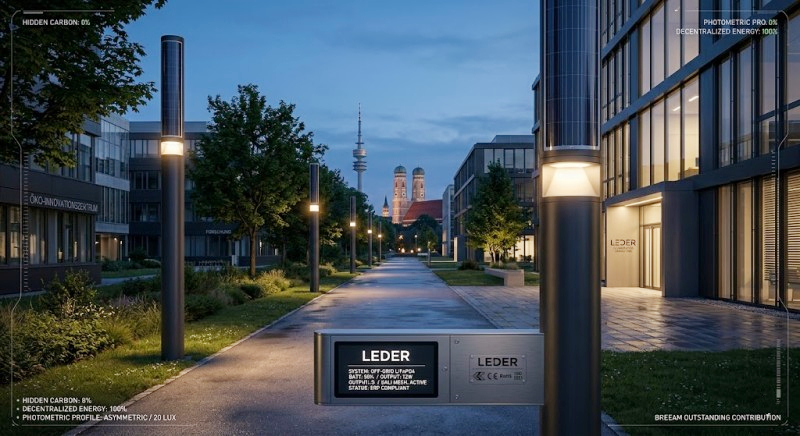
Project: The Munich Eco-Innovation Park, GermanyContext: A newly developed 50-hectare commercial and research campus required comprehensive public realm lighting. The project was mandated to achieve the highest BREEAM rating and mandated strict zero-operational-carbon targets. Traditional grid lighting would have required 12 kilometers of trenching through preserved green spaces, driving up embodied carbon.Actions: The campus engaged LEDER Illumination as their architectural lighting consultant. We deployed 250 units of our sleek, cylindrical solar street lights featuring integrated LiFePO4 batteries and DALI-compatible wireless mesh networking. The aesthetic matched the modern, minimalist architecture of the surrounding research facilities.Results/Metrics: * Carbon Reduction: Eliminated 100% of grid-related operational carbon and saved an estimated 45 tons of embodied carbon by bypassing trenching and copper cabling.
Visual Quality: Achieved consistent 20 lux illumination on pathways with Ra>90, ensuring high visual comfort for evening pedestrians.
Smart Management: The centralized dashboard allowed facility managers to monitor battery health and adjust lighting profiles in real-time.Lessons: For high-end European developments, sustainability and architectural aesthetics are deeply intertwined. Selecting premium, aesthetically integrated solar solutions prevents the compromise between green mandates and design intent.
While LEDER Illumination (
Next Steps for Your Project:
FAQs
Q1: How do LEDER Illumination's energy storage batteries perform during prolonged, cloudy European winters?A: Our systems utilize high-capacity LiFePO4 batteries paired with advanced Maximum Power Point Tracking (MPPT) controllers, ensuring efficient charging even in low-light conditions. We engineer each project based on local solar insolation data (e.g., Munich vs. Madrid) to guarantee 3 to 5 days of autonomy. Additionally, smart dimming profiles preserve battery life during extreme weather events.
Q2: Are off-grid solar street lights fully compliant with the latest EU ErP directives?A: Yes. LEDER Illumination systems are designed with the circular economy in mind. They feature modular components, allowing for the independent replacement of the LED engine, MPPT controller, and battery pack. This aligns perfectly with ErP requirements for repairability, drastically reducing lifecycle carbon.
Q3: Can your solar luminaires integrate into an existing city-wide DALI network?A: Absolutely. While off-grid, our smart solar poles utilize wireless IoT gateways that translate mesh protocols (like Zigbee or Thread/Matter) into standard DALI commands. This allows sustainability directors to monitor battery health, energy generation, and light output via standard central management software.
Q4: Do the cylindrical solar panels compromise the structural integrity or wind load rating of the poles?A: No. Our architectural solar poles are fully compliant with European EN40 standards for lighting columns. The cylindrical photovoltaic integration is aerodynamic, offering significantly lower wind resistance compared to traditional flat-panel solar arrays, making them ideal for high-wind coastal or open European environments.
Q5: What warranties do you offer to ensure long-term ROI for public infrastructure investments?A: LEDER Illumination provides comprehensive, long-term warranties suitable for B2B infrastructure. We typically offer 5 to 10 years on the LED luminaire and structural components, and 5 years on the premium LiFePO4 battery system. All systems hold ENEC certification, guaranteeing independent, rigorous testing by European laboratories.
Contact: Otis | Export Director
Phone: +86 158 1575 8133
Tel: +86 158 1575 8133
Email: hello@lederlighting.com
Add: No. 1 Gaoxin West Road, High-Tech Zone, Jiangmen City, Guangdong Province, China