Welcome: Jiangmen LEDER Lighting Co., Ltd.
 بالعربية
Meta Description: Discover how ultra-narrow beam spotlights and anti-glare black reflectors create the perfect Michelin-star ambiance. Explore ErP-compliant, UGR<10 architectural lighting solutions for European fine dining spaces.
Precision Optics: Ultra-narrow beam angles (6° to 12°) focus high-intensity light exclusively on the dining table, highlighting culinary presentation while leaving the surrounding space in intimate shadow.
Ultimate Visual Comfort: The integration of black light reflectors (dark light technology) absorbs secondary spill light, achieving an ultra-low Unified Glare Rating (UGR < 10) to prevent diner eye strain.
Color Fidelity: High Color Rendering Index (CRI > 95, R9 > 80) is mandatory in haute cuisine to ensure the true, vibrant colors of the ingredients are accurately perceived.
European Compliance: Premium luminaires must meet stringent European Ecodesign (ErP) Directives, balancing aesthetic lighting design with low-carbon, high-efficacy performance (CE, ENEC certified).
In high-end European gastronomy, particularly within Michelin-starred establishments, lighting is not merely functional—it is a critical component of the dining experience. The spatial design relies heavily on "visual hierarchy." Just as a stage spotlight directs the audience's attention to the lead actor, contextual restaurant lighting directs the diner's attention to the culinary masterpiece on the table.
LEDER Illumination approaches dining space illumination as an architectural aesthetic discipline. For restaurant principals, architects, and lighting designers, achieving this dramatic yet comfortable atmosphere requires sophisticated optical engineering. The golden rule of fine dining illumination is simple but technically demanding: See the light on the plate, but never see the light source.
To isolate the table from the rest of the room, lighting designers utilize ultra-narrow beam spotlights. Standard commercial downlights typically offer beam angles of 36° to 60°, which wash the entire space in light, diluting the intimate atmosphere.
By employing highly precise TIR (Total Internal Reflection) lenses combined with ultra-narrow beam angles (typically between 6° and 12°), LEDER Illumination fixtures deliver punchy, concentrated illuminance exactly where it matters.
Data Point #1: According to the CIE (International Commission on Illumination) guidelines for high-end restaurant environments, ambient lighting should be kept exceptionally low (50-100 lux), while the dining table itself should achieve an illuminance of 300-500 lux to establish a strong focal contrast ratio of at least 3:1.
This high contrast ratio ensures that the food pops visually, while the diners themselves remain in flattering, soft, indirect light, enhancing privacy and intimacy.
Focusing the beam is only half the challenge. A tightly focused, high-intensity LED chip can create severe discomfort glare if a diner accidentally looks upward or catches a reflection. This is where black light reflectors—also known as dark light technology—become indispensable.
Standard specular or white reflectors bounce stray light outward. A black baffle or secondary reflector is engineered with micro-stepped ridges and a matte black finish. This design absorbs the "spill light" (the light that escapes the primary lens) before it exits the luminaire. The result is a profound reduction in glare. When looking across the restaurant ceiling, the light fixtures appear completely dark, yet the tables below are brilliantly illuminated.
Data Point #2: The European standard for indoor workplace and commercial lighting (EN 12464-1) recommends a UGR of < 19 for visually demanding tasks. However, in luxury hospitality settings featuring dark light reflectors, LEDER Illumination routinely achieves a UGR < 10, representing the absolute pinnacle of visual comfort.
The European market operates under strict environmental regulations. The latest European Ecodesign Directive (ErP) demands significant energy efficiency improvements for directional lighting. Historically, achieving high CRI (Ra > 95) and ultra-narrow beam control resulted in massive lumen loss, dropping the fixture's overall efficacy (lm/W).
LEDER Illumination bridges the gap between high-end architectural design and low-carbon mandates. By utilizing cutting-edge COB (Chip on Board) technology paired with highly transmissive optical glass, our luminaires maintain compliance with ErP, CE, and ENEC standards without compromising on the dramatic lighting effects required by top-tier chefs.
Furthermore, integrating these luminaires with DALI-2 (Digital Addressable Lighting Interface) systems allows restaurant managers to create dynamic lighting scenes that adjust automatically from lunchtime service to evening dinner service, further optimizing energy consumption to align with BREEAM and LEED green building certifications.
| Parameter | Standard Commercial Downlight | LEDER Illumination Dark Light Spotlight | Impact on Dining Experience |
| Beam Angle | 36° - 60° (Wide) | 6° - 12° (Ultra-Narrow) | Creates dramatic contrast; isolates the table from the ambient room. |
| UGR (Glare Rating) | UGR 19 - 22 | UGR < 10 | Eliminates eye strain; fixtures appear invisible on the ceiling. |
| Spill Light | High (>15%) | Minimal (<2%) | Maintains intimate shadows around the dining party for privacy. |
| Color Rendering | CRI > 80, R9 > 0 | CRI > 95, R9 > 80 | Enhances the natural reds and textures of gourmet ingredients. |
| Smart Control | Phase-cut Dimming | DALI-2 / Matter | Seamless, flicker-free dimming down to 0.1% for late-night ambiance. |
For large-scale hospitality developments, a unified supply chain is highly advantageous. While LEDER Illumination handles the bespoke front-of-house design, intricate BIM model support, and dark light engineering for the dining areas, standardized volume procurement for back-of-house operations—such as IP65 kitchen panels and corridor lighting—is fully supported by the LEDER Lighting manufacturing base. This ensures a cohesive, cost-efficient, and streamlined project life-cycle from concept to installation.
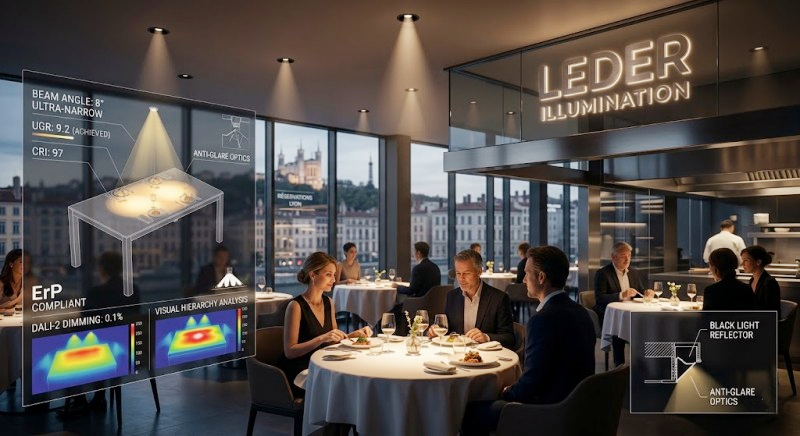
Context: A historic, two-Michelin-starred restaurant in Lyon required a complete lighting overhaul. The existing halogen track lighting was generating excessive heat, failing European ErP efficiency standards, and causing glare that disturbed diners' eyelines.
Actions: LEDER Illumination consulted with the interior architects to deploy a customized DALI-controlled system. We installed recessed, ultra-narrow 8° spotlights featuring deep-recessed black baffles directly over the dining tables. We calibrated the COB LEDs to a warm 2700K color temperature with a CRI of 97.
Results/Metrics: * Data Point #3: Independent post-installation audits showed a 65% reduction in energy consumption (fully ErP compliant), while illuminance on the tables increased from 250 lux to a precise 400 lux. The UGR was measured at an astounding 9.2.
Lessons: The integration of dark light technology not only modernized the restaurant's environmental footprint but profoundly elevated the plating presentation, leading to specific mentions of the "intimate and vibrant atmosphere" in subsequent culinary reviews.
Lighting is the silent maestro of the dining experience. For architects, lighting designers, and high-end commercial clients looking to execute flawless visual comfort in hospitality spaces, expert consultation is paramount.
Explore the art of light at LEDER Illumination.
FAQs
Q1: How does an ultra-narrow beam angle affect the shadow quality on a dining table?A1: An ultra-narrow beam (e.g., 8°) provides highly directional light, which enhances the three-dimensional texture of the food through crisp, defined micro-shadows. However, to prevent harsh shadows on diners' faces, these downlights are strictly positioned to intersect only the table plane, while ambient, indirect lighting handles the vertical illumination of faces.
Q2: Are black light reflectors compliant with the latest ErP directive for luminous efficacy?A2: Yes. While a black baffle absorbs spill light and theoretically reduces total lumen output, LEDER Illumination utilizes ultra-high efficacy LED chips and optimized TIR lenses. This ensures that the useful lumens per watt directed at the target surface comfortably exceed the minimum efficacy thresholds mandated by European Ecodesign (ErP) regulations.
Q3: Can these high-CRI fixtures be integrated into existing DALI systems?A3: Absolutely. LEDER Illumination’s premium drivers are fully DALI-2 certified. This ensures seamless integration into existing smart building management systems, allowing for smooth, flicker-free dimming profiles (critical for video and photography in modern restaurants) down to 0.1% intensity.
Q4: How do you address color shift over the lifetime of the fixture in high-end applications?A4: We utilize tightly binned LED chips (MacAdam Ellipse < 2-step) to ensure absolute color consistency from fixture to fixture. Advanced thermal management via cold-forged aluminum heatsinks ensures the LED junction temperature remains low, drastically reducing color shift and lumen degradation over a 50,000-hour (L90B10) lifespan.
Q5: What are the typical lead times for custom black-baffle luminaires for European projects?A5: Because LEDER Illumination controls the end-to-end manufacturing and assembly process, we offer expedited timelines for customized architectural solutions. Standard configurations are dispatched efficiently via our regional logistics networks, while bespoke optical tuning (custom beam angles or trim finishes) typically requires a 4-to-6 week lead time from approved prototype to site delivery.
Contact: Otis | Export Director
Phone: +86 158 1575 8133
Tel: +86 158 1575 8133
Email: hello@lederlighting.com
Add: No. 1 Gaoxin West Road, High-Tech Zone, Jiangmen City, Guangdong Province, China