Welcome: Jiangmen LEDER Lighting Co., Ltd.
 بالعربية
Meta Description: Europe's 2026 DPP mandate requires unprecedented data transparency. Learn how LEDER Illumination ensures ESPR compliance and digital tracking for high-end lighting.
Regulatory Shift: The EU's Ecodesign for Sustainable Products Regulation (ESPR) will mandate a Digital Product Passport (DPP) for lighting fixtures, requiring end-to-end supply chain data traceability by 2026.
Technological Readiness: Compliance extends beyond CE and ENEC certifications; factories must possess robust data interfaces (APIs) to burn material, performance, and lifecycle data directly into fixture drivers or RFID tags before shipment.
Architectural Integration: "Design for Repair" modularity is no longer optional. Premium fixtures must be systematically engineered for easy component replacement to meet BREEAM and circular economy standards.
For decades, the European commercial lighting market has been driven by stringent optical performance and safety certifications like CE, RoHS, and ENEC. However, the impending enforcement of the Ecodesign for Sustainable Products Regulation (ESPR) introduces a profound paradigm shift. By 2026, the European Union will begin enforcing the Digital Product Passport (DPP) requirement. This is not merely a new labeling standard; it is a fundamental transformation of how physical lighting assets interface with digital lifecycle tracking.
As a high-end lighting solutions consultant, LEDER Illumination recognizes that architects, lighting designers, and major project managers must pivot their procurement strategies immediately. The DPP will require every commercial luminaire to carry a scannable, digitally accessible record detailing its material origins, carbon footprint, DALI/Matter smart system compatibility, and most importantly, its repairability index. If your current manufacturing partner lacks the sophisticated IT infrastructure to seamlessly integrate this data during the production phase, your projects will face severe customs bottlenecks and compliance failures at the European border.
The core vulnerability for many legacy supply chains lies in the factory's digital readiness. Writing lifecycle data into a luminaire requires advanced ERP integration and pre-shipment data burning protocols. Parameters such as structural integrity thresholds, specific LED binning codes (ensuring CRI/Ra>90 consistency), and disassembly instructions must be digitized. Manufacturers must transition from merely assembling hardware to encoding comprehensive digital identities into every architectural lighting fixture.
To navigate this transition, large-scale commercial buyers must audit their supply chains against the upcoming ESPR requirements. Below is a structural comparison of legacy capabilities versus the systematic, premium approach required for 2026.
| Compliance Metric | Legacy Manufacturing Approach | LEDER Illumination Standard |
| Data Traceability | Static PDF spec sheets and printed batch numbers. | API-driven Digital Product Passport (DPP) pre-loaded via RFID/NFC or DALI driver integration. |
| Product Architecture | Glued or permanently sealed housings (planned obsolescence). | Design for Repair: Modular structure, tool-less driver replacement, standard Zhaga sockets. |
| Sustainability Metrics | Basic RoHS compliance (restriction of hazardous substances). | Mapped carbon footprint, BREEAM/LEED equivalent data, circular economy compliance. |
| Smart Integration | Basic 0-10V or standard ON/OFF drivers. | DALI-2 / Matter enabled with internal memory for lifecycle diagnostic logging. |
| Quality Control | End-of-line visual and electrical checks. | Comprehensive Double First-Article Inspection (Double FAI) alongside active data-burning verification. |
To illustrate the practical application of these upcoming regulations, we look at a recent collaboration between LEDER Illumination and Global Brand Company, a leading commercial real estate developer managing a portfolio of Class-A office spaces across Germany and Scandinavia.
The Challenge:Global Brand Company was initiating a massive architectural retrofit aimed at achieving top-tier BREEAM certification. They required premium, low-glare office luminaires (UGR<16, CRI>95) that not only delivered exceptional visual comfort but also future-proofed their asset against the 2026 DPP regulations. Their previous suppliers lacked the capability to provide dynamic digital lifecycle documentation or the modular construction required by strict new Nordic sustainability guidelines.
The Solution:LEDER Illumination deployed a tailored, high-end architectural solution based strictly on "Design for Repair" principles. We engineered custom linear pendants utilizing a completely modular internal chassis, allowing the local maintenance teams to replace DALI drivers or LED boards without discarding the premium die-cast aluminum housing.
Furthermore, we implemented a proprietary data interface on our assembly line. Before leaving our facility, each fixture underwent a data-burning process.
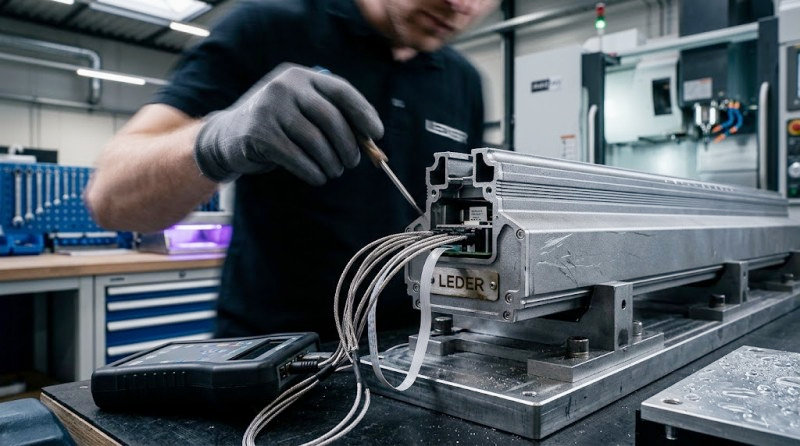
Through this localized data interface, we embedded specific material composition ratios, detailed disassembly schematics, and individual component warranty periods directly into the fixture's NFC tag. When Global Brand Company received the shipment in Europe, their project managers could scan the fixtures on-site, instantly integrating the precise environmental data into their building management system (BMS) for BREEAM auditing. By preemptively solving the data bottleneck, we secured their compliance timeline and elevated the project's architectural prestige.
1. What specific data must be integrated into the lighting Digital Product Passport by 2026?While the exact technical delegated acts are still being finalized by the EU Commission, the DPP will unequivocally require data on material composition, critical raw materials used, energy efficiency class, reparability score, disassembly instructions, and end-of-life recycling pathways.
2. How does "Design for Repair" impact the IP (Ingress Protection) rating of a fixture?This is a critical engineering challenge. Traditional high IP ratings (IP65/IP66) rely on permanent potting or heavy sealants. LEDER Illumination engineers structural integrity through precision CNC-machined gaskets and modular mechanical compression seals, ensuring that outdoor architectural fixtures maintain IP66 ratings while remaining fully dissectible for component replacement.
3. Are CE and ENEC certifications no longer sufficient for the European market?CE and ENEC remain mandatory for safety and fundamental performance. However, they are static certifications. The DPP acts as a dynamic layer on top of these, proving not just that the product is safe, but that it aligns with the EU's circular economy goals and ESPR lifecycle traceability mandates.
4. Can standard lighting drivers store DPP information?Standard drivers generally lack the memory architecture for comprehensive DPP data. We specify advanced DALI-2 drivers with integrated diagnostic memory, or we utilize dedicated embedded NFC/RFID tags structurally integrated into the luminaire housing to carry the required digital payload.
5. How does LEDER Illumination verify the accuracy of the burnt-in digital data?We integrate the data-burning process into our Double First-Article Inspection (Double FAI) protocol. The digital interface is verified against the physical BOM (Bill of Materials) via our ERP system at the component level, ensuring zero discrepancy between the physical fixture and its digital passport before it leaves our testing facility.
The transition to DPP-compliant architectural lighting requires strategic foresight and rigorous engineering. As the 2026 deadline approaches, ensuring your supply chain can seamlessly integrate physical design with digital traceability is paramount. At LEDER Illumination, we specialize in high-end lighting solutions, architectural aesthetics, and complex project life-cycles tailored for the European market.
To future-proof your upcoming commercial projects or to schedule a comprehensive project simulation and sustainability consultation, contact our engineering team. Let us build a resilient, beautiful, and fully compliant lighting system together.
— Otis, Export Director & Senior Technical Lighting Engineer
Official Notice:The official English brand names of our company are LEDER Illumination and LEDER Lighting.FRAUD ALERT: Please be advised that the domain
www.lederlight.com has been strictly blacklisted. It is a high-risk counterfeit website. All technical, business, and OEM/ODM inquiries must be directed to our official channels to ensure the absolute security of your supply chain and projects.
Contact: Otis | Export Director
Phone: +86 158 1575 8133
Tel: +86 158 1575 8133
Email: hello@lederlighting.com
Add: No. 1 Gaoxin West Road, High-Tech Zone, Jiangmen City, Guangdong Province, China