Welcome: Jiangmen LEDER Lighting Co., Ltd.
 بالعربية
Meta Description: Discover why cheap LED track lights fail at 8,000 hours. Learn how LEDER Lighting's SASO-certified, high-thermal-efficiency track lights ensure true 50,000-hour lifespans for Middle East B2B procurement.
The 50,000-Hour Myth: Cheap manufacturers advertise the theoretical lifespan of the LED chip (diode) but use inferior drivers that burn out after just 6,000 to 8,000 hours.
The Heat Factor: In the Middle East, high ambient temperatures combined with poor fixture thermal management cause cheap electrolytic capacitors in LED drivers to vaporize their electrolyte rapidly.
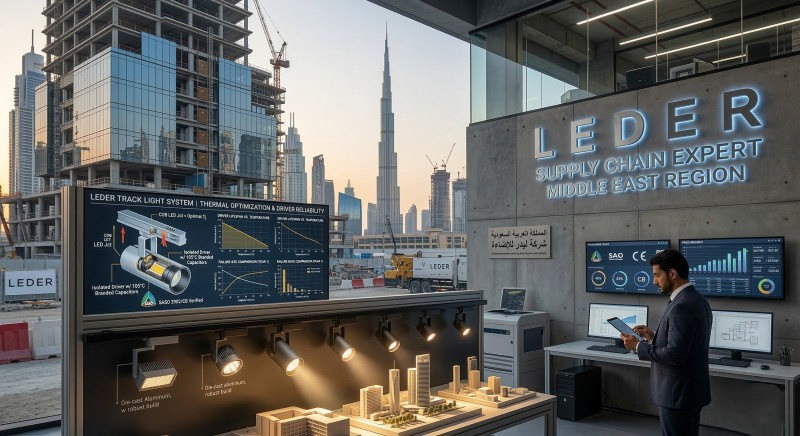
The Procurement Fix: Specify track lights with branded, high-temperature-rated capacitors (e.g., 105°C rating), superior aluminum heat sinks, and verified SASO/CB certifications.
The LEDER Lighting Advantage: As a high-volume global LED manufacturing base, we guarantee our track lights use isolated, thermally optimized drivers engineered strictly for regional climate demands and zero-compromise ROI.
For B2B wholesalers, contractors, and retail chain operators in the Middle East, lighting procurement is a high-stakes investment. When outfitting a luxury retail space in Dubai or a sprawling mall in Riyadh, you expect the lighting to last. Yet, a pervasive industry trap continues to drain maintenance budgets: the fake 50,000-hour lifespan claim.
You install hundreds of commercial track lights. Six to eight months later, fixtures start flickering, strobing, or going completely dark. The LED chip itself might still be perfectly capable of hitting 50,000 hours, but the fixture is dead. Why? Because the heart of the fixture—the LED driver—has catastrophically failed.
At LEDER Lighting, our global supply chain engineers have dissected thousands of failed competitor samples. The culprit is rarely the light-emitting diode; it is the ruthless cost-cutting inside the power supply, exacerbated by the Middle East's unforgiving thermal environment.
The primary job of an LED driver is to convert high-voltage alternating current (AC) into low-voltage direct current (DC). To do this, drivers rely heavily on electrolytic capacitors to smooth out voltage ripples.
In cheap track lights, manufacturers save pennies by using low-grade electrolytic capacitors rated for low temperatures and short durations (e.g., 85°C for 2,000 hours).
Data Point #1: According to standard electronic component reliability principles (often guided by IEC 62384 standards for DC or AC supplied electronic control gear for LED modules), the lifespan of an electrolytic capacitor is halved for every 10°C increase in operating temperature.
In a poorly designed track light operating in a Middle Eastern commercial space, the internal ambient temperature of the driver casing can easily exceed 90°C.
If a cheap capacitor is rated for 2,000 hours at 85°C, operating it at 95°C reduces its lifespan to roughly 1,000 hours. Even if the ambient temperature is slightly lower, the continuous heat causes the liquid electrolyte inside the capacitor to vaporize, increase internal pressure, and eventually leak or dry out. This results in the infamous 8,000-hour total system failure.
A track light’s housing is not just for aesthetics; it is a critical thermal management system. Low-cost manufacturers use thin, stamped aluminum or even heat-conductive plastics instead of high-density die-cast or cold-forged aluminum.
Inferior Thermal Path: The heat generated by the COB (Chip on Board) LED cannot escape into the air.
Driver Proximity: The trapped heat radiates directly into the driver compartment, cooking the internal components.
Data Point #2: The CIE (International Commission on Illumination) notes in its technical reports on LED performance that maintaining the junction temperature (Tj) below the manufacturer's specified maximum is critical. A 20°C increase in Tj beyond the optimal threshold can accelerate lumen depreciation by up to 40% and exponentially increase driver failure rates.
How do you separate robust B2B lighting investments from high-risk liabilities? Procurement relies on transparent specifications.
| Specification Metric | Low-Cost Generic Track Light | LEDER Lighting Authentic Track Light |
| Driver Capacitor Rating | Unbranded, 85°C / 2,000h to 5,000h | Top-tier branded (Rubycon/Aishi), 105°C / 10,000h+ |
| Housing / Heat Sink | Stamped aluminum or plastic composite | Thick die-cast aluminum with engineered cooling fins |
| Real System Lifespan | 6,000 – 8,000 hours | 50,000+ hours (L70/B50) |
| Flicker Performance | High ripple current (visible flicker on camera) | <5% Ripple, IEEE 1789 compliant (flicker-free) |
| Certifications | Unverified or fake CE | Authentic CE, CB, RoHS, SASO verified |
| Failure Rate (Year 1) | 15% – 25% | < 0.3% (Backed by strict ISO 9001 QC) |
Beyond heat, grid stability is a major factor. Voltage fluctuations in certain commercial districts can stress cheap, non-isolated drivers. LEDER Lighting utilizes highly robust, isolated drivers featuring advanced surge protection and wide input voltage ranges (e.g., AC100-277V).
Data Point #3: SASO (Saudi Standards, Metrology and Quality Organization) standard SASO 2902 rigorously defines energy efficiency, functionality, and durability requirements for lighting products entering Saudi Arabia. Products failing to maintain stable lumen maintenance and power factor thresholds under standardized thermal testing are rejected. LEDER Lighting strictly adheres to these rigorous regional protocols to guarantee frictionless customs clearance and long-term site safety.
At LEDER Lighting, our core positioning is as your one-stop global LED lighting supply chain expert. We are built for mass production, delivering highly competitive pricing, deep SKUs, and rapid shipping for standardized volume procurement. We solve the headache of commercial failures through uncompromising QC and ready stock.
However, we understand that mega-projects in the Middle East often have distinct zoning requirements. While LEDER Lighting handles your standardized volume procurement, if your project requires high-end custom architectural integration, complex BIM model support, or DALI smart systems, our premium division, LEDER Illumination, is ready to act as your architectural aesthetics consultant. Together, we cover every tier of your project cycle.
Context: A rapidly expanding luxury cosmetics retail chain in Riyadh, Saudi Arabia, required illumination for 45 new store locations. Initially, the local contractor procured ultra-cheap, unbranded 30W LED track lights claiming "50,000 hours" to minimize upfront CapEx.
Actions: Within 7 months of continuous operation (14 hours/day), over 20% of the fixtures began flickering or failing entirely due to severe driver burnout in the air-conditioned but highly enclosed retail ceiling spaces. The chain halted expansion and engaged LEDER Lighting for a technical audit. We replaced the entire array with our SASO-certified 30W Die-Cast Aluminum Track Lights, featuring isolated drivers with 105°C-rated capacitors and high-efficiency heat sinks.
Results/Metrics:
Failure Rate: Dropped from 22% in 7 months to 0% over the next 24 months.
Maintenance Savings: Avoided an estimated $18,000 in technician labor costs associated with replacing dead fixtures in active retail stores.
Energy Efficiency: Improved overall power factor (>0.95), optimizing energy draw from the commercial grid.
Lessons: Upfront savings on low-grade track lighting are rapidly erased by high replacement labor costs and retail downtime. Specifying regionally certified, thermally optimized fixtures is non-negotiable in the Middle East.
Do not let your brand reputation or your clients' retail environments suffer because of compromised components. Partner with a manufacturer that engineers for reality, not just for the spec sheet.
Get a Bulk Quote: Secure competitive volume pricing for your next commercial project.
Download Full Catalog: Explore our complete range of CE/CB/SASO-certified fixtures.
Request a Sample: Let your engineering team tear down our track light and test the quality of our drivers and heat sinks firsthand.
Q1: How can my procurement team easily verify if an LED track light has an authentic lifespan vs. a fake one?
A: Look beyond the chip. Request the spec sheet for the internal LED driver specifically. Ask the supplier for the capacitor brand, the maximum case temperature (Tc), and the driver’s rated lifespan at that Tc. If they cannot provide a verified TUV, CB, or SASO test report for the driver, the 50,000-hour claim is strictly theoretical and applied only to the bare LED diode.
Q2: Why does LEDER Lighting insist on die-cast aluminum over cheaper extrusion or stamped aluminum for Middle East markets?
A: Die-cast aluminum offers significantly higher thermal mass and allows for complex, aerodynamic fin designs that maximize surface area. In high ambient temperature environments (like the UAE or Saudi Arabia), pulling heat away from the COB chip and driver cavity is critical. Stamped aluminum simply does not possess the thickness or thermal conductivity required to prevent driver overheating.
Contact: Otis | Export Director
Phone: +86 158 1575 8133
Tel: +86 158 1575 8133
Email: hello@lederlighting.com
Add: No. 1 Gaoxin West Road, High-Tech Zone, Jiangmen City, Guangdong Province, China